


Your sales team and business development reps are doing everything right—hand-crafting personalised cold emails and checking their analytics diligently. Yet, corporate booking momentum is stalling because reply rates are plummeting across the board. The problem isn’t your value proposition; it’s that modern AI spam filters are treating automated sales templates and unverified prospecting lists as hostile threats
Because AI filters now cross-reference text patterns to spot automated sales playbooks, repetitive pitches to corporate bookers and event planners face immediate blocks. Operating with out-of-date or unverified prospect data doesn’t just waste your sales team’s time—it damages your domain reputation enough to interrupt the crucial emails needed to confirm corporate hotel bookings, private dining reservations, and large-scale food service contracts.
In this edition of Hospitality Marketing Insight, we explore why AI spam detection is more stringent than ever, and why standard business development playbooks are triggering immediate server rejections. We will break down how automated warm-up services leave behind technical footprints that can get your entire domain banned by Google and Microsoft email servers, and why direct messages on social media could replace the inbox.
📄 On the Menu
Email Deliverability in 2026
Understanding Sender Reputation
The Danger of Warm-Up Services
Why Social DMs are the New Inbox
Let’s Check In ☕
Share this with a colleague in hospitality
to help them protect their domain reputation.

📥 Email Deliverability in 2026
There is nothing more frustrating than watching your sales team hand-craft highly targeted outreach to event planners and corporate bookers, only to be met with complete silence. So why is this happening?
Google and Microsoft have recently rolled out advanced AI-powered spam filters that heavily analyse incoming messages, causing cold email reply rates to plummet. These stringent filter updates are reducing open rates to record lows, with some service businesses reporting that their open rates plummeted from 35% to 8% almost overnight.
A major cause of email marketing failure right now is the degradation of data quality, which has caused bounce rates to spike to 13% for some.
🏀 Bounce Rates
Google and Microsoft have a 2% bounce rate as their strict danger threshold. Exceeding this triggers immediate “550 5.7.515” server rejections from Microsoft, while Google starts throttling your delivery speeds or dropping your emails straight into spam folders across their entire network. So what are bounces?
Hard Bounce - Permanent Error
This means that the email address does not exist or has been permanently deleted. AI filters consider a high number of hard bounces a sign that you are using purchased, unverified, or outdated lists.Soft Bounce - Temporary Error
This occurs when the email address is real, but the message cannot be delivered right now because the person’s inbox is full or their server is temporarily down. If you try to send to an address that soft-bounces 3 times in a row, the AI automatically treats it as a hard bounce and lowers your reputation.
If your bounce rates are usually around 1.8% or 1.9%, that puts you one bad list segment away from an automated penalty. Because filters have tightened, reputable senders must aim to keep total bounces below 1% to stay entirely safe.
🛑 Do Not Buy Lists
Unscrupulous vendors sell scraped, recycled databases that are heavily decayed. Not only is this illegal, but they often contain dead corporate accounts and hidden spam traps.
Spam traps are inactive email addresses turned into digital tripwires by network providers specifically to catch unconsented senders. They act as monitoring tools across the internet, operating in two primary ways:
Pristine Spam Traps: These are brand-new email addresses created by inbox providers that have never belonged to a real person. They are deliberately planted on public web pages. Because they have never opted into any communications, the only way they end up on an outbound sales list is via automated data scraping software. Hitting just one of these can instantly blacklist your company’s domain.
Recycled Spam Traps: These are old, abandoned corporate email accounts—such as a former procurement manager, hotel operations lead, or event coordinator—that providers deactivate and later repurpose as fraud detectors. If your sales team continues pitching to an old prospect list that hasn’t been verified in years, hitting these recycled addresses signals to AI filters that your data is heavily decayed, tanking your sender reputation
Launching unverified outbound sequences to old, inactive prospect lists can trigger spam spikes so severe that they blackhole your entire domain. When this happens, it doesn’t just stop your sales pitches; it blocks your company’s regular, day-to-day emails.
Imagine your event coordinators being unable to send out venue contracts, your booking system failing to deliver hotel reservation confirmations, or your procurement team being cut off entirely from food service suppliers because your network is flagged as hostile!
These operational nightmares aren’t just hypothetical IT headaches—they are the direct consequences of a damaged digital footprint. When your network is flagged as hostile, it means mailbox providers have judged your sending domain or IP address and found it lacking. To prevent these catastrophic delivery failures and ensure your critical business communications always reach their destination, you must first understand the invisible metric governing it all: sender reputation.

If your emails aren’t landing in the inbox, you’re literally paying to be ignored.
In an industry already battling rising hospitality and food service costs,
a wasted marketing budget is fatal.
Subscribe now to unlock the exact blueprint for repairing your domain reputation, escaping the spam filter, and dominating
modern B2B outreach via DMs.
Every time your business sends an email, it undergoes a silent, instantaneous evaluation. Internet Service Providers (ISPs) and mailbox managers act as digital gatekeepers, deciding whether your message deserves a prominent spot in the inbox or a one-way ticket to the spam folder. They make this critical decision based on a complex credit score for your email health: sender reputation.
To gain complete control over your email deliverability and safeguard your daily operations, it is crucial to pull back the curtain on how this hidden metric actually works.
✅ Understanding Sender Reputation
Marketers are increasingly discovering that their failing campaigns are caused not by bad email copy, but by broken technical infrastructure.
If a sending domain does not have perfectly configured SPF, DKIM, and DMARC records, the major providers reject the email before it even reaches the recipient’s inbox. So what do all these acronyms mean?
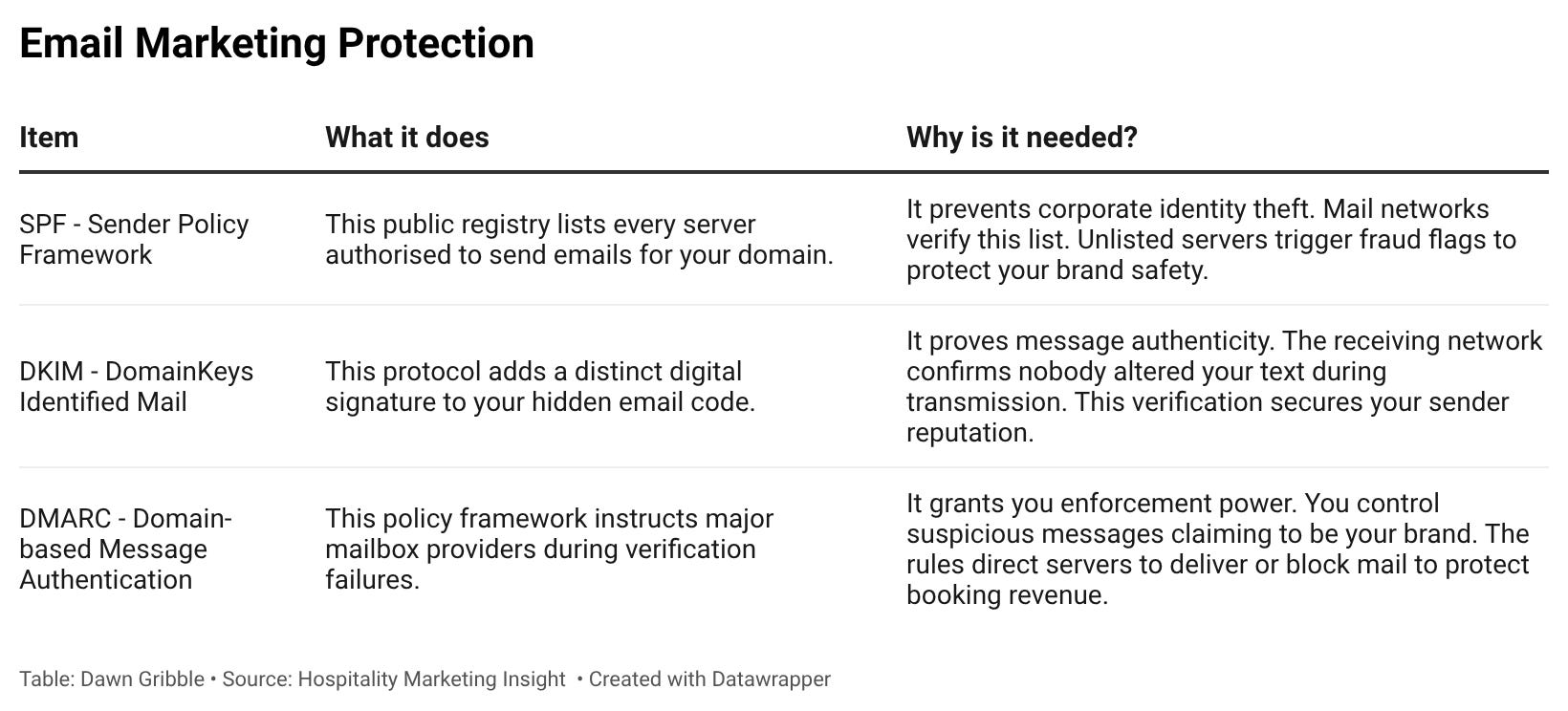
Correctly configured technical records are the absolute foundation of your delivery infrastructure. Skipping these settings or looking for automated shortcuts with your domain reputation is a direct route to being blacklisted, instantly stalling your outreach momentum and cutting off core business revenue.
These technical records must be added to your DNS (Domain Name System) settings through your domain registrar or hosting provider, e.g., GoDaddy, Namecheap, Cloudflare, or Google Domains
Because getting these foundational technical settings right requires manual configuration and patience, it can be tempting to look for quick fixes. This desire for immediate inbox placement drives many to seek out automated shortcuts to boost their new domain’s standing artificially. This trap often leads straight to the next major deliverability pitfall.
⚠️ The Danger of Warm-Up Services
When deciding to send to a new or dormant email list, many marketers use warm-up services to prepare their email addresses. However, you must proceed with caution because they may use automated bot accounts to fake real human conversations.
In theory, an email warm-up service is designed to trick mail networks into thinking a new or dormant domain belongs to a highly active, reputable sender. The service works by connecting your email account to a network of thousands of other simulated inboxes. These automated platforms then send messages back and forth between your account and their network, automatically opening the emails, pulling them out of spam folders, and generating artificial replies. The logic is that this fake interaction data will trick Google and Microsoft into granting your domain a high sender score, giving you a clear runway to launch mass outbound sales campaigns.
However, relying on these automated tricks is a gamble that rarely pays off in the long run. If you want to know where your domain actually stands without guessing, you need to audit your real-time reputation.
To check your sender score and track your deliverability health, you can use specialised tools like SenderScore.org, Google Postmaster Tools, MxToolBox, or Mail-Tester. There is an abundance of these monitoring platforms available online, and keeping a close eye on their metrics is the only reliable way to ensure your sales campaigns land in the inbox rather than the junk folder.
AI filters now easily detect this automated pattern and will suspend your entire domain. Microsoft and Google use AI to spot impossible human behaviour. They instantly flag accounts where opens and replies happen within seconds of delivery, or where a domain only interacts with a known cluster of other warm-up domains.
In February 2023, Google explicitly updated its Developer Policies to ban automated warm-up tools from using the Gmail API, cutting off these platforms from accessing Workspace infrastructure.
When the AI detects that an inbox is participating in a warm-up ring or triggering a high bounce rate from a dirty list, it issues a full tenant-level suspension. Microsoft and Google shut down the entire company’s Workspace or Microsoft 365 account, cutting off all corporate email and data.


📱 Social DMs are the New Inbox
Because traditional email infrastructure is blocking automated campaigns, some marketers are moving to direct messages to protect their delivery rates.
Over 62% of key B2B platform users are now younger decision-makers who naturally communicate and make purchasing decisions via rapid, conversational DMs instead of traditional email chains.
The B2B Strategy - Corporate Bookings
Instead of sending cold email sequences to office managers, B2B sales teams are moving to LinkedIn to run direct, real-time conversations based on active job changes and business signals. Traditional B2B cold email response rates have plummeted to averages between 1% and 5%. In contrast, LinkedIn direct outreach anchored to warm intent or context achieves a 10.3% average reply rate, effectively doubling the performance of cold email.
The B2C Strategy - Consumer Dining & Staycations
For everyday guests, hospitality brands are using automated Comment-to-DM funnels on Instagram and Facebook. Instead of telling a user to click a link, the post says: Comment the word ‘SUMMER’ below. An automated system immediately opens a DM with that user, providing menu packages and booking links instantly while their interest is highest.
40% of users now expect a business to respond to a query via social channels within a single hour, making slow email ticketing systems look obsolete by comparison.
Furthermore, research from McKinsey proves buyers place significantly higher trust in individual, peer-to-peer messaging than in mass company email broadcasts, making localised DMs a more effective sales and customer support tool.
You now understand how modern AI filters read template text structures; Why keeping hard bounce rates under 1% protects your server reputation, and how automated warm-up rings risk full domain suspension.
On Thursday, the VIP briefing delivers the practical implementation steps. You will discover exactly how to format your outbound text to work with AI spam filters, alongside the modern engagement metrics that actually protect your domain. This strategic action plan gives you calm control over your communication infrastructure, allowing your sales team to safely protect hotel stays, private dining bookings, and food service contracts before your next campaign budget is committed.
That’s it for this edition. I hope you’ve enjoyed the newsletter. I look forward to serving you again soon.
All the best
Dawn Gribble MIH MCIM
Hospitality Marketing Insight
Here’s to Your Success 🥂

Know someone trying to protect their outbound pipeline? Forward this to a fellow hotelier, restaurateur, or food service director who needs to audit their technical setup.
📚 Sources & Resources
Add custom spam filters to Gmail, Google Workspace Help (2026)
Advanced Outlook.com security for Microsoft 365 subscribers, Microsoft Support (2026)
Advanced phishing and malware protection | Gmail, Google Workspace Help (2026)
Bursztein, E., Zhang, M., Vallis, O., Jia, X., & Kurakin, A., RETVec: Resilient and Efficient Text Vectorizer (arXiv:2302.09207), arXiv (2024)
Change the level of protection in the Junk Email Filter in Outlook, Microsoft Support (2026)
Cold Email Inbox Bounce Rate: Acceptable Thresholds and What to Do When Crossed, Litemail (2026)
Deccio, C., Yadav, T., Bennett, N., Hilton, A., Howe, M., Norton, T., Rohde, J., Tan, E., & Taylor, B., Measuring email sender validation in the wild, Proceedings of the 17th International Conference on Emerging Networking EXperiments and Technologies (2021)
Effective end-to-end customer service with social media, McKinsey (2026)
Effectiveness of B2B social media marketing: The effect of message source and message content on social media engagement, ResearchGate (2026)
Email Marketing Benchmarks 2026: Open Rate, CTR & Bounce Rate, EmailAwesome (2026)
Email sender guidelines, Gmail Help (2026)
Email sender guidelines FAQ, Gmail Help (2026)
Email Validation Tools & Email List Cleaning, ZeroBounce (2026)
Ho, G., & Javed, M., Detecting Credential Spearphishing Attacks in Enterprise Settings (2026)
How to Reduce Staff Turnover in Hospitality Industry, The Access Group (2026)
Jiminez, A., Email Open Rates By Industry (& Other Top Email Benchmarks), HubSpot (2025)
Petrov, S., 20 Statistics About Hotel General Managers + Demographics, OysterLink (2026)
Protect Privacy Online with Google—Google Safety Centre, Safety Center (2026)
Restaurant email marketing statistics: How emails drive reservations, loyalty, and revenue, Stripo.Email (2026)
Set up DMARC | Security & data protection, Google Workspace Help (2026)
Soldo, F., & Metwally, A., Traffic anomaly detection based on the IP size distribution, 2012 Proceedings IEEE INFOCOM (2012)
What are DMARC, DKIM, and SPF?, Cloudflare (2026)
Domain reputation is basically GEO for your inbox—the spam model is scoring your sender the same way search engines score your site.