



While you have been busy perfecting the guest experience on the floor, the digital gatekeepers have fundamentally changed how your business is found. According to recent data, AI brand sentiment is now a primary factor in whether an AI agent will even suggest your property to a high-value traveller. If an AI agent flags even a single recurring service theme, such as slow service, your venue could be filtered out of recommendations entirely, regardless of your five-star rating.
In this July 2026 Strategic Update, we are lifting the lid on why your business profile might be failing the AI Filter and how standard social proof could actually be leaking revenue. We also explore the surprising truth about guest psychology: why travellers now trust algorithms more than your team for logic and facts, but still crave the human touch for taste and emotion.
📄 On the Menu
Why Your Business Profile is Failing the AI Filter
Why Guests Trust Your Data More Than Your Team
When Social Proof Hits a Revenue Ceiling
The Specific Service Failures Killing Your Retention
Let’s Check In ☕

🗺️ Why Your Business Profile is Failing the AI Filter
According to Deloitte’s 2026 Travel Outlook, AI Brand Sentiment is now a primary factor in whether an AI agent will even suggest your property to a high-value traveller.
Let’s say a guest asks their AI assistant to book a premium dinner for four with efficient service. Even if you have a five-star rating, if the AI’s sentiment analysis has flagged slow service as a recurring theme, you will be filtered out of that recommendation entirely.
After last week’s newsletter, a few people reached out to ask whether AI content ranks on Google. The answer is yes, it can. However, there is a massive catch. Google does not care who wrote the content, whether human or machine, but it cares deeply about why it was written and how helpful it is to the reader.
Google’s official stance as of the latest Core Update is that they reward high-quality content regardless of how it’s produced. If an AI writes a perfect, helpful guide on the best way to cook a steak, it can rank #1. If a human writes a boring, unhelpful version of the same thing, the human will lose.
It’s important to remember that AI has no senses. It hasn’t tasted your food or slept in your hotel rooms; you need to add this descriptive information in your marketing. And this is important because Google prioritises E-E-A-T, which stands for Experience, Expertise, Authoritativeness, and Trustworthiness.
If you use AI to write The Top 10 Things to Do in London and it looks exactly like every other list on the internet, you will never rank. Google’s AI Overviews will simply summarise the common knowledge and skip your link entirely.
Confused guests never book. Follow my VIP plan to fix your distribution and give your guests a clear, direct path to your door
Here’s a template to expense a subscription

👤 Why Guests Trust Your Data More Than Your Team
While we often hear that people distrust AI, the opposite is true for functional tasks. Guests actually prefer algorithms for accuracy and logic. This is why 56% of leisure travellers now use AI for tasks like building itineraries or comparing flight logistics. They believe a computer processes vast amounts of data more objectively than a person.
A guest will trust a chatbot to confirm if your hotel has an EV charger, what the parking charges are, or if you have a gluten-free menu. They want a fast, factual yes or no without waiting for a human to answer the phone.
But that same guest will ignore an AI recommendation for the most romantic table or a wine pairing. For experiences based on taste and emotion, they want to hear from your team.
⚠️ When Social Proof Hits a Revenue Ceiling
We hear a lot about the importance of social proof, but it’s essential to recognise that it is not universally effective in every situation for every audience.
Many people assume that showing high booking volumes or highlighting a popular choice will encourage others to buy. This applies to marketing messages like Best Seller, Our Most Popular Package, etc.
The commercial reality is different; if marketing applies a single message to every guest at every daypart, you risk pushing away valuable segments before the booking journey even begins.
Think about it, we all wear different hats in our lives. A guest might be a corporate executive on Tuesday morning but a parent on Saturday afternoon. These multiple social identities change how we react to marketing.
Evidence from the Journal of Consumer Behaviour shows that some consumers actively seek out popular trends specifically to avoid them. Are you offering something for guests who don’t want the same thing?
☹️ The Service Failures Killing Your Retention
New data shows that guest expectations before they arrive are focused most heavily on your staff. When staff expectations are not met, it triggers the most significant emotional fallout. Specifically, guests cite uninterested or unwilling staff as their primary frustration.
However, when we look at what actually stops a guest from returning, food is the focal point. Food-related complaints are the strongest predictor of a guest deciding never to return or recommend your venue. In recent studies, 36% to 40% of complaints focused specifically on the taste and quality of the food. If you fail on the plate, you lose the guest for good.
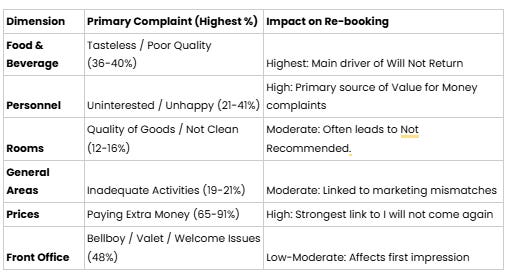
There is also a direct link between pricing and how guests perceive your team. Guests who feel they did not get value for their money primarily vent that frustration through complaints about the staff.
We see a massive trend in price-related anger when guests are asked for extra money unexpectedly. In some regions, over 90% of pricing complaints are about these hidden costs. This creates a feeling of being cheated, which immediately kills any chance of a repeat booking.
Dissatisfied guests show strong negative intentions; between 53% to 55% of unhappy guests explicitly state they will not recommend the hotel to others. Furthermore, 44% to 46% stated they will never come back.

Using AI for food photos is a death wish for your reputation.
One "synthetic" burger and your trust is gone forever.
Join VIP to learn how to weaponise your raw, messy,
human reality against the bots.
That is it for this edition. I hope these insights help you protect your margins and refine your decision-making as you plan for the coming month.
Managing a hospitality business is a constant balancing act between operational pressure and commercial growth. I hope this update makes that balance a little easier to navigate.
All the best
Dawn Gribble MIH MCIM
Hospitality Marketing Insight
Here’s to Your Success 🥂

📚 Sources
Bell, A., The 9 Biggest Breakfast Trends In 2026 (So Far), Tasting Table (2026)
Creator, T. L. a., A short-form web series becomes a 28-episode Netflix commission, Think Like a Creator (2026)
Global Drinks Industry Forecast: Trends, Challenges & Innovations, Mintel (2026)
Goodwin, D., New Google Maps features: Local Guides redesign, AI captions, photo sharing, Search Engine Land (2026)
Hanek, K. J., & Garcia, S. M., Countering Social Information: Low Identity Integration Leads to Nonconformity in Consumption Choices, Psychology & Marketing (2026)
Horton, H., Move over matcha: How ube cocktails and coffees are hitting the UK’s sweet spot, The Guardian (2026)
How we’re reimagining Maps with Gemini, Google (2026)
Logg, J. M., Minson, J. A., & Moore, D. A., Algorithm appreciation: People prefer algorithmic to human judgment, Organizational Behavior and Human Decision Processes (2019)
Mutlubaş, I., Evaluation of Online Customer Complaints for Hotel Businesses in Terms of Expectation Management and Behavioral Intention, Journal of Tourism and Gastronomy Studies (2023)
PuzzleheadedLunch199, Pizza shop owner used AI for advertising and signage despite my protests. We got a bad review for it., R/KitchenConfidential (2026)
Ready-to-Eat (RTE) Food Market: Growth, Trends, and Future Outlook, Futurism (2026)
Schulte, J., Bleeker, M., & Kaufmann, P., Don’t Measure Once: Measuring Visibility in AI Search (GEO), arXiv (2026)
Stanciuc, A.-M., Google Maps launches Ask Maps, TNW | Google (2026)
This update is for informational purposes only and does not constitute legal or financial advice. Always check local regulations regarding pricing transparency and advertising standards.
I think this is also where working a travel advisor comes in. I have been seeing clients come to me with a suggested itinerary produced by AI, and asking for my opinion on it.