


We’re all used to digital slop. Since the birth of the internet, we’ve been subjected to clip-art figures shaking hands, banner ads blinking in neon loops, and WordArt titles proudly curving across PowerPoint slides.
But what we’re seeing now is a different beast entirely. The rapid proliferation of low-quality, mass-produced AI-generated content has triggered a significant backlash known as AI Slop. In 2026, research shows that AI-generated material now constitutes 64% of all newly published content, outpacing human-created work by a staggering 17 to 1.
As a result, we are witnessing the birth of Banner Blindness for Ideas. Just as we learned to physically ignore the right-hand side of websites in the 2000s, slop is training people to subconsciously ignore entire categories of information. If a post looks like a generic AI listicle or sounds like a ChatGPT-standard greeting, the human brain now filters it out before it’s even processed.
Brands using AI as a shortcut for creative output should be aware that it can severely damage their reputation and customer trust, as purely AI-generated content is systematically ignored or penalised by search and answer engines.
📄 On the Menu
The Problem with AI Slop
Combatting AI Content Fatigue
How to Spot AI Slop
Top of the Slops - Mistakes to Avoid
Let’s Check In ☕
Last Updated 4th August 2026
Subscribe if you want the frameworks to turn raw guest insights into
slop-free content that search engines actually reward.
Here’s a template to expense a subscription

📉 The Problem with AI Slop
People are tired of being sold to by a machine. I’m seeing a massive move toward Dark Social, such as private groups and gated chats simply because the open web has become a dumpster for low-quality, synthetic filler.
Content farms use AI to mass-produce articles with little originality or value, cluttering search engine results. On average, 94,000 articles per day, each, contributing to a 312% increase in spam-related content removal actions taken by Google compared to 2023 figures. This makes it harder for users to find reliable, high-quality content, reducing trust in digital media.
Major platforms are actively handing moderation tools to users as backlash grows. For example, LinkedIn launched a 'Seems like AI slop' reporting button that lets members flag inauthentic posts and comments, while simultaneously retiring its own AI post-rewriting tools to preserve authentic human voices.
As a direct consequence, search engines are already adjusting algorithms to prioritise human-created content, but distinguishing between AI and human writing is becoming increasingly difficult.
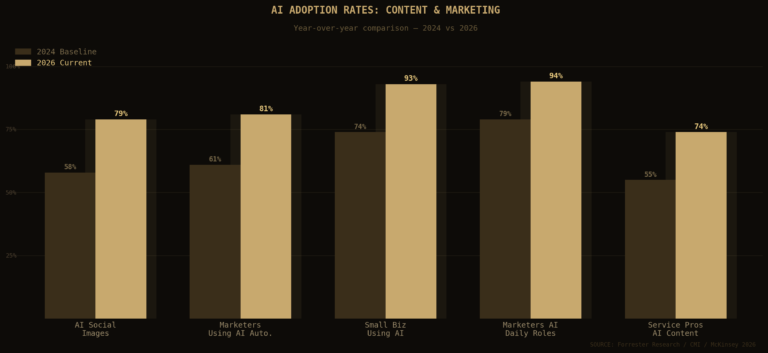
And it’s not just copy, AI is used to create the estimated 79% of images on Instagram, TikTok and Pinterest. On social media, approximately 50% of brand posts are AI-assisted, from core ideas to captions.
For a time-strapped operator, the appeal of generative AI is clear. Research shows 70% of marketers in the UK and US use generative AI to save 5 hours per week.
But for many operators, the drive for efficiency has become a trap. While the cost to produce 1,000 words of content is now essentially zero, the cost to verify those words is increasing. It still requires human time to ensure information is accurate and safe.
I’m seeing a trend where marketers spend more time fixing synthetic outputs than they would have spent creating them from scratch. But when your marketing sounds like the other 90% of the web, you lose the ability to differentiate your brand and/or offer.

😫 Combatting AI Content Fatigue
Your guests now spend more mental energy filtering out irrelevant information than they do actually consuming your message. In the past, the burden was on the creator to make something worth seeing. Today, that burden is on the consumer to validate what is real.
If your brand sounds like the global average of the internet, you’re paying a Bland Tax you can’t afford. When a guest senses that overly smooth AI tone, they switch off.

This change has created AI content fatigue. It is a form of digital burnout caused by a constant bombardment of bland, low-quality content that lacks a human perspective.

To understand why this happens, we look at Cognitive Load Theory and the mental energy a person has available to process information. When content is fragmented or repetitive, it drains that energy. The resulting exhaustion makes it harder for them to make a conscious decision, such as booking a table or a room.
The human brain is beginning to filter out common AI structures subconsciously. When a guest sees phrases like in the ever-evolving landscape or unlock your potential, they mentally switch off.
Because AI models reflect the average of all data, they produce average results.
As machines learn to sound like the average person, generative AI is losing its ability to identify true experiences. This has created a trust gap. Frustrated by AI slop audiences are actively seeking out authentic sources. We are seeing a renaissance in traditional content formats, such as long-form interviews and podcasts, where guests can find genuine human engagement.


Coming Up in This week’s VIP guide
How to Protect Your Brand From Google's AI Content Penalties
It deconstructs everything I know about eliminating AI slop and protecting your brand equity; it’s like having a CMO in your inbox, helping you move beyond basic prompts to high-level strategic thinking.
You’ll get a clear 7-phase system to move AI from a basic generator to a strategic content creation partner.
Upgrade to VIP and get this guide plus immediate access to my full library of strategic resources.
🕵️ How to Spot AI Slop

How many lights can you spot?
The human capacity for detecting synthetic content is rapid and instinctive. MIT neuroscientists found that the human brain can process and identify entire images seen for as little as 13 milliseconds. This suggests that the gut feeling a user has when an image feels off occurs almost instantly on sight.
While a lot of AI is obvious and I can easily spot a lot of it …, it gets too exhausting trying to analyse every freaking post to know whether I can trust it’s real or not, and then ultimately trust nothing, so I close out.
That uncomfortable gut feeling is often called the uncanny valley, where a guest feels something is not quite right. It often relates to content that is almost human but feels slightly strange, causing immediate distrust.
Even when users cannot prove a post is synthetic, the instinctive discomfort remains. This leads to a profound commercial risk, as 43% of people are less likely to buy from brands they perceive as over-reliant on AI.
Impact on Brand Trust
This change in user sentiment carries a heavy price for your revenue and brand performance. When guests spot these patterns, they don’t just lose interest; they actively distrust the offer, as the figures below confirm:
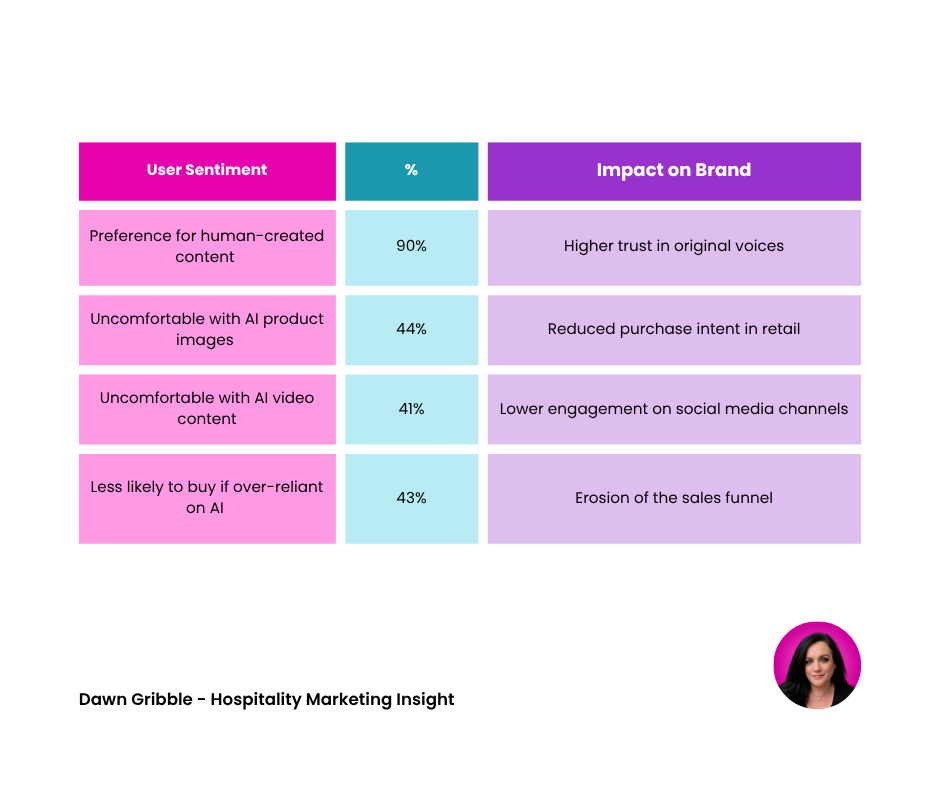
The sentiment data is clear: audiences have an instant and instinctive resistance to synthetic content. To protect your brand from being ignored, you must understand the specific linguistic patterns that signal a lack of human oversight.
✍️ Keywords and Phrases
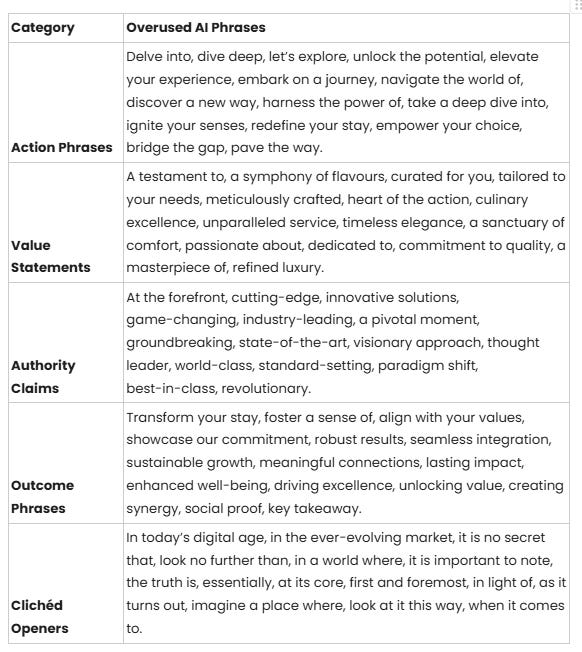
Users are becoming increasingly adept at recognising AI-generated copy. The language tends to be excessively smooth, correct, and safe. It reads like polished corporate language designed to avoid any potential controversy, which can strip away the personality of your brand.
Slop frequently relies on generic statements and vague formulations, offering little more than repackaged information without contributing any new insights or fresh angles to the discussion.
This is the very opposite of Google’s E-E-A-T (Experience, Expertise, Authoritativeness, and Trustworthiness) standards. By providing only interchangeable information, you fail to prove the unique experience or expert authority of your venue.
Here are some of the most overused AI phrases.
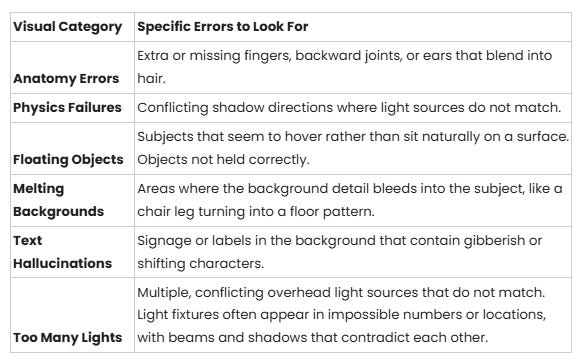
🖼️ Image Errors
While most creative directors are worried about copyright or losing the human touch, they are missing the systemic flattening of the creative imagination, what some theorists are calling Aesthetic Alienation.
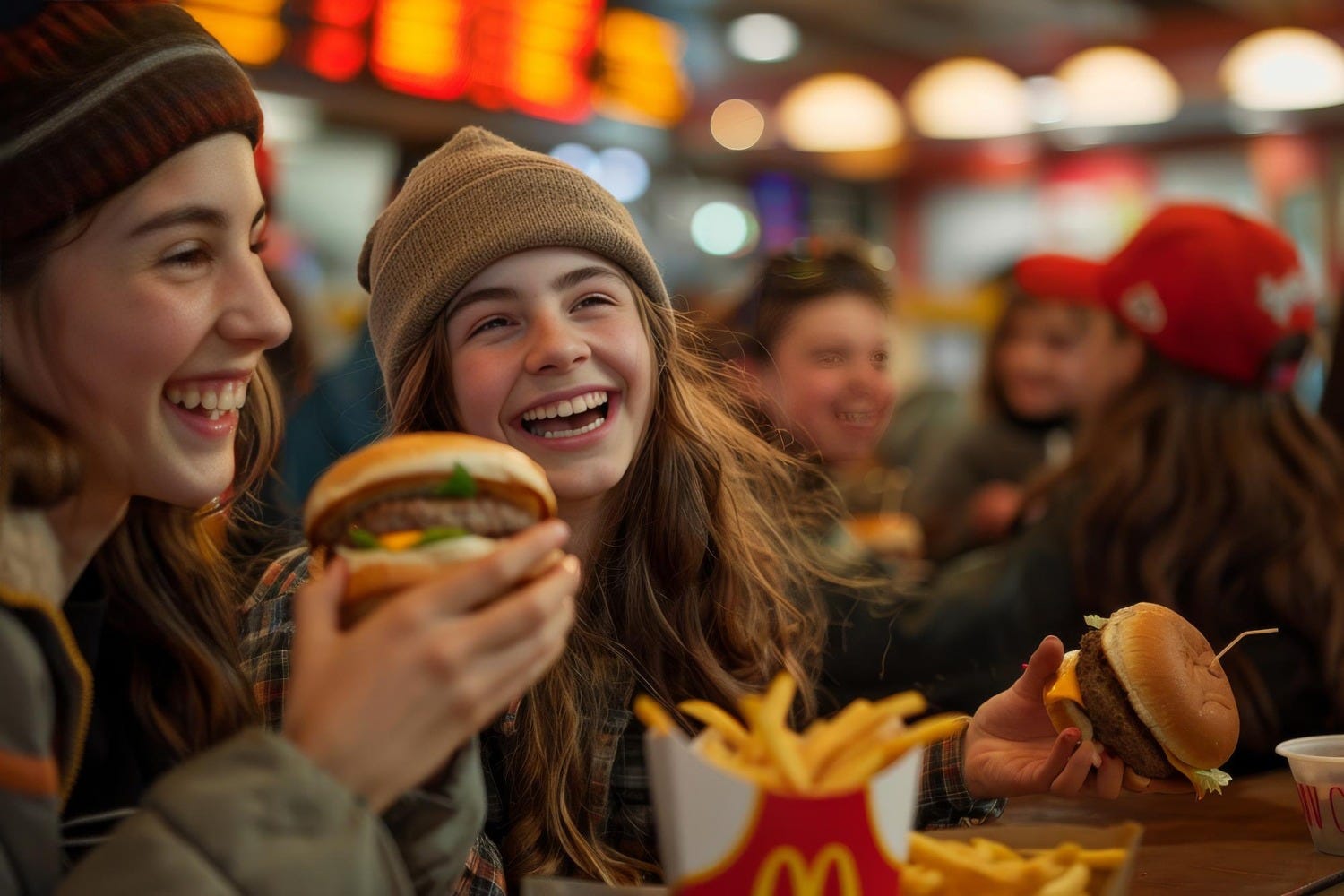
Is this how we hold burgers now?
In visual media and advertising, audiences spot slop when the final imagery feels rushed, lazy, or soulless. Because AI lacks inherent human taste, judgment, and contextual understanding, its raw outputs immediately signal AI to viewers.
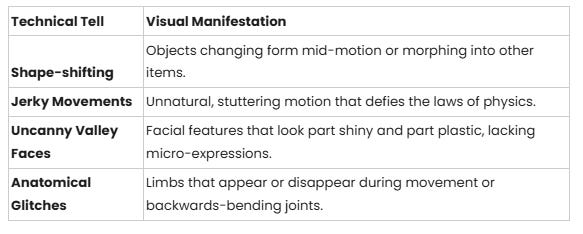
🎬 Video Tells
In video production, these errors become even more obvious as motion reveals the lack of a consistent physical framework.
The Coca-Cola Christmas Backlash of 2024
In 2024, Coca-Cola faced significant public backlash after releasing an AI-generated Christmas advert.
The advert features an AI-generated fleet of red trucks moving through snowy landscapes and festive villages. Animals, including squirrels and polar bears, appear throughout the scenes. Notably, the ad avoids showing a live-action Santa; he is represented only by a hyper-realistic close-up of his face and a brief glimpse of a hand holding a bottle.
To avoid the uncanny valley problem, the 2025 ad focused more on animals like polar bears and pandas, and less time on human faces.
Analysts estimate that generative AI tools cut the production cost of such large-scale ads (typically $1M to $3M) by up to 70%.
While Coca-Cola leadership viewed the campaign as a transformational leap, utilising tools like Google Veo to achieve craftsmanship they claimed was ten times better than previous experiments, the public disagreed.
The campaign was viewed as a direct contradiction to the heritage of Coca-Cola’s Real Magic and Real Thing brand pillars.

Despite the high production volume, the video is full of technical glitches, such as flickering, inconsistent overhead lights and trucks that change shape between frames.
This backlash from the creative community wasn’t just about the aesthetics; it was a reaction to perceived corporate laziness. By releasing a campaign that prioritised speed and cost-cutting over human craftsmanship during a period of intense job anxiety, Coca-Cola turned its back on the very authenticity it has spent decades building. The result was a PR disaster that proves technical efficiency is no substitute for emotional resonance.
This failure at the top of the market serves as a warning for every hospitality operator. While you may not be producing global TV spots, the same rules apply to your daily output. To avoid your own New Coke moment, you need a practical framework to identify and remove the technical tells that trigger this instinctive guest rejection.

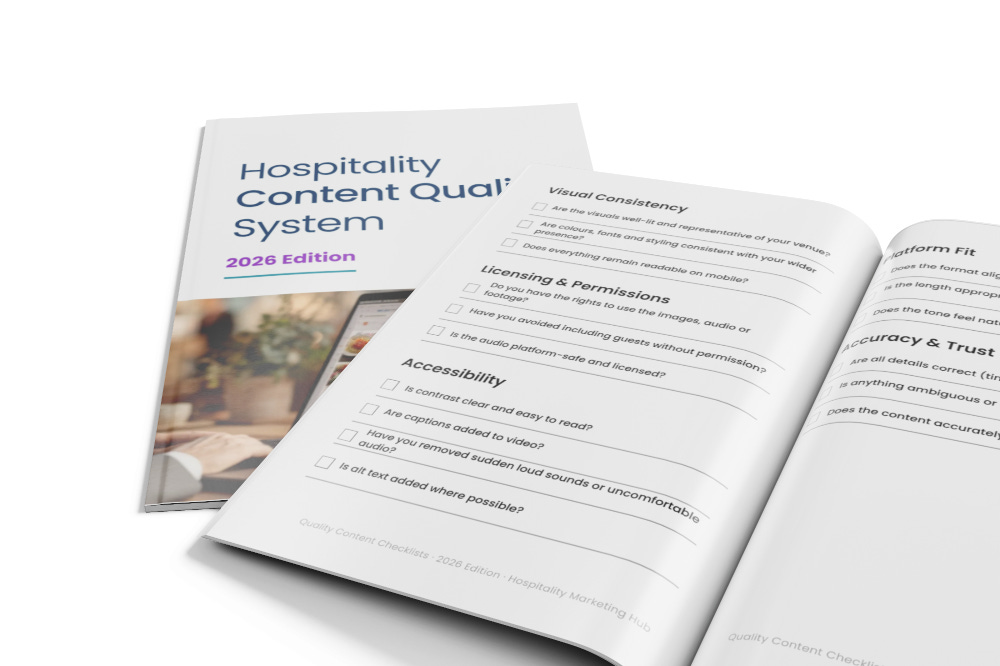
Your brand is being buried alive by Workslop - interchangeable, superficial noise that crowds out genuine creators. If your output is just a re-hash of the top 10 search results, the algorithm treats it as invisible noise.
The Hospitality Content Quality System is your weapon to fight back, protecting your proprietary data and ensuring your business stays compliant.
🏆 Top of the Slops - Mistakes to Avoid
Identifying AI slop in your marketing comes down to two primary commercial failures: losing your unique brand identity to an algorithm and overlooking the human creativity that guests actually trust.
👥 Losing Your Identity
When hotel or restaurant marketing loses its uniqueness, it becomes indistinguishable from other venues.
As AI search engines increasingly act as the new gatekeepers of the internet, they are actively conditioning themselves to filter out and ignore bland, average, or generic content. If a brand produces content that simply repackages what already exists in the top search results, it pays a severe invisible penalty. The February 2026 Google Core Update has formalised this penalty, specifically targeting the mass-produced patterns of AI slop to ensure that lazy, unoriginal content is stripped from search results.


The implication is that artificial intelligence, by its very nature, produces a kind of cultural residue, content without culture.
If your brand produces content that simply repackages what already exists in the top search results, you pay a severe invisible penalty. Because your content offers nothing new, AI systems will:
Filter you out of the synthesised answers entirely.
Ignore your brand in favour of sources with unique, proprietary data.
Summarise your work without attribution, effectively turning your intellectual property into free training data for your competitors.
❤️ Overlooking Human Concerns & Creativity
While AI can process information and automate tasks rapidly, relying on it as a content creator rather than a collaborative tool leads to several detrimental outcomes. For a start, this reliance strips work of its authenticity, nuance, and original value, turning your brand into ignorable digital noise.
Rather than streamlining complex tasks, an over-reliance on these tools creates a Cognitive Strain Cycle. When professionals lean too heavily on AI outputs, especially when already experiencing mental fatigue, they fall victim to automation bias. They stop evaluating, stop questioning, and start blindly accepting synthetic outputs. This doesn’t relieve pressure; it exacerbates exhaustion and compromises the integrity of the work.
Many creative professionals feel that AI is negatively impacting their day-to-day roles. Marketers have noted that content creation is turning into content supervision. One user lamented that AI is slowly killing the strategist in me.

When you replace human creative direction with AI supervision, you lose the ability to predict cultural shifts. AI only knows what happened yesterday; it cannot invent tomorrow.

How to Protect Your Brand From AI Blindness
It is a strange paradox: the more content we produce with AI, the less our audience sees. We are creating a digital environment where the average is effectively invisible. My VIP guide provides the behavioural tweaks necessary to bypass this new Banner Blindness
By taking the time to understand the ‘slop’ vs. ‘substance’ divide today, you’re already making the choice to lead rather than just contribute to the noise. I hope these insights give you the resolve to keep your standards high and your voice unapologetically human.

That’s it for this edition. I hope you’ve enjoyed the newsletter. I look forward to serving you again soon.
All the best
Dawn Gribble MIH MCIM
Hospitality Marketing Insight
Here’s to Your Success 🥂


Audit Your Way Back to Being Remarkable
AI Slop is training people to ignore entire categories;
don't let your brand be one of them.
📚 Sources & Resources
Arnone, D., AI Fatigue: The Cost of AI Overuse, Neodata (2026)
Coca Cola’s AI-Generated Ad Controversy, Explained, Forbes (2024)
D’Isa, F., The Idea of ‘AI Slop’ Is Slop, The Philosophical Salon (2025)
Goodwin, D., The hidden ‘bland tax’ that could erase your brand from AI search, Search Engine Land (2026)
Hui, X., Reshef, O., & Zhou, L., The Short-Term Effects of Generative Artificial Intelligence on Employment: Evidence from an Online Labor Market, Social Science Research Network (2023)
In the blink of an eye, MIT News | Massachusetts Institute of Technology (2014)
jumpmanpapi23, Coca Cola and the huge backlash from people about them using AI in their ads, r/Advertising (2026)
Khan, S. M. F. A., & Suhluli, S., Generative AI and Cognitive Challenges in Research: Balancing Cognitive Load, Fatigue, and Human Resilience, Technologies (2025)
Marianantoni, A., Content Marketing in the AI Era: Strategies for Startup Success, M ACCELERATOR by M Studio (2025)
MetaKnowing, AI ‘slop’ is transforming social media—And a backlash is brewing, r/Technology (2026)
Mueller, J., Advocate, S., & Google, Google’s February 2026 Discover Core Update, Google Search Central Blog (2026)
Nemeroff, A., What is AI slop? A technologist explains this new and largely unwelcome form of online content, The Conversation (2025)
Ott, A., Is AI content fatigue setting in?, EY (2026)
Reporter’s Guide to Detecting AI-Generated Content, GIJN (2026)
The 2026 AI Index Report, Stanford HAI (2026)
TOP 20 AI-GENERATED CONTENT STATISTICS 2026 THAT REVEAL SHOCKING GLOBAL AI CONTENT EXPLOSION, Amra & Elma (2025)
Enjoyed this article? Buy Me a Coffee ☕
An incredibly important piece Dawn! It pains me to see so much slop in hospitality, especially since it’s an industry whose whole product practically is human connection and communication!!!!