




Managing a beverage programme under current trading pressures requires absolute clarity on what drives your bank balance. Many operators rely on standard gross profit percentages to measure performance. However, this metric can hide serious cash flow leaks across your cellar.
This briefing identifies the structural flaws of percentage-based pricing. It examines how conventional markup rules reduce cash intake and tie up operational capital. You will see exactly how standard calculations distort your true returns.
Welcome to Nick Fischer from Beyond the Pass, who is our guest author for this analysis. Nick joins us to share his operational perspective on beverage profit structures.
📄 On the Menu
The Wine Margin Myth
Cash Margin Versus Percentage Margin
The By-The-Glass Leak
The Slow-Stock Problem
What The Bath Owner Actually Did
Run This On Your Own Wine Programme This Week
The Lesson Underneath The Wine List
Let’s Check In ☕

🍷 The Wine Margin Myth
Why pricing wine by percentage leaves cash on the table, and the difference between the margin you quote and the money that actually reaches the till.
A restaurant owner in Bath told me, with real pride, that his wine programme ran at a 70% gross margin. Every bottle is marked up to hit the number. He’d trained his managers to protect that 70% like it was sacred.
He was quietly losing money at both ends of his own wine list, and the 70% was the reason he couldn’t see it.
The problem is one of the most expensive misunderstandings in hospitality, and almost every operator carries it: the belief that gross margin percentage is the thing to maximise on wine. It isn’t. Percentage margin is a ratio. It doesn’t pay your rent, cover your labour, or land in your bank account. Cash margin does. And when you price wine to protect a percentage, you systematically leave cash on the table at the premium end while overcharging at the cheap end, which is the exact opposite of what a wine list should do.
Here is the myth, taken apart
💰 Cash Margin Versus Percentage Margin
Start with the single fact that changes how you price wine forever.
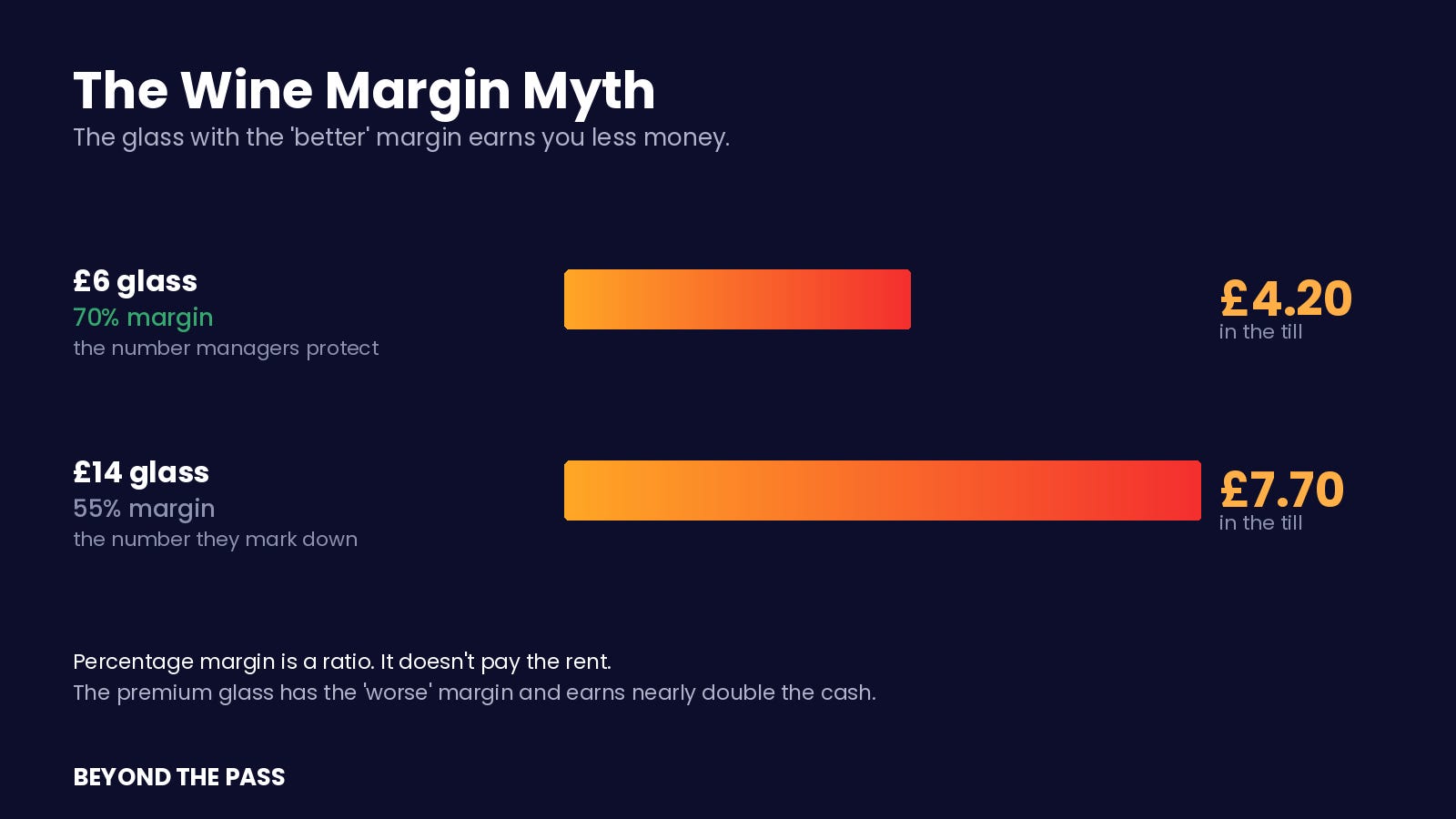
A £6 glass at 70% margin earns you £4.20 in cash.
A £14 glass at 55% margin earns you £7.70 in cash.
The second glass has a “worse” margin by every percentage-obsessed manager’s reckoning. It also puts nearly twice as much money in your till. If you priced both glasses to protect the 70%, you’d push the £14 glass up to £16 or £17, at which point fewer people would order it, and you’ve traded a large certain cash margin for a slightly larger percentage on far lower volume.
This is the heart of the myth.
Percentage margin and cash margin pull in opposite directions at the premium end of a wine list, and the operators who chase the percentage almost always end up with less actual money.
The Bath owner was pricing his best bottles, the £40-£60 range where customers are least price-sensitive and cash margins are enormous, to hit the same 70% he applied to the house red. That meant his premium wines were priced too high relative to their real cash-margin opportunity, and they undersold. Meanwhile, his cheap wines, priced at the same 70%, were as high as the market would bear at the value end, capping volume where he needed it most.
He had the pricing logic exactly upside down, and the 70% rule was what kept it there.
📉 The By-The-Glass Leak
The second place wine quietly bleeds is by the glass, and it’s a wastage problem, not a pricing one.
An open bottle of wine has a short life. Once it’s open, it oxidises, and within a couple of days it’s no longer sellable. A restaurant offering a broad by-the-glass list, especially at the premium end, is constantly opening bottles it may not sell through before they turn.
Here’s the maths operators miss. If you open a bottle to sell four glasses and only sell two before it oxidises, your actual cost per sold glass has doubled. The 70% margin you carefully calculated on paper has quietly become a loss, not because you priced it wrong, but because half the bottle went down the sink. And because it’s wastage rather than a line on an invoice, it never shows up in the margin calculation at all.
The wider the by-the-glass list, the worse this gets. Every additional wine by the glass is another open bottle at risk. Operators add breadth to look generous and end up subsidising a wastage problem that eats into the margin they thought they were protecting.

⏳ The Slow-Stock Problem
The third leak is the cash tied up in wine that doesn’t sell.
A wine list that runs to eighty bins, half of which sell a bottle or two a month, is not a sign of a serious cellar. It’s a sign of dead money sitting on shelves. Every bottle of slow-moving stock is cash you’ve paid out and haven’t recovered, occupying space, tying up capital you could use elsewhere, and ageing (not always gracefully) while it waits.
Operators justify the long list as offering choice. But most customers order from a small fraction of any wine list. The long tail of rarely-ordered bottles is carrying cost with almost no return. A tighter, faster-turning list frees up cash, cuts the by-the-glass wastage risk, and is easier for staff to actually know and sell.
The Bath restaurant had sixty-odd bins. When we looked at actual sales, twelve wines accounted for nearly 80% of volume. The rest was cash frozen on a shelf.

👤 What The Bath Owner Actually Did
He didn’t blow up his wine programme. He made four changes, none of them dramatic.
He repriced the premium end for cash margin, not percentage. The £40-£60 bottles came down slightly in markup, which lifted their margin percentage-wise but, because they sold more, increased total cash margin substantially. The customers who buy at that level are the least price-sensitive on the list, and a fair price moved more of them.
He tightened the by-the-glass list, dropping the slowest premium glasses that were oxidising more than they sold, and kept the by-the-glass offer to wines that turned over fast enough to open safely. He also moved to preservation on the two premium glasses worth keeping.
He cut the list from sixty bins to around thirty, built around what actually sold, which freed up several thousand pounds of tied-up cash and made the remaining list something his staff could genuinely know and recommend.
And he retrained his managers off the 70% rule and onto cash margin per sale, so they stopped protecting a percentage and started maximising the money that reached the till.
His wine cash margin went up, his wastage went down, and his tied-up capital dropped, all from abandoning the one number he’d been proudest of.
🍾 Run This On Your Own Wine Programme This Week
Three steps. Half an hour with your wine sales and your list.
Step 1. Rank your wines by cash margin, not percentage. For each wine, work out the actual pounds it earns per sale, not the percentage. You’ll almost certainly find your premium bottles earn far more cash than your percentage-based pricing gives them credit for, which means you have room to price them keener and sell more.
Step 2. Audit your by-the-glass wastage. Over two weeks, track how many opened bottles you throw away or write off to oxidation. Convert it to a real cost. That number is the true margin on your by-the-glass programme, and it’s usually well below the paper figure.
Step 3. Find your dead stock. Rank every wine by bottles sold per month. The slow tail, the wines selling one or two a month, is frozen cash. Ask honestly whether the choice they offer is worth the capital they tie up and the complexity they add.
Most operators find the same three things the Bath owner did: premium wines underpriced for cash margin, a by-the-glass list leaking through oxidation, and a long tail of dead stock. Fix all three, and wine goes from a percentage you protect to a genuine profit centre you actively manage.
🧾 The Lesson Underneath The Wine List
Wine is the clearest example of the trap this whole series is built on: the number that feels like it measures profit often has nothing to do with the money that reaches your bank account. Gross margin percentage on wine is comfortable, familiar, and actively misleading.
The operators who make real money on wine are the ones who stop protecting the percentage and start managing the cash, the wastage, and the capital tied up in stock.
The 70% was never the profit. The profit was always the harder number underneath, and it was hiding in plain sight the whole time.
---
This is part of the Beyond the Pass series on hospitality economics, the numbers that decide whether a site makes money but rarely show up cleanly in the accounts. If you run or advise a hospitality business and you want the frameworks that most operators never get taught, plain-language breakdowns of the margin, labour, and pricing maths that actually move profit, subscribe and get each one as it lands. No jargon, no fluff, just the numbers that matter.



About the Author: Nicolas Fischer is a Michelin-trained chef who writes about the operational economics of hospitality, the kitchen, bar and margin numbers that decide whether a business actually makes money. He publishes Beyond the Pass, a newsletter helping independent operators find the profit hiding in their own numbers.
A huge thank you to Nick for his expert perspective on beverage profit structures for this edition. I highly recommend subscribing to his newsletter, which you can read here
That’s it for this edition. I look forward to serving you again soon.
Dawn Gribble MIH MCIM Hospitality Marketing Insight

Here’s to your success! 🥂
I’m an award-winning marketing expert with 25+ years of international experience helping brands like Wagamama, Sysco, Ramada, and the UN grow.
📊 Need an expert marketing audit? Get in touch at DG Consulting
🚀 Grow your brand: Download courses, workshops, and campaign plans at the Hospitality Marketing Hub