



Mid-season trading creates heavy operational pressure.
Marketing teams want to launch new campaigns to increase revenue. Operations teams focus on managing daily service without breakdown.
In our previous guide, we covered the CHEF ideation matrix and the CHECK evaluation matrix. Those frameworks show how to generate fresh campaign ideas and test them against your P&L.
Today, we put those frameworks into practice with a detailed hotel case study. You will see how a frontline venue team evaluated eight raw ideas and filtered out margin risks.
We also introduce two new frameworks in the VIP section.
The TASTE positioning canvas helps you package your offer to connect with guest desires. The SERVE go-to-market engine gives your floor team a clear launch plan.
By the end of this guide, you will have a complete four-part system to ideate, validate, position, and launch venue campaigns.
📄 On the Menu
The CHEF Ideation Framework
Applying the CHECK Validation Filter
The TASTE Offer Positioning Canvas
The SERVE Go-To-Market Engine
Let’s Check In ☕

👨🍳 The CHEF Ideation Framework
Picture the scene at The Highcliff Hotel, a 50-room coastal venue with a 70-cover restaurant.
The General Manager wanted to increase midweek dining covers and room margin before the summer planning window closed. She did not write a marketing plan in isolation. Instead, she brought seven team members into the staff room for a 60-minute session.
The Team in the Room
The group included:
General Manager
F&B Director
Marketing Lead
Night Manager
Front Desk Supervisor
A senior restaurant server
A morning barista
Before the meeting started, the marketing team placed every public-facing touchpoint across a large table. They printed active Facebook ads, upcoming social media posts, email campaigns, room service menus, and lobby signage.
The GM established one firm rule. The team had 40 minutes to generate raw ideas using C.H.E.F. This stage functions purely as an ideation engine. No decisions occur during this session. No ideas are rejected, agreed upon, or approved at this stage.
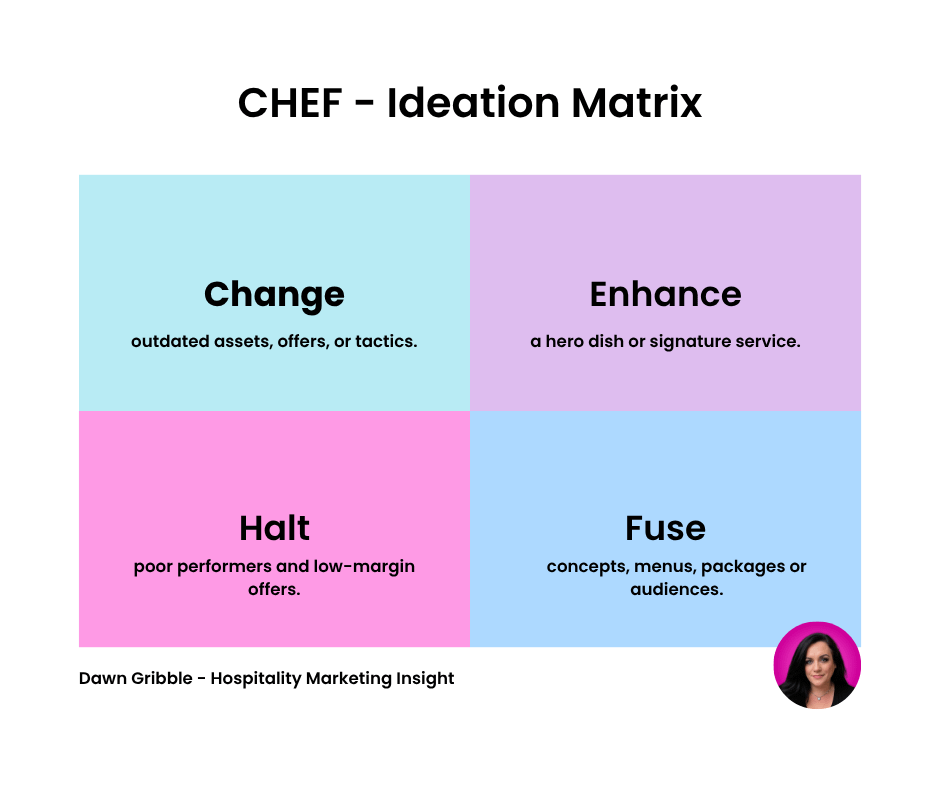
1. C — Change (Swap & Substitute)
The team spends 15 minutes reviewing the printed materials on the table.
The senior server points at a Facebook ad for the main restaurant. The ad uses a formal photo of an empty dining table with white tablecloths. She notes that arriving hotel guests often wear casual clothes and walking boots. Guests might feel underdressed for the restaurant because the ad looks formal. She logs a raw idea to swap the stock photo for an image of the chef plating a local seafood dish.
Next, the barista looks at a draft email campaign. The draft offers 20% off Tuesdays. He notes that no one has asked for the Tuesday discount in several weeks. He suggests swapping the offer to Buy One Get One Free.
2. H — Halt (Stop & Eliminate)
The marketing lead shares recent conversion data. The General Manager asks everyone to open the hotel website on their mobile phone, tablet or laptop and attempt to book a dining table or room as if they were a guest.
The front desk supervisor needs five separate steps to reach the reservation page. She abandons the attempt twice on her screen. She logs a suggestion to halt the complex 5-step booking form and test a 2-click process.
Next, the F&B Director reviews the room service menu with the Night Manager. The menu lists 18 items. Three complex dishes require line cooks to stay late, accounting for less than 2% of total room service orders. The Night Manager puts these three dishes on the list of potential items to halt.
3. E — Enhance (Amplify Best-Sellers)
The team reviews guest comment cards and online reviews.
The Night Manager notes a clear pattern. Guests constantly praise the coastal views and ask night staff for walking routes. He suggests an idea to enhance marketing for outdoor walkers. Instead of generic room ads, he proposes creating a downloadable trail map with recommended local pub stops.
The senior server mentions another common guest request. Families often ask for smaller portions of main menu items for their children. She puts forward an idea to enhance the children’s menu by adding smaller portions of signature dishes instead of pizza, pasta or burgers.
4. F — Fusion (Combine Existing Assets)
Finally, the team looks at underused venue assets.
The General Manager notes that three family suites usually stay empty on Wednesday nights. At the same time, the kitchen has extra prep capacity on Wednesday evenings. She writes down an idea to fuse these two assets into a package called Midweek Coastal Family Break. The concept combines a room night, breakfast, and an early family dinner deal where children eat free before 6 PM.
The barista points to the quiet lounge area between 3 PM and 5 PM. He suggests fusing afternoon drink service with a local cream tea offer for returning walkers.
At the end of the session, the following ideas were generated
Change formal dining stock photos on Facebook ads for real images of the chef plating local seafood and a busy dining room.
Swap the 20% off Tuesdays email offer for a Buy One Get One Free offer.
Halt the complex 5-step website booking form and test a 2-click booking process.
Remove three complex room service dishes that require line cooks to stay late for under 2% of total orders.
Enhance the experience for walkers with a downloadable walking trail map featuring recommended local pub stops for outdoor walkers.
Improve the Kid’s Menu by adding smaller portions of signature main dishes to the children’s menu, in addition to pizza, pasta, or burgers.
Combine empty Wednesday family suites with spare kitchen capacity into a Midweek Coastal Family Break package.
Combine quiet lounge space between 3 PM and 5 PM with an afternoon drink and local cream tea offer.
🏨 Applying the CHECK Validation Filter
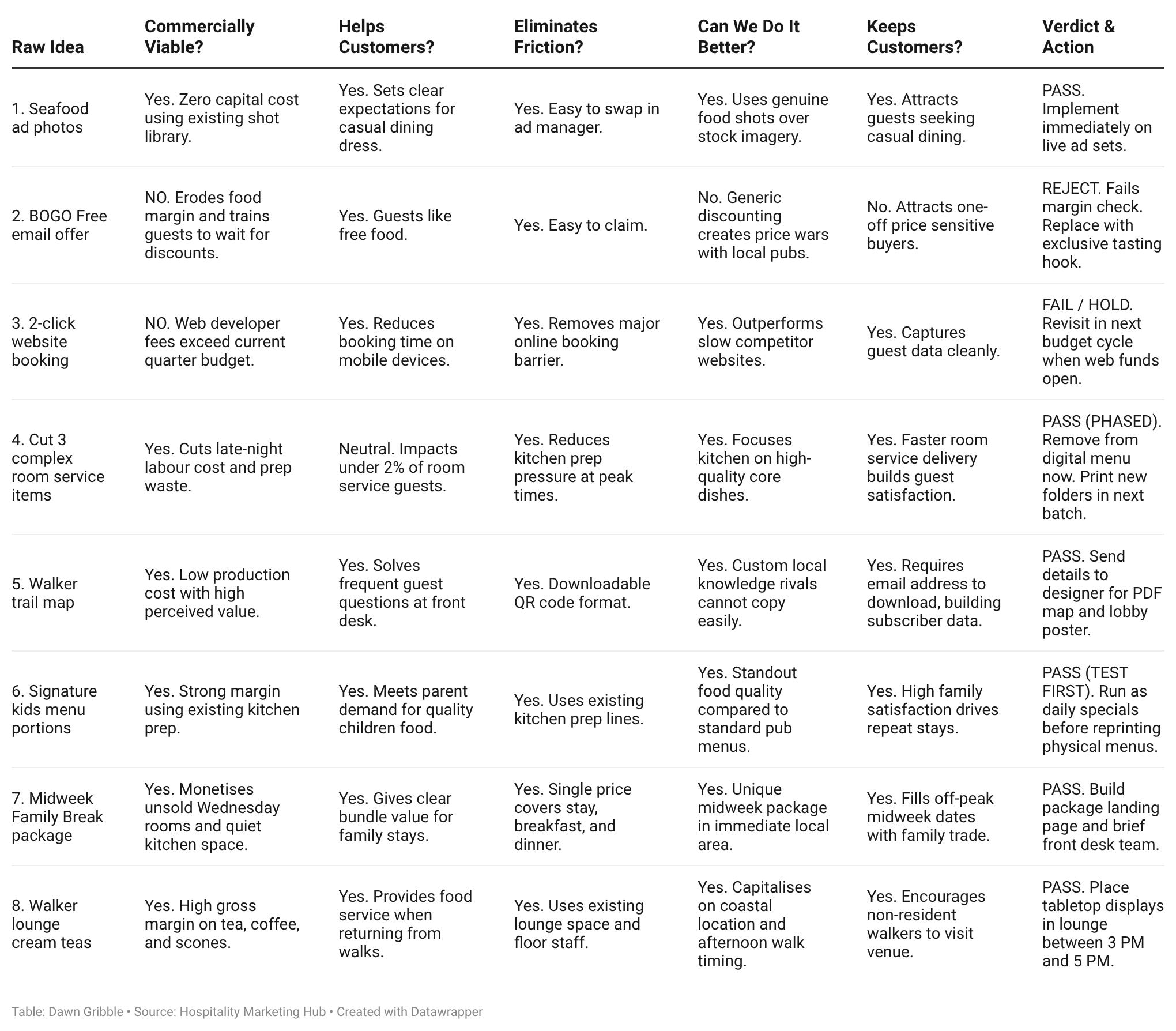
Before committing staff time or marketing spend, the General Manager runs all eight raw ideas through the CHECK evaluation matrix.
To pass, an idea must meet five distinct criteria:
C — Commercially Viable: Will this protect margin or generate clear profit?
H — Helps Customers: Does this solve a genuine guest desire or point of friction?
E — Eliminates Friction: Is this simple for staff to execute and easy for guests to buy?
C — Can We Do It Better?: Does this give the venue a clear advantage over local rivals?
K — Keeps Customers: Does this drive repeat visits or capture useful guest data?
If an idea fails even one check, the team either rejects it or adapts it until it passes.

🎯 The TASTE Offer Positioning Canvas
Passing the CHECK filter proves an idea is commercially viable. However, a viable idea still fails if you package it poorly for your target market.
The TASTE framework turns an operational concept into an attractive guest offer. It aligns your marketing messaging with real guest desires so you can sell experiences without discounting.
Here is how the framework breaks down:
