


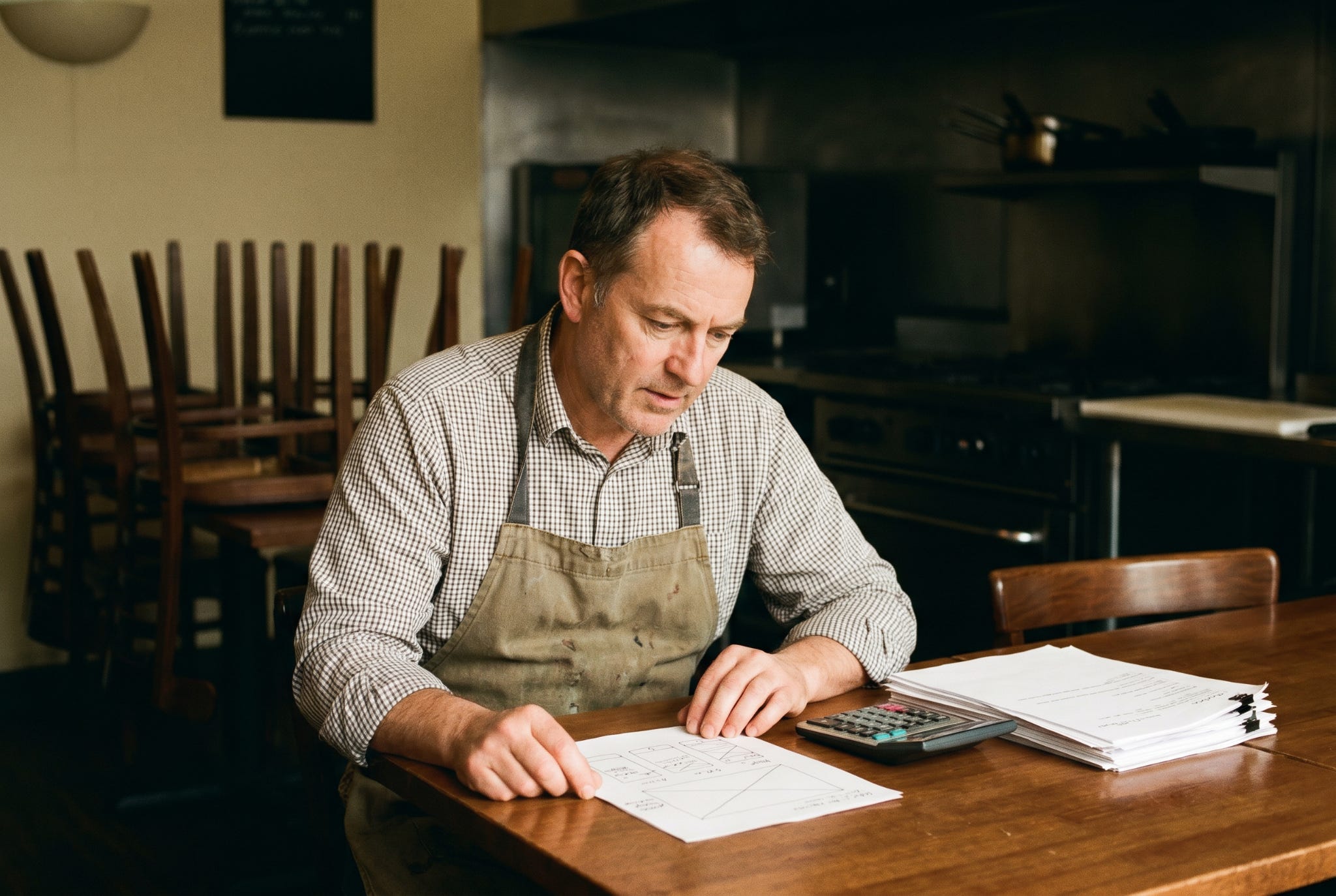
A chef doesn’t perfect a signature dish in one night. They refine it recipe by recipe, service by service, improving 1% every single day.
That is my philosophy for marketing, and it is exactly why we are breaking down menu engineering in this edition. You don’t need to reinvent your entire business tomorrow; you just need to sharpen the small, high-impact techniques hiding in plain sight.
When done correctly, effective menu layout goes beyond aesthetics to boost sales, speed up decision-making, and maximise your profitability.
📄 On the Menu this week
Price Anchoring
Decoy Pricing
Primacy & Recency
Let’s Check In ☕
Last Updated 16th September 2026

Stefano had spent weeks crafting a beautiful new menu for his brasserie. He took equal care in formatting the PDF version for his website and socials, too. He felt proud of the final design.
But over time, he realised that he was frequently selling the lower-margin dishes rather than the high-margin ones; it was the same story with delivery orders.
Stefano felt stuck. His kitchen team was working incredibly hard under tight constraints. Taxes and bills were up, and customers were struggling with the cost-of-living crisis.
He knew he couldn’t increase his prices without losing guests. And he cannot absorb higher food costs either. So what can he do? How can he increase sales for higher-margin orders when the pricing is locked?
The answer lies in menu engineering and layout.
⚓ Price Anchoring
While many operators treat menu design as an aesthetic project, the reality is that strategic layout dictates financial success. To maximise your returns, you must understand how the human brain evaluates price and value.
Price anchoring uses human psychology to protect your gross profit. The human brain relies heavily on the first piece of cost information it sees. When a guest views a menu, the highest price creates a mental reference point. Every other choice is measured against this initial figure. This process guides diners naturally toward your preferred options.
💸 The 27% Revenue Lift
Research from Cornell University School of Hotel Administration found that strategic menu styling and layout choices can boost a restaurant’s overall sales by up to 27% without changing any ingredients or base prices.
This approach offers clear operational advantages.
It increases the sales volume of high-margin items.
You do not need to offer discounts.
It supports your kitchen team by directing demand toward consistent dishes.
Your average spend per head increases.
Guest satisfaction remains high because diners recognise the value.
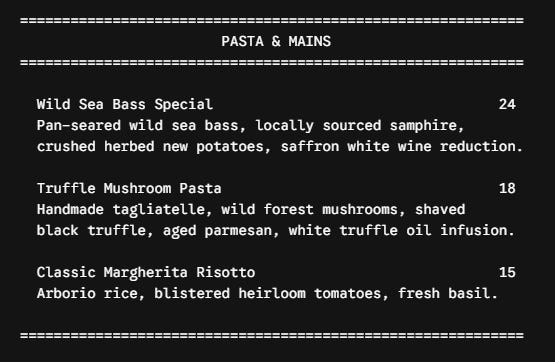
For instance, placing a high-margin £18 Truffle Mushroom Pasta next to a £24 Wild Sea Bass Special makes the pasta appear more affordable.
The anchor item does not even need to sell well. Its entire job is to change the baseline perception of value for the dishes below it. You are not trying to clear inventory on that expensive dish. You use it to frame the cost of your other menu items.
📡 Emerging Trends
Global dining behaviour trends indicate that the anchor of the first category ordered dictates the price tolerance for the rest of the dining experience.
If a table is successfully nudged into buying a premium, well-anchored starter, their subconscious valuation of the main course instantly rises. Main course sales for mid-to-high tier items can jump by over 20% for the rest of the meal. This outcome occurs even if those main courses have no anchor in their own section. And there’s more.
The anchor changes the guest’s entire spending mindset for the night.
🚨 The Rejection Threshold
But if the anchor is too extreme, the brain flags it as a gimmick. For example, placing a £150 Caviar Platter next to a £14 Wagyu Beef Burger triggers a rejection bias that breaks customer trust. The anchor must be premium. It must remain completely authentic to the brand concept.

🎟️ Menu Engineering Optimisation Checklist

In The Science of Profitable Menu Engineering, we covered Price Anchoring, Decoy Pricing, and Primacy and Recency Effects. In this VIP edition, you will learn how to identify high-margin dishes, optimise your physical layout, and implement precise pricing mechanics
🎭 Decoy Pricing
You encounter decoy pricing every day without realising. This commonplace marketing tactic works completely undetected because it plays directly on a hardwired mental habit. The human brain hates being inefficient, so consumers always look for maximum value when ordering.
Decoy prices shape the buyer’s perception, nudging them towards higher-margin options without direct price hikes. For the customer, choosing the higher-priced option feels like an intellectual win, rather than an upsell.
You’ll see this used in most coffee shops and wine bars.
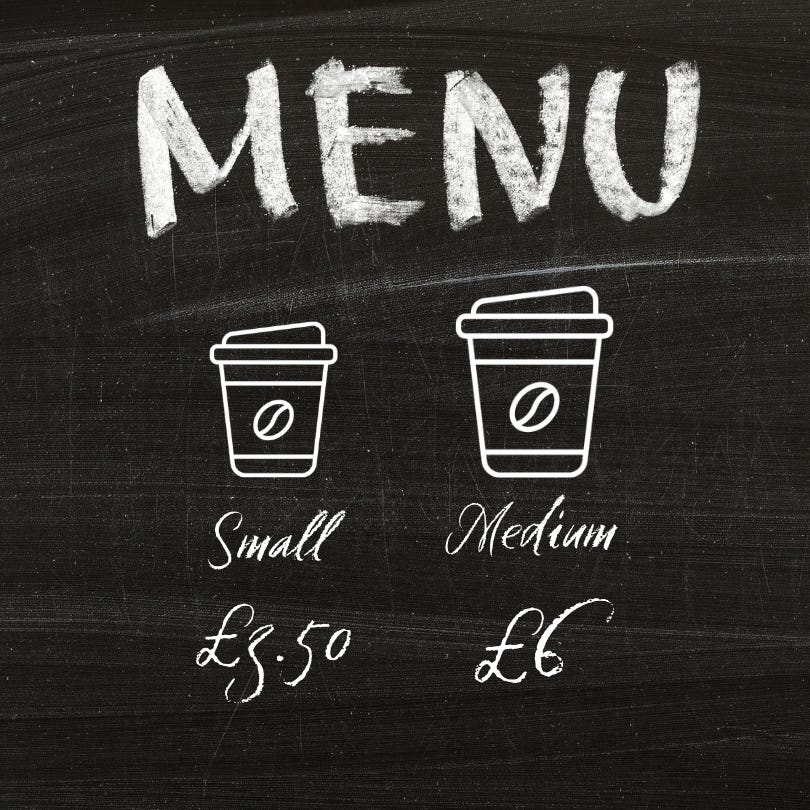
While the Small Coffee is £3.50, the Medium Coffee at £6.00 feels overpriced in comparison.
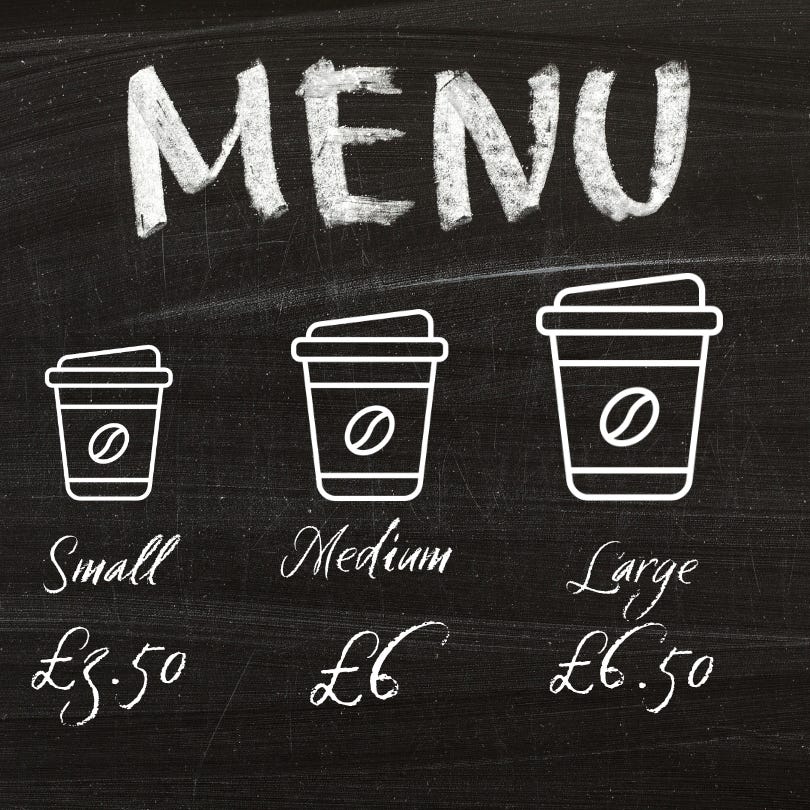
By placing the Large Coffee at £6.50, the price difference between the Medium and Large makes the Large Coffee look like the better value.
Now, the Medium coffee appears to be an unattractive option, and customers are more likely to opt for the Large, which brings in a higher margin for the business.
A study published in the International Hospitality Review looked at restaurant menu bundling. Without a decoy, only 45% of diners chose a higher-priced combo bundle, for example, burger + soda + fries, over a standalone lower-priced burger. By introducing a decoy pricing structure, the proportion of diners selecting the highest-priced combo option surged to 71%.
The same study tracked how this consumer behaviour scales across wider hospitality sectors, evaluating hotel booking habits. Without a decoy, 35% of guests selected a higher-priced room tier with an open cancellation policy. Introducing an intentionally unappealing intermediary option drove 65% of consumers to select the highest-priced room option.
⚠️ A Word of Caution
Deploy this tactic with respect to your customers. This is about guiding choice, not setting a trap. Modern diners are incredibly sharp; if a decoy feels like a synthetic trick rather than a genuine layout of value, you instantly erode the hospitality trust that brings them back through your doors.
You must watch out for decoy fatigue. Do not apply this tactic to every section of your menu. Too many decoys create visual confusion. Guests become overwhelmed by constant value calculations, which means they default to the lowest-priced option to save time.
Consumers are also highly sensitive to perceived price gouging. The decoy option must offer real, physical substance. An artificial middle option destroys guest trust instantly.
The decoy must be completely inferior to the target option in terms of value, but closely aligned in attributes. If the decoy offers a separate, distinct benefit like a completely different flavour profile or unique ingredient, the customer treats it as a brand-new choice, which causes analysis paralysis and lowers overall spend.
Operational friction kills momentum. FOH teams report that poorly executed decoy pricing generates awkward guest queries. When a menu fails to explicitly clarify the value delta between a £6 medium and a £6.50 large, your front-of-house staff take the heat, dragging down table turns and souring guest sentiment.

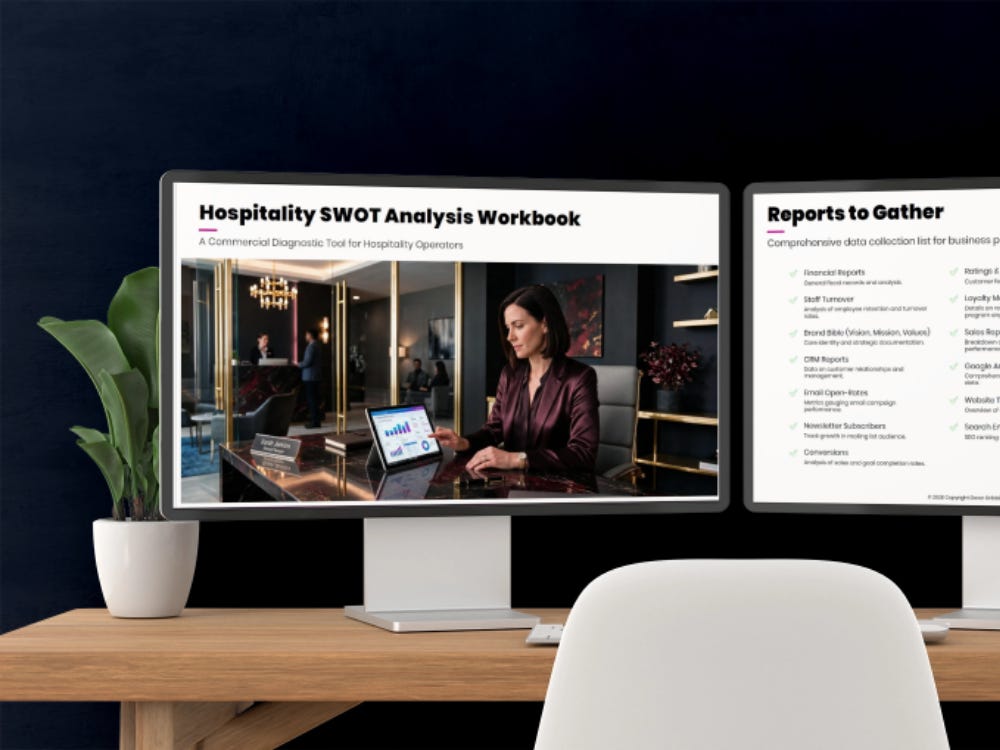
Featured Tool - Hospitality SWOT Analysis Workbook
Identify rate-parity leaks and fix conversion friction in your booking engine without external agency fees. Protect your cash flow and safeguard menu margins today.
🧠 Primacy & Recency Effects
Did you know that the sequence of your menu text dictates guest choices before they even read a description?
Most operators assume guests read a category list evenly. In reality, human attention hits specific hot spots. Diners focus naturally on the first and last items in any menu section. This consumer behaviour relies on a bias known as the primacy and recency effects.
The first item captures immediate attention. The final item benefits from a lingering pause. These specific positions are primed for your high-margin, high-desire dishes.
Apply this high-level placement to protect your profit margins.
Open each category with a reliable performer. This can be a dish with broad appeal, high profitability, or strong brand association. This top position uses the primacy effect to capture immediate interest.
Place your second high-margin target dish at the very end of the list. This bottom position uses the recency effect to capture the final choice before the guest decides.
Hide your low-margin utility items in the middle section. They remain accessible without stealing focus from your profitable options.
“Just because consumers know a product exists, does not mean they will be more likely to buy it.” Dr Sybil S. Yang
🧩 The Chunking Reset
Long lists kill guest attention completely. If a category features more than six items, it must be visually broken into distinct sub-sections. Use subtle dividers or short category headers to group your dishes. This structural change manually resets the brain of the customer. It generates two sets of primacy and recency hotspots instead of one, giving you more opportunities to feature top dishes
📱 Physical Layouts Versus Digital Screens
You must evaluate digital menus differently from physical paper pages. Traditional behavioural experts still rely on eye-tracking studies from print media. Mobile ordering follows entirely different rules.
AI models analyse millions of smartphone viewport metrics. The data reveals that the classic F-shape reading pattern is completely dead on digital or mobile menus. On a screen, users do not scan horizontally. They swipe vertically. Primacy becomes a constantly moving target. It is whatever occupies the top 30% of the phone screen at any given millisecond.
AI has detected a severe pattern called the scroll void. When users swipe down a menu, their scrolling speed accelerates by up to 300% in the exact centre of a long category. Diners do not deliberately ignore the middle items. Their thumbs physically push past the text too fast for the human eye to register the words.
The middle of a mobile menu is a completely invisible void. You must use a structural break, a distinct icon, or a micro-animation to halt the kinetic velocity of the thumb.
Review your mobile screen layouts and apply these positions before your next planning window closes.


A beautiful menu means nothing if your item sequence hides your most profitable dishes. True menu engineering commands guest attention to make your high-margin choices completely unavoidable.
That’s it for this edition. I look forward to serving you again soon.
Here’s to your success! 🥂
Dawn Gribble MIH MCIM
Hospitality Marketing Insight

I’m an award-winning marketing expert with 25+ years of international experience helping brands like Wagamama, Sysco, Ramada, and The Institute of Hospitality get clarity and creative insight on their marketing performance.
📊 Need an expert marketing audit? Get in touch at DG Consulting.
🚀 Grow your brand: Download courses, workshops, and campaign plans at the Hospitality Marketing Hub

Menu Engineering FAQs
What is price anchoring on a restaurant menu? Price anchoring is a behavioural psychology tactic where a premium, high-priced item is placed at the top of a category to establish a mental reference point, making surrounding high-margin items appear more affordable.
How does decoy pricing increase restaurant profit margins? Decoy pricing introduces an intentionally unappealing intermediary option that guides diners to select a higher-margin, premium option by making it look like superior value.
How do you structure a digital restaurant menu? Digital menus must discard traditional F-shape reading patterns and account for vertical swiping, placing the highest-margin items in the top 30% of the mobile viewport to capture immediate attention.
📚 Sources & Resources
Almoradie, C., [WATCH] Optimizing your Menu – Mission Possible by Professor Sherri Kimes, HSMAI Academy (2025)
Anchoring decisions: The role of decoy pricing in consumer choices, ResearchGate (2026)
Berkman, S. H., Eric., Designing Mobile Interfaces, O’Reilly Media (2026)
Gribble, D., The Menu Mistakes Draining Your Margins, Hospitality Marketing Insight (2025)
Huber, J., Payne, J. W., & Puto, C., Adding Asymmetrically Dominated Alternatives: Violations of Regularity and the Similarity Hypothesis, Journal of Consumer Research (1982)
Judgment under Uncertainty: Heuristics and Biases, Science (2026)
Menu Psychology: How Customers Make Ordering Decisions | 2026 Guide, NeatMenu (2026)
Noone, B. M., & Cachia, G., Menu engineering re-engineered: Accounting for menu item substitutes in pricing and menu placement decisions, International Journal of Hospitality Management (2020)
Roediger, H. L., & Yamashiro, J. K., Memory, The Cambridge Handbook of the Intellectual History of Psychology (2019)
The Decision Lab—Behavioral Science, Applied, The Decision Lab (2026)
Whitfield, J., No, You Shouldn’t Use the F Pattern in UX Design, Medium (2023)
Yang, S. S., Eye movements on restaurant menus: A revisitation on gaze motion and consumer scanpaths, International Journal of Hospitality Management (2012)
Yoo, M., Bahg, G., Turner, B., & Krajbich, I., People display consistent recency and primacy effects in behavior and neural activity across perceptual and value-based judgments, Cognitive, Affective & Behavioral Neuroscience (2025)
Enjoyed my work? Buy Me a Coffee ☕
I like this, especially the point about guiding choice rather than setting a trap.
The part I would push slightly is this:
menu engineering should not only ask, “How do we move the guest toward the profitable item?”
It should also ask, “Does the guest still feel the choice was theirs?”
That matters more than we admit.
Anchors, decoys, and placement can lift spend. But if the guest later feels they were managed too neatly, the restaurant may win the check and lose a little trust.
The best menu engineering does not feel like selling.
It feels like help.
The guest spends more, but leaves feeling smart, not steered.
Menu engineering is really just empathy in disguise....anticipating what a guest needs before they even know it. Love the focus on boosting spend through better experience design rather than just price hikes.