



Part of our Hospitality Marketing Psychology series
🌞 Hello and welcome to Hospitality Marketing Insight. I’m your host, Dawn Gribble, and in this edition, we’re looking at one of the most persistent problems in hospitality: no-shows.
No-shows cost the hospitality industry billions every year. In the UK alone, the cost is estimated to be between £16 billion and £17.59 billion annually, and in 2023, 76% of UK venues reported being affected, losing an average of £3,621 per venue.
At the venue level, the impact is just as stark. A single no-show can cost a restaurant between $28 and $120 per cover, and across the sector, restaurants lose 5% to 20% of potential revenue to empty tables.
For an industry operating on tight margins, two empty tables on a busy night can wipe out the evening’s profit entirely.
When reservation data is analysed, clear patterns begin to emerge. The likelihood of a no-show changes depending on lead time, day of week, group size, and booking behaviour. Longer lead times increase risk. Same-day bookings are significantly more reliable. Larger groups introduce more uncertainty. No-shows are rarely random, and the data shows that some reservations are far more likely to fail than others. Yet almost every venue still treats reservations as if they are all the same.
Understanding what’s really happening requires looking beyond the symptoms and examining the psychology behind why guests no-show in the first place.
📄 On the Menu
👻 Why Guests No-Show
🧠 Five Behavioural Drivers Behind No-Shows
💳 Do Deposits Actually Reduce No Shows?
Let’s Check In ☕

👻 Why Guests No-Show
When consumers fail to honour a reservation, the reasons they give are surprisingly consistent. Across multiple studies, a small number of explanations appear again and again.
Some guests decide the evening will be too expensive. Others change their plans. Sometimes someone in the group becomes ill, or the booking simply slips their mind. In other cases, the reservation was never fully committed to in the first place.
The distribution typically looks like this.

At first glance, these explanations appear unrelated. But when viewed together, they reveal something important: most no-shows are not deliberate acts of bad behaviour. They are the predictable result of how people make plans.

These explanations tell us what guests say happened. But they do not fully explain why the behaviour occurs in the first place. To understand this, it helps to look at the behavioural forces shaping how people make reservations.
🧠 Five Behavioural Drivers Behind No-Shows
📅 Plans Change
Guests often book tables days or weeks in advance. At the moment of booking, the reward is simple: securing a plan.
But as the date approaches, priorities shift. Energy levels change. Weather changes. Other invitations appear. The perceived value of the reservation can look very different on the day itself than it did when the booking was first made.
Reservation reliability declines as lead times increase. In fact, the probability of a no-show rises by 10% to 15% for every additional week between booking and the reservation date.
What began as a good idea can start to feel like an obligation.
👥 Groups Dilute Responsibility
Group reservations introduce a different dynamic.
When several people are involved, the responsibility for managing the booking becomes shared. Each person assumes someone else will cancel if plans change. Individuals may also assume their absence will not matter if the rest of the group still attends.
The result is that no one feels fully accountable for the reservation.
Larger groups consistently carry higher no-show risk. Because responsibility is shared, operators frequently treat parties of 6 or more as high-risk reservations and require deposits or credit card holds to secure them.
And when reservations involve groups, the dynamics become even more complicated.
🔀 Guests Keep Their Options Open
Scarcity messaging and limited availability can unintentionally encourage a behaviour known as spread booking.
Rather than committing to a single venue, some guests keep their options open by reserving multiple restaurants for the same time slot. When the day arrives, they choose one and abandon the others.
From the guest’s perspective, this feels harmless. From the operator’s perspective, it creates the illusion of demand while leaving tables empty.
In some markets, 10–30% of reservations are estimated to involve spread booking, where guests secure multiple tables and decide later which one to keep.
Making those extra reservations has also become much easier with digital booking systems.
📱 Digital Booking Removes Social Friction
Online reservation systems have made booking faster and more convenient than ever.
But they have also removed the social interaction that once created a sense of accountability. Cancelling a reservation used to require a phone call and a brief conversation with another person. Today, it may involve nothing more than ignoring a confirmation message.
That distance makes disengaging from a booking psychologically easier.
The same pattern appears across hospitality. For hotels, Online Travel Agencies such as Booking.com and Expedia experience cancellation rates between 31% and 42%, compared with 11.1% to 18% for direct bookings and just 4.6% for Global Distribution System bookings used by corporate travel planners.
The easier it becomes to make a reservation, the easier it becomes to abandon it.

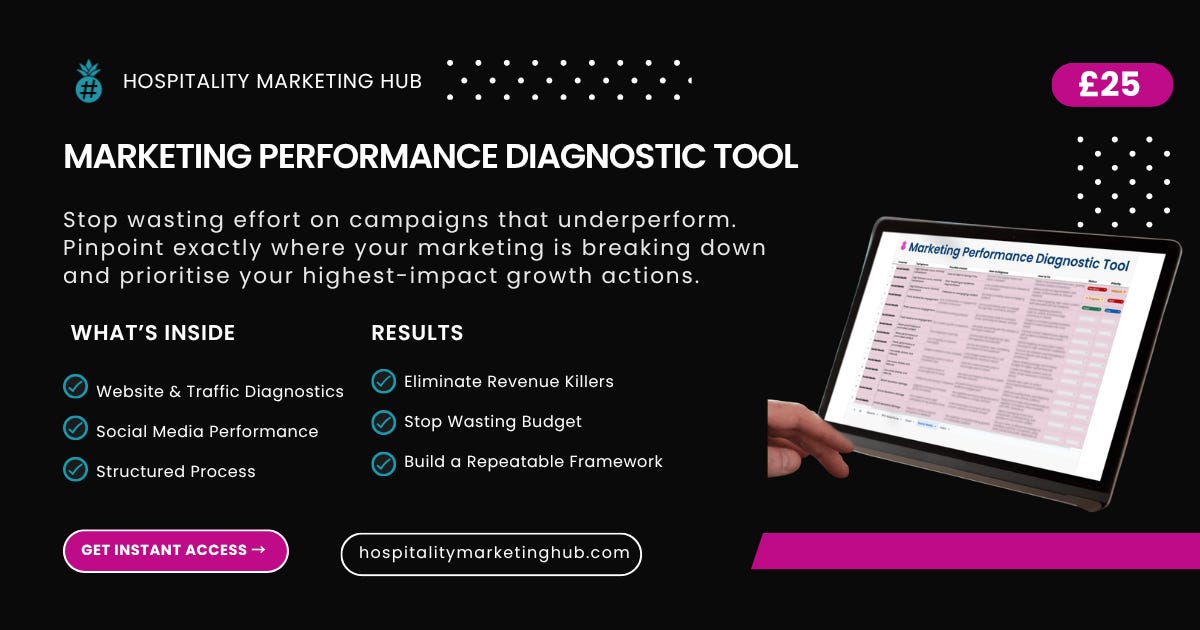
Where are your reservations actually breaking down?
If your booking engine or checkout path is leaking covers, stop guessing which channels are at fault. The Marketing Performance Diagnostic Tool gives you structured, channel-by-channel spreadsheets to isolate conversion bottlenecks, fix booking friction, and prioritise your immediate fixes.
💳 Do Deposits Actually Reduce No Shows?
Yes, they do. And the reason comes down to commitment.
From a behavioural perspective, deposits work because they act as a commitment device. Instead of making a reservation that carries no consequence, the guest makes a small financial commitment upfront and pays the balance later. That early stake changes the psychology of the booking. What was previously just a plan now becomes something of value that the guest risks losing.
Consumers recognise this themselves. Around 30% of diners say the risk of losing a deposit makes them more likely to honour a reservation.
Because deposits increase commitment, they are becoming increasingly common across the industry. Today 94% of the world’s top restaurants charge a cancellation fee, and around 42% of UK restaurants now require prepaid deposits to secure reservations.
At the same time, consumer attitudes are shifting. Research suggests that 3 in 4 diners are now open to paying a reservation deposit, particularly for high-demand venues, special occasions, or tasting menus.
However, acceptance is not universal. Some diners—particularly younger guests—still strongly dislike the idea of being penalised simply for making a booking. In fact, around 7% of non-bookers say they avoid making reservations altogether if a deposit is required.
When deposit policies are implemented poorly, the consequences can escalate quickly. Restaurants that enforce strict cancellation fees without empathy have occasionally found themselves at the centre of viral online debates. In one widely discussed case, a Boston restaurant faced significant backlash after charging a guest a $250 cancellation fee when a sudden medical emergency prevented them from attending. Situations like this often spill onto review platforms, where the damage can multiply. Research suggests 94% of consumers avoid a business after seeing negative feedback, and a single negative review can cost a venue up to 30 potential customers.
Disputes can also move beyond reviews. Guests who feel unfairly treated may initiate credit card chargebacks, which are heavily regulated and often favour the consumer. For operators, this creates additional administrative work, bank charges, and lost revenue, even when the policy itself is technically correct.
The deeper challenge is that deposits introduce a trade-off. As deposits increase, no-shows tend to fall. But booking conversions can fall as well. After a certain point, increasing the deposit further does little to improve attendance, while making guests less willing to book in the first place.
There is an optimal friction point.
Most venues guess.
Very few optimise.
And that raises a more interesting question: how do you design reservation systems that increase commitment without discouraging bookings in the first place?
That’s exactly what we’ll explore in Tuesday’s VIP edition.
🔒 Coming Up in this week’s VIP Edition
Deposits change behaviour because they introduce loss aversion.
But they are only one tool.
The deeper question is how reservation systems can be designed to work with human psychology rather than against it.

In Tuesday’s VIP edition, we break down the system operators use to reduce missed reservations:
How to run a No-Show Audit
How to engineer deposits correctly
The booking follow-up schedule that reduces forgotten reservations
How to handle deposit complaints without reputational damage
The rebooking recovery protocol most venues miss
👉 Become a VIP to unlock Tuesday’s playbook

That’s it for now. If there’s one takeaway, it’s this: most no-shows are not random, and they are rarely personal. They’re the predictable result of how people make plans, manage uncertainty, and respond to incentives.
Once you understand the behaviour behind it, the problem becomes far easier to diagnose. Small adjustments to how reservations are structured, communicated, and reinforced can compound over time into meaningful improvements.
In hospitality, margins are tight and every table matters. Even a small reduction in no-shows can make a noticeable difference to revenue, team morale, and operational stability.
If you found this useful, feel free to share it with a colleague who might be wrestling with the same challenge.
I look forward to serving you again soon.
All the best

Dawn Gribble MIH MCIM
Hospitality Marketing Insight
Here’s to Your Success 🥂
📚 Sources & Resources
Almost All Top Restaurants Charge for No-Show Bookings, and Many Other Restaurants Are Following Their Lead, Mandoe Media (2024)
Blog: 7 Sobering Stats on No-Shows in Pubs and Restaurants, Zonal (2026)
Gribble, D., Dealing With Negative Reviews, Hospitality Marketing Insight (2025)
How to Prevent Hotel No-Show and Last-Minute Cancellations?, Hospitality Net (2024)
Negative Online Reviews Have Increased for Restaurants, Nation’s Restaurant News (2026)
No-Shows Calculator, Zonal Insights (2026)
Operator Resources, Zonal (2026)
SchedulingKit, 50 Appointment No-Show Statistics (2026)—Rates, Costs & Prevention, SchedulingKit (2026)
Should Your Restaurant Require Reservation Deposits?, SevenRooms (2026)
Why Businesses Rely on Reservations and Cancellation Fees, Northeastern University News (2026)
Ready to go deeper? Expense a Subscription for
just £15 month or £150 for the year
The VIP Edition unlocks advanced strategy,
exclusive data and practical playbooks.


💡 The Role of Consumer Psychology in Hospitality Marketing

Effective Hospitality marketing is heavily influenced by consumer psychology.
🧰 The Psychology of Food Presentation

When it comes to dining, taste is undoubtedly the top priority. But did you know how food is presented can also significantly impact customer choices?
💥 The Power of Influence in the Hospitality Industry

Influence plays a vital role in the hospitality industry by shaping consumer decisions, improving brand reputation, and driving business growth. By understanding the psychological principles of influence, hospitality professionals can create memorable experiences, establish strong customer relationships, and foster loyalty.
Do you enjoy my work? Buy Me a Coffee ☕
A good breakdown of how behavioral psychology shapes reservation behavior
This is a really clear breakdown of how behavioural friction shapes commitment.
What stood out to me is the point about digital booking removing social friction. When the social cost disappears, a reservation stops feeling like a promise and becomes more like a placeholder. Introducing even small stakes—financial or social—seems to shift it back into a real commitment.