


“I don’t know if social media is working for us.” “Why aren’t we seeing a return on our ad spend?”
Many hospitality teams ask these exact questions before campaign budgets are committed.
Traditional advice tells venue operators to use Instagram for photos, Google for directions, and your website for bookings. This approach ignores how modern tech platforms generate revenue.
Meta, Alphabet, and ByteDance do not want users leaving their apps. Over recent years, they have locked down their ecosystems into walled gardens, building native booking engines directly into their apps. They actively reduce the reach of content that sends users to external websites.
Social channels now act as native conversion engines through tools like Comment-to-DM funnels, TikTok GO, and automated WhatsApp messaging. This represents a massive opportunity for forward-thinking hospitality marketers.
📄 On the Menu
Why External Website Links Kill Your Organic Reach
The 3-Stage Funnel: Converting Views into Direct Bookings
The £11,000 Weekend Void: Why Direct Messages Are Sales Leads, Not Admin
Let’s Check In ☕

🧱 Why External Website Links Kill Your Organic Reach
Social media doesn’t want you to send users away from their platforms
Over the past few years, strict privacy rules like GDPR ended traditional third-party tracking cookies. Tech networks like Alphabet, Meta, and ByteDance responded by building walled gardens. A walled garden is a closed ecosystem. The platform controls user data, technology, and advertising in one place.
Because users stay logged in, these networks collect deep first-party data. Alphabet logs daily commute routes and travel speeds. Google Maps registers the exact minutes a user spends inside a competing venue. It notes when someone pauses near a local street corner or menu board. Meta measures how many times a user activates their phone screen each day. Algorithms record the exact milliseconds a user pauses over a video clip of food or cocktails.
Platforms combine nearby Wi-Fi connections and Bluetooth signals to trace physical footfall. They identify when an office worker leaves their desk at 12:15 PM every Thursday. They detect when a corporate traveller arrives at a local train station.
They understand guest routines better than any website analytics tool.
According to research by Skai, 70% of marketers are moving more budget into walled gardens to adapt to privacy restrictions.

🎯 The 3-Stage Funnel: Converting Views into Direct Bookings
To protect organic reach and capture guest demand, campaign activity must align with native platform features. The table below maps each platform across the first three stages of the buyer journey: Dreaming, Planning, and Deciding, which make up the Sales Funnel.
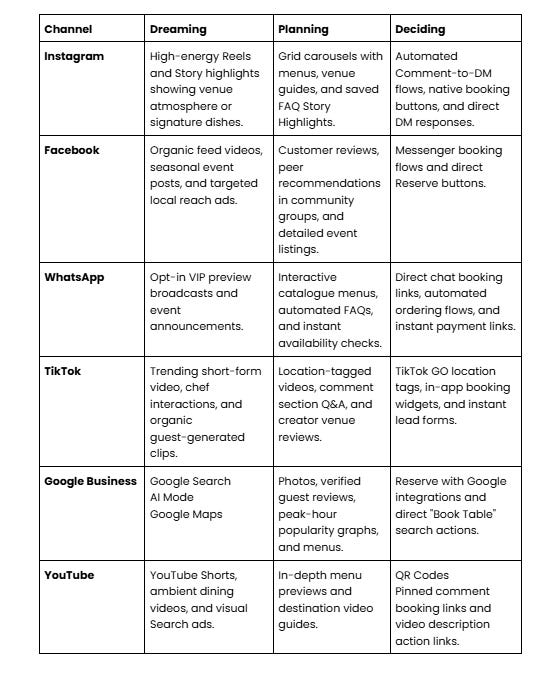
Many venue accounts concentrate heavily on the Dreaming stage with visual photo and video content. However, they often lack Planning and Deciding infrastructure.
If a guest moves from Dreaming to Planning, they require immediate details. When they encounter broken bio links, missing menus, or slow message replies, purchase intent drops rapidly. The booking goes to a venue with direct, native conversion tools in place.
Before campaign budgets are committed, audit your social channels against these three stages. Closing the gaps between Planning and Deciding converts existing view counts into direct venue revenue.

❓ The £11,000 Weekend Void: Why Direct Messages Are Sales Leads, Not Admin
⏰ How Much Revenue Do Hospitality Venues Lose from Slow Social Media Response Times?
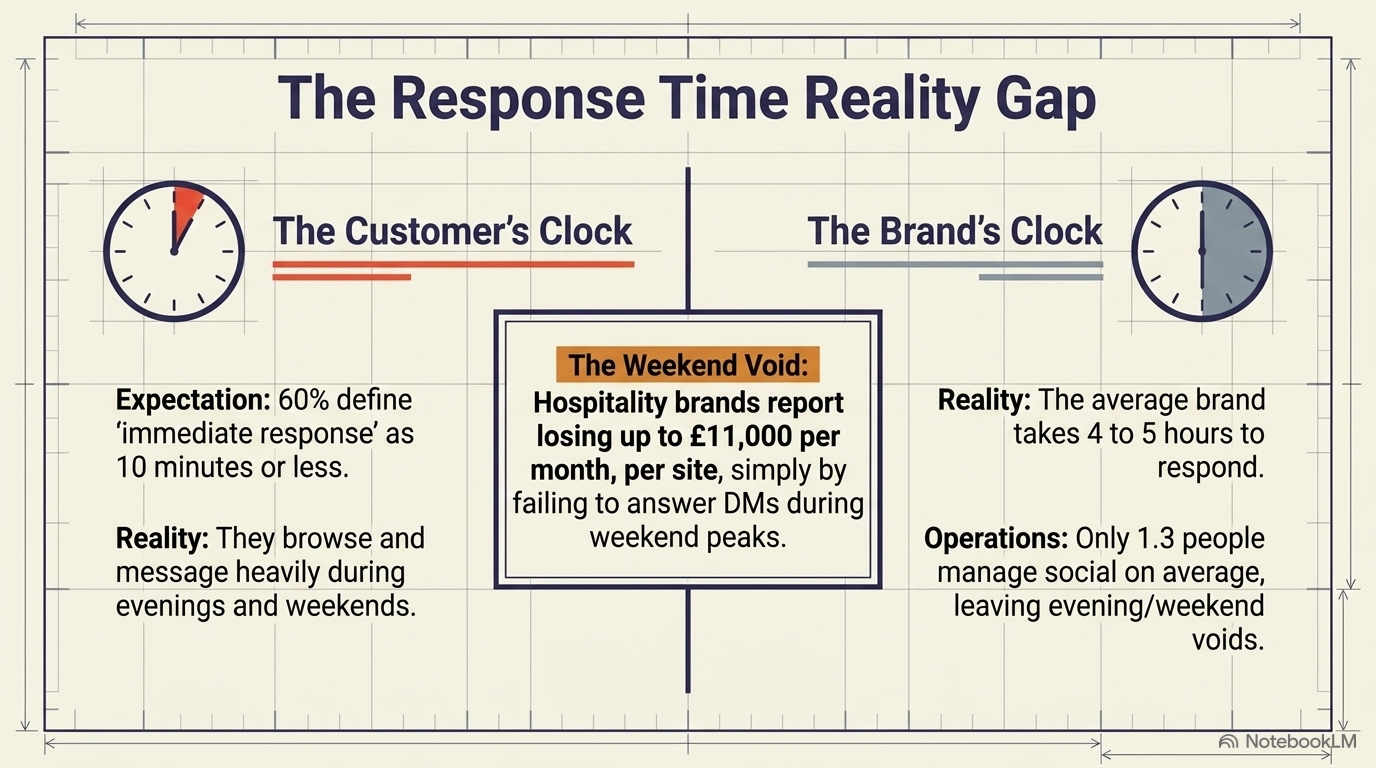
Consumers have been conditioned by years of real-time messaging with friends and family to expect near-instant responses. They bring these same expectations to their interactions with businesses. In fact, 83% of customers expect an immediate response when reaching out, and 73% say they will simply buy from a competitor if a brand stays silent.
A direct message asking about weekend availability or menu options is not casual admin. It is a high-intent sales lead.
In hospitality, that purchase intent degrades rapidly:
0–5 minutes: Peak intent. The guest is hungry or actively planning right now.
2 hours: The guest has likely booked with a competitor.
48 hours: The message is totally irrelevant.
This intent decay happens because of a structural timing mismatch. Guests are most active on social media during evenings and weekends when planning nights out. This is precisely when marketing teams are off the clock, and venue staff are flat-out serving physical tables. With hospitality brands running on an average of just 1.3 people handling social channels, messages naturally accumulate during peak trading hours.
Ruth Carpenter, Sales and Marketing Director at Black Rock Restaurants, put a concrete figure on this operational gap. She calculated that unhandled direct messages cost an estimated £11,000 per month, per site, in lost weekend trade.
When an enquiry sits unanswered until Monday morning, that customer hasn’t just received slow service. They have taken their booking—and their spend—straight to the venue down the street.
⭐ How is Social Media Engagement Tied to Brand Loyalty?
Brand loyalty is measurably tied to how quickly a venue responds to guest messages. According to consumer research, 76% of guests report feeling more loyal to brands that reply to their direct messages or comments. That represents an 8% increase year-on-year, showing that guest expectations around digital responsiveness are rising.
When a venue consistently answers DMs with speed and clarity, the commercial return extends far beyond securing a single table booking. It builds guest trust that drives repeat visits, positive reviews, and word-of-mouth recommendations.
Replying to a direct message is not an administrative burden or a basic customer service chore. It is a commercial sales function. Every prompt response protects your acquisition costs and builds long-term guest lifetime value that compounds across trading periods.

Ready to turn your DMs into your highest-margin booking channel?
In Thursday’s VIP Briefing, upgraded members get the complete execution pack:
The Native Funnel Framework for every major platform.
GA4 & Native Tracking made ridiculously simple.
Custom URL Builder Tool to measure exact ROI.
Don’t let competitors down the street grab your weekend leads while your marketing team is offline.
Your social media accounts act as your second front desk. Managing direct messages and native tools requires real operational focus during busy trading periods. Taking it step by step builds a predictable, high-margin booking channel for your business.
I hope these insights help you. I look forward to sharing more practical frameworks with you next time.
Dawn Gribble MIH MCIM
Hospitality Marketing Insight

Here’s to your success! 🥂
I’m an award-winning marketing expert with 25+ years of international experience helping brands like Wagamama, Sysco, Ramada, and The Institute of Hospitality get clarity and creative insight on their marketing performance.
📊 Need an expert marketing audit? Get in touch at DG Consulting.
🚀 Grow your brand: Download courses, workshops, and campaign plans at the Hospitality Marketing Hub
📚 Sources & Resources
Dubey, E., Top Social Media Customer Service Statistics for 2026, Kayako (2026)
Introducing TikTok’s Attribution Portfolio, TikTok For Business (2026)
Skai, K., Complete Guide: What Is Walled Garden Media?, Skai (2023)
Social Media Algorithms in 2026: How They Work + Best Practices, IQfluence (2026)
Social Media Is Costing (and Making) Hospitality Brands, LinkedIn (2026)
Team, L., Social Media Customer Service Statistics 2026: 15 Data Points on Why Customers Expect Fast Replies, Lead Response (2026)
URL builders: Collect campaign data with custom URLs, Google Analytics Help (2026)
This was legitimately helpful! Gave me several ideas to bring back to my team, thank you!