



Picture this: You are sitting in a packed, noisy restaurant. You are ready to order, so you try to catch the waiter’s eye. You do the awkward half-wave. You try the intense, pleading eye contact. You even do that weird half-stand out of your chair.
But they just breeze right past your table to serve someone louder.
That is exactly what it feels like to market your business online right now.
You spend hours scripting, shooting, and editing what you think is the perfect Reel or TikTok. You hit publish, holding your breath. You get a tiny spike of hope, and then the views crater after exactly two seconds. Your audience and the algorithm just breezed right past your table.
It is incredibly frustrating, but right now, it is also dangerous. Autumn campaigns, Halloween, Black Friday, Cyber Monday, and Christmas are arriving fast. If you cannot get the waiter’s attention on a random Tuesday, how are you going to get it when the restaurant or hotel is triple-booked in November?
📄 On the Menu
The Mathematical Reality of Guest Attention
The Three Operational Flaws Killing Video Conversion
Your Questions Answered - Visibility vs Active Attention
Let’s Check In ☕

🧮 The Mathematical Reality of Guest Attention
So, why does it feel like your audience is ignoring you? Because mathematically, they are.
Social media platforms do not care how good your food looks or how luxurious your hotel suites are. They only care about your Hook Rate. TikTok decides your video’s fate in less than 2 seconds. Instagram gives you 3 seconds. If you do not stop the scroll in that micro-window, the algorithm buries you.
It is not just the algorithm; it is human behaviour. Your customers are overwhelmed. They are suffering from chronic decision fatigue, fuelled by the infinite scroll. In fact, Meta reports that 42% of online shoppers abandon bookings because of cognitive overload.
This has created a dangerous operational issue: The Engagement Trap. We try so hard to stop the scroll that we focus entirely on being funny, trending, or shocking. We end up entertaining people past the checkout.
You might get the views. But because the cognitive friction to buy the product is too high, you get zero sales. You are trading your revenue for likes.
🚨 The Three Operational Flaws Killing Video Conversion
Why is it harder than ever to turn a view into a customer? It comes down to three fundamental realities in how consumers consume media.
First, you are battling Ghost Attention. According to data on digital consumption habits, the typical online adult spends 18 hours and 36 minutes per week scrolling through social and video feeds. That accounts for 16% of their waking time spent in a passive, trance-like state. Social platforms default to auto-play to keep users on the app. Your dashboard might show 10,000 views, but a massive chunk of that is zombie scrolling. You are capturing their screen, but not their brain.
Second, marketers are relying on Lazy Distribution. Slapping the exact same vertical video on TikTok, Reels, and Shorts ignores a critical psychological rule: Platform Context. A user on TikTok wants raw entertainment; a user on Instagram wants a curated aesthetic. When you cross-post blindly, you interrupt rather than market.
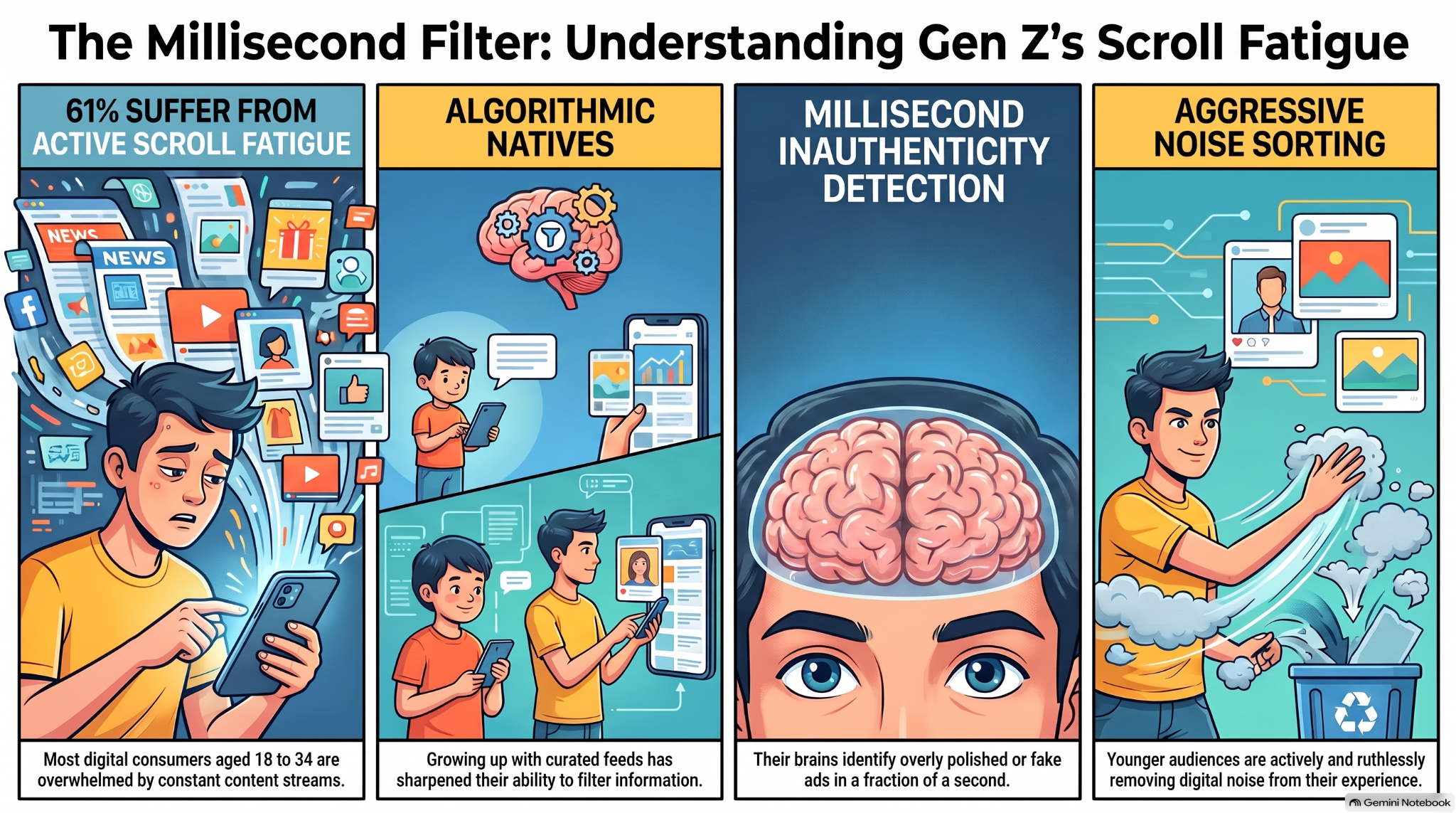
Finally, younger audiences have built an exceptionally sharp filter. Data shows 61% of digital consumers aged 18 to 34 suffer from active scroll fatigue. Gen Z grew up native to algorithmic feeds. Their brains detect an inauthentic, overly polished ad in milliseconds. They are aggressively sorting out the noise.
Throw in the recent explosion of AI-generated content flooding the feeds, and consumer trust is at rock bottom.

💡 Stop Wasting Budget on Passive Views
Vanity metrics won’t fill your venue this Q4. Upgrade to VIP Membership to receive our complete Attention Masterclass Execution Checklist —featuring the exact editing frameworks, visual hooks, and booking-path optimisations needed to convert scroll time into confirmed bookings.
👀 Your Questions Answered - Visibility vs Active Attention
What is the difference between visibility, impressions, and active attention?
The easiest way to understand these metrics is to think about a billboard on a highway:
Impressions (Presence): The billboard was built and placed on the side of the road. In digital terms, the ad loaded on a page. It doesn’t mean a human was anywhere near it.
Visibility/Viewability (Potential): A car drove past while the billboard was in their line of sight. They could have seen it, but they might have been looking at their phone.
Active Attention (Processing): The driver actually looked directly at the billboard and read the message. In digital marketing, this is measured by Attentive Seconds—proving the user’s eyes and brain were focused on your content long enough to encode the memory.
Does high engagement always mean high levels of active attention?
No. Relying on engagement alone is exactly how brands fall into the Engagement Trap. A user can passively double-tap a visually pleasing video of a hotel pool or share a funny restaurant meme without ever registering what brand posted it or what the core offer was. Engagement is simply a physical action; active attention is cognitive processing.
How can marketers measure attention without expensive eye-tracking software?
You do not need a neuromarketing lab to measure cognitive focus; you just need to look at the right proxy metrics on your dashboard:
Hook Rate: The percentage of people still watching at the 2-second or 3-second mark. This proves you successfully interrupted their scroll.
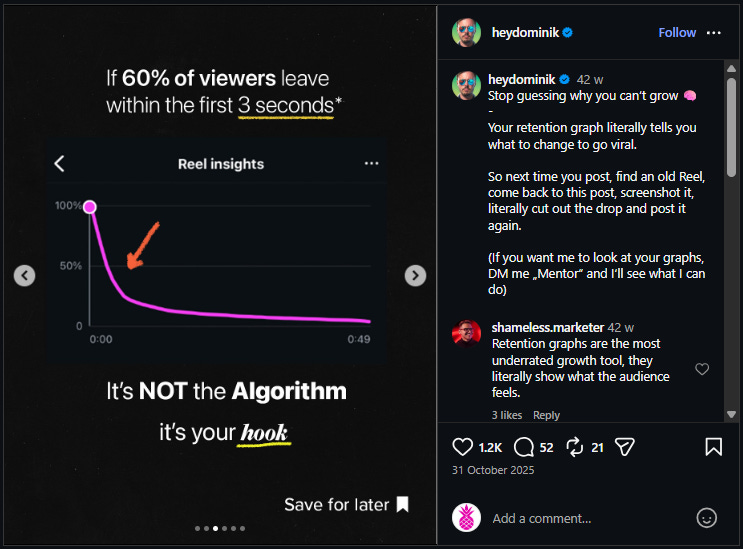
Retention Curves: Look at the shape of your retention graph rather than total views. For Instagram Reels, short clips of 7 to 15 seconds typically retain 60% to 80% of viewers. When clips stretch to 15 to 30 seconds, retention drops to 40% to 60%. A gradual slope means you held working memory; a vertical cliff means they ghosted you.

🛠️ Practical Tools for Hospitality Marketing Leaders
Move from basic engagement to active customer processing. VIP members gain instant access to step-by-step swipe files, timing templates, and journey friction audits designed specifically for hospitality brands.
Commanding those first 3 seconds stops your ad budget from bleeding into ghost views. It gives your upcoming autumn and holiday campaigns the exact baseline performance needed to pull real diners and guests through the door.
That’s it for this edition. I hope you’ve enjoyed the newsletter. I look forward to serving you again soon.
Dawn Gribble MIH MCIM
Hospitality Marketing Insight

Here’s to your success! 🥂
I’m an award-winning marketing expert with 25+ years of international experience helping brands like Wagamama, Sysco, Ramada, and The Institute of Hospitality get clarity and creative insight on their marketing performance.
📊 Need an expert marketing audit? Get in touch at DG Consulting.
🚀 Grow your brand: Download courses, workshops, and campaign plans at the Hospitality Marketing Hub
📚 Sources & Resources
Brandberries, Signals For 2026: What’s Shaping The Future Of Brands, Media And Technology?, The Brand Berries (2026)
Department of Commerce, Loyola College, Chennai, Tamilnadu, India, Salathiyan, Dr. M., Prathipa, S. M., & S, K. A., Decision Fatigue in Infinite-Scroll Shopping: Evidence from Meta’s Report of 42% Abandonment Rates, INTERNATIONAL JOURNAL OF SCIENTIFIC RESEARCH IN ENGINEERING AND MANAGEMENT (2025)
Foundation, T. A. R., ARF Releases Large-Scale Study of Attention Metrics in Live Campaigns, PR Newswire (2026)
Lee, R. A., Social Media Attention Span Statistics 2026: Viral Content Data, SQ Magazine (2026)
Miller, S., Some Quick Thoughts on Marketing in 2026, LinkedIn (2026)
Preobrazhenskaia, T., Digital Marketing Attention Economy Strategy, LinkedIn (2026)
Relation, S. P., The Decline of Attention Span in the Digital Era, Swiss German University (2026)
Rieger, D. (heyDominik), Stop guessing why you can’t grow: Your retention graph literally tells you what to change to go viral, Instagram (2025)
Team, R., Hook rate: What it is, how to calculate it, and what good looks like, Rule1 (2026)