


Most of us have spent the last two years asking a version of the same question: what happens to our bookings when travellers stop typing into Google and start asking an assistant instead? The worry usually lands in a familiar place. If artificial intelligence becomes the front door, do the online travel agents own it the way they came to own search?
To answer that question with empirical evidence rather than industry speculation, I have handed over the pass this week to my guest author, Meriç Murat Erdinç, founder of Stay Indexed. He has prepared this proprietary study specifically for Hospitality Marketing Insight readers.
On the Menu
Let’s Check In ☕

🥊 Your Website Isn’t Even in the Fight
What the study looked at
40 properties across five cities: New York, London, Dubai, Sydney and Milan. Eight per city, four four-star and four five-star, so the two tiers could be compared directly. Every property went through the same standardised scan: eight traveller questions run across ChatGPT, Gemini, Claude and Perplexity. That came to 1,277 AI answers in total.
The questions were the ones real travellers ask. General “where should I stay in this city”, romantic getaways, family trips, luxury stays, budget stays, last-minute bookings.
For every answer, I recorded which sources the model cited, sorted into three buckets: the hotel’s own domain, booking sites, and everything else. Properties are anonymised throughout. The point is the pattern, not naming individual hotels.
The number that stopped me
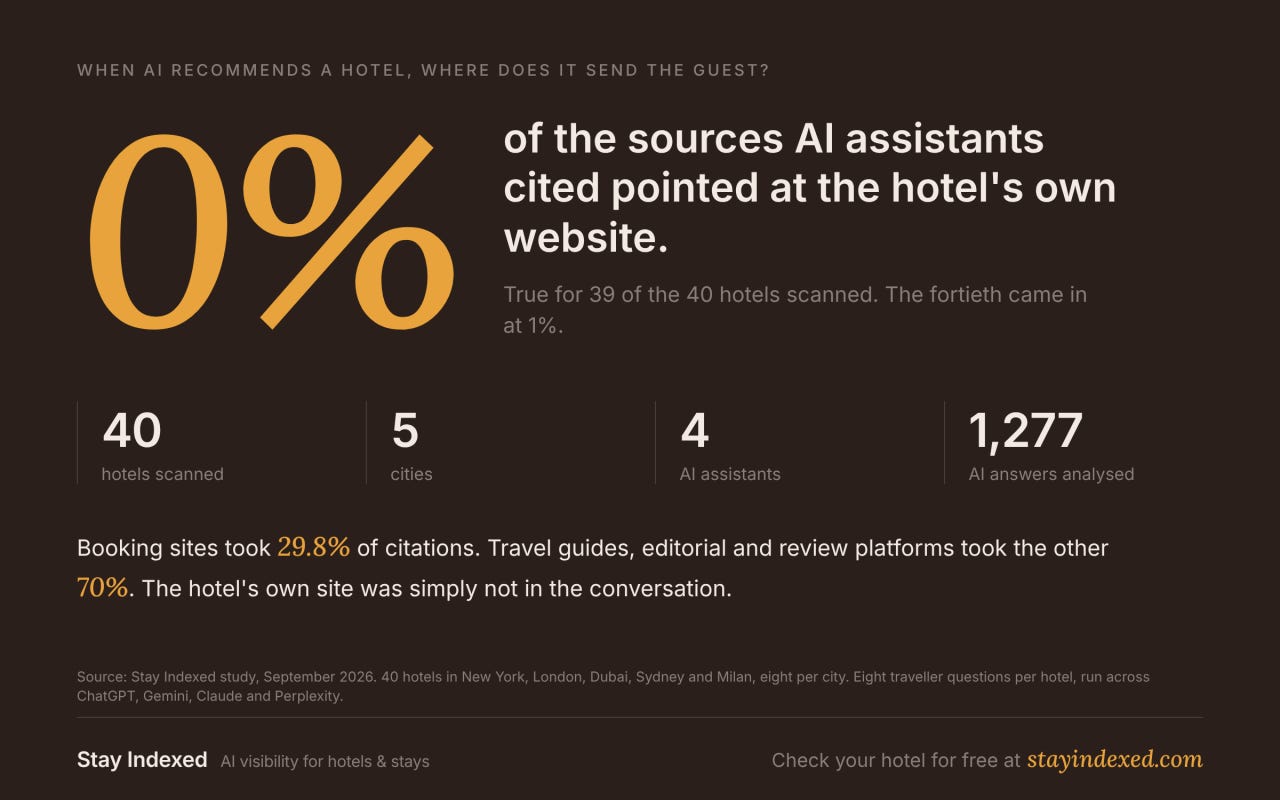
Across 39 of the 40 properties, the share of cited sources pointing at the hotel’s own website was 0%. The 40th came in at 1%.
Not low. Not declining. Effectively absent.
These are whole percentages as the scan reports them, so a property sitting at 0.4% would show as zero. That caveat aside, the picture does not soften. Across 1,277 answers covering 40 hotels in 5 of the most competitive markets in the world, the hotels’ own websites were almost never the source an assistant reached for.
So where do the citations go?
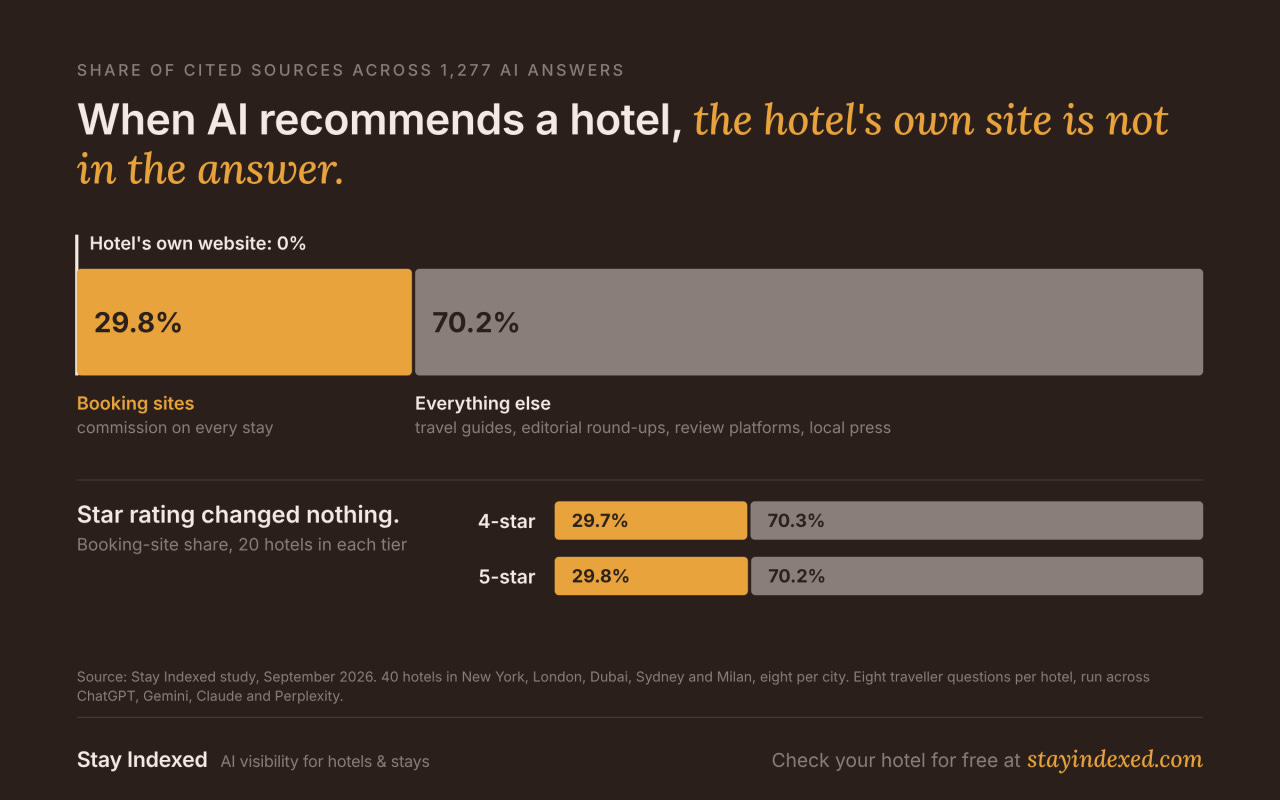
Booking sites took an average of 29.8% of cited sources, with a range from 20% to 39% depending on the property.
The remaining 70% went to what I called “everything else”: travel guides, editorial round-ups, review platforms, local press, city guides, listicles.
This reframes the direct-versus-OTA question in a way I did not expect when I started. The fight is not your site against the OTAs. Your site is not in the fight at all. OTAs hold roughly a third of the citation space, and the other two-thirds belong to publishers and platforms writing about hotels rather than selling them.
If you have been treating AI visibility as a website problem, that is the finding worth sitting with.

⭐ Why Five Stars and Clean Code Won’t Save You
Star rating changed nothing.
This surprised me more than the headline.
Four-star properties: 29.7% of citations to booking sites. Five-star properties: 29.8%.
Twenty properties in each tier, and the two numbers land within a tenth of a point of each other. Being a five-star property bought no protection whatsoever from OTA-dominated sourcing. The luxury tier was cited slightly more often overall, but the mix of where those citations pointed was identical.
City differences exist, but hold them loosely.
With eight properties per city, these are directional rather than conclusive, so treat them as a hypothesis rather than a result:
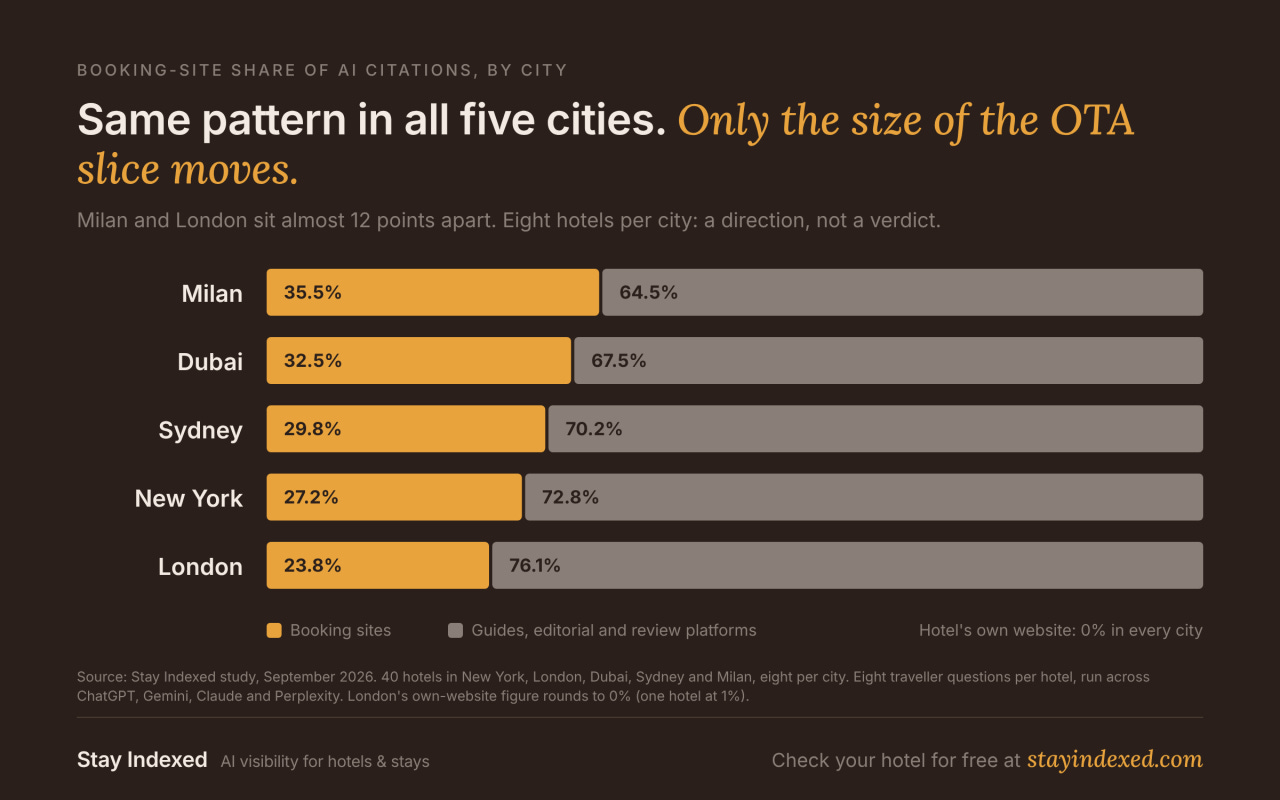
Milan and London sit almost twelve points apart. My working explanation is the depth of independent travel media. London has a dense layer of editorial, city guides and press that assistants can cite instead of an OTA.
A clean website did not buy visibility.
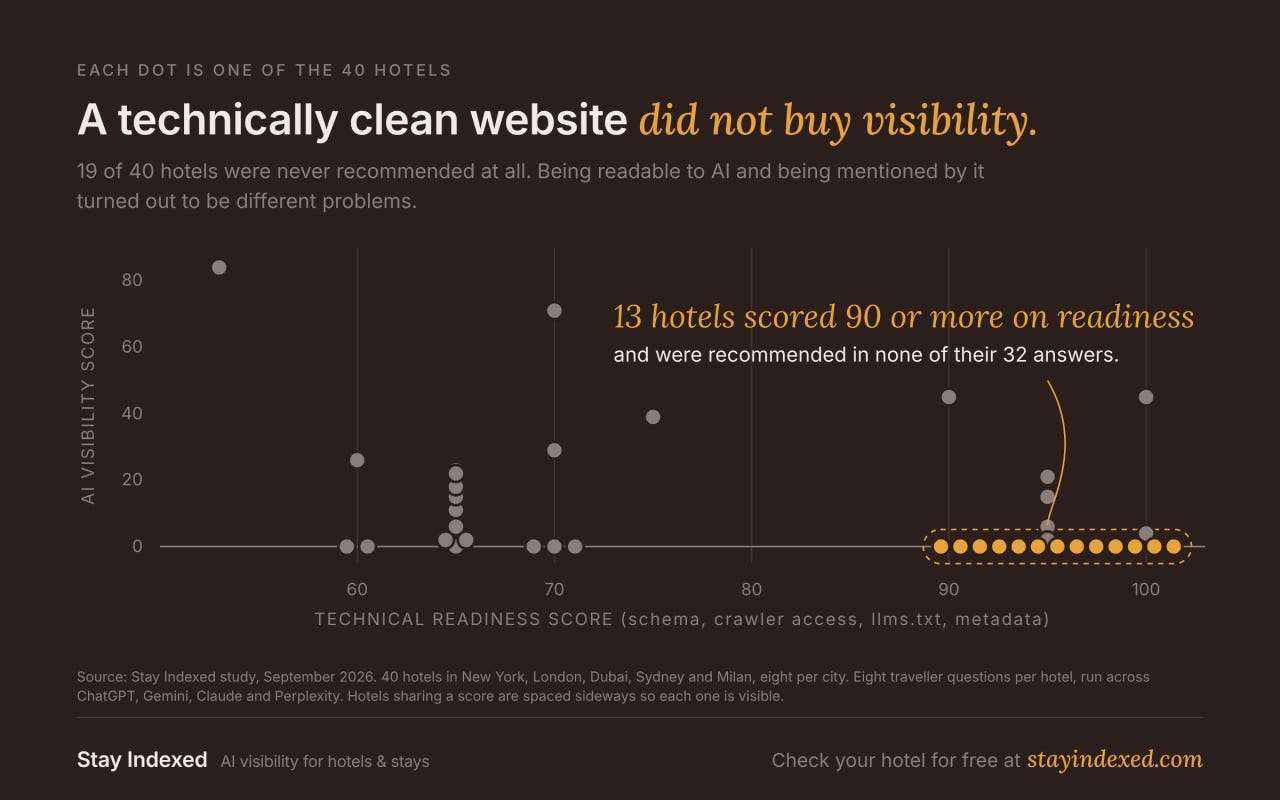
Each scan also produces a technical readiness score: schema markup, machine-readable address, crawler access, description quality, llms.txt, the mechanical things that make a site legible to a model.
19 of the 40 properties appeared in none of their 32 answers. Not a single recommendation across four assistants.
13 of those 19 scored 90 or above on readiness.
Across the sample, properties scoring 90+ on readiness averaged a visibility score of 6.9. Properties scoring below 90 averaged 18.2. The correlation runs mildly negative.
The honest reading is this. Readiness determines whether a model can read you. It has very little to do with whether a model mentions you. Being mentioned appears to depend on whether anyone else has written about you.
The shortlists are narrower than you think.
In each city, one property name dominated the “recommended instead” position:
Sydney: the same property appeared as the leading alternative for seven of the eight hotels scanned
New York: six of eight
Dubai and Milan: five of eight
London: four of eight
Assistants are not producing a wide, varied field. They are converging on a small set of names per market and repeating them. Just under 12% of all 1,277 answers mentioned the property being scanned. The rest of the space belongs to whoever already occupies the shortlist.
Between platforms, the differences were modest. Gemini mentioned the scanned property most often, ChatGPT least, with Claude and Perplexity in between. No assistant was meaningfully friendlier to direct sources than another.

📋 How to Get on the AI Shortlist
What I would do with this
Three things, in the order I would do them.
Audit who is writing about you, not just what you publish. Your citation share lives in the 70% bucket. That means guides, editorial, local press and review platforms. If nobody has covered your property in two years, no amount of site work fixes that.
Check what those sources actually say. Assistants summarise what they read. An out-of-date guide entry listing rooms you renovated in 2023 becomes the model’s version of your property.
Keep the technical work, but demote it. Schema and crawler access are cheap and worth doing. They are table stakes rather than a growth lever, and the data here suggests they will not move visibility on their own.
What this study does not tell you
It is 40 properties in 5 cities, scanned over a few days in September 2026. AI answers shift. A different week could produce different placements, though the structural finding – the near-total absence of hotel domains as cited sources – was consistent across every city, every tier and every platform.
It also measures citations and mentions, not bookings. Nobody yet has clean attribution from an AI answer to a confirmed reservation. Anyone claiming otherwise is ahead of the evidence.
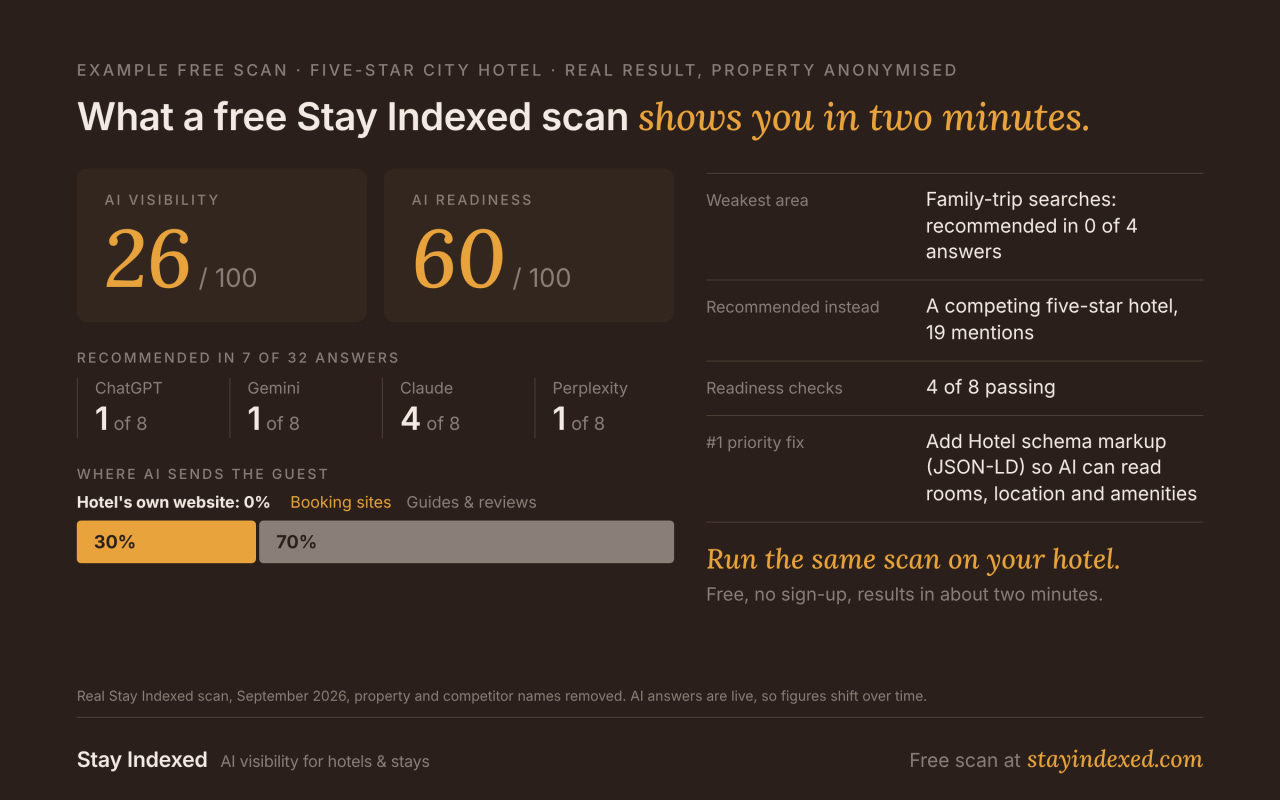
If you want your own numbers
The scan behind this study is a product I built called Stay Indexed. It checks how a property appears across ChatGPT, Gemini, Claude and Perplexity, and reports the citation split for that property. You can run it at stayindexed.com
For readers of this newsletter, there is a discount code: HMI30OFF, which takes 30 USD off the 99 USD report. It is limited to 50 uses, so it stays with this audience.
Thanks to Dawn for the space. What I am curious about now is what your own property returns. The pattern here held across forty hotels in five markets, but your city, your coverage and the sources that write about you are your own. The only way to see your numbers is to run the scan on your property.
If you do, I would like to hear what came back. Whether your own-site share sits at zero like almost every property in this sample, or whether you turn out to be one of the exceptions, both are worth knowing. My inbox is info@stayindexed.com, and I read everything that lands there.
Thank you, Meriç! When search evolved from static directories to algorithms twenty years ago, hoteliers who treated the web as a brochure lost ground to platforms that treated it as an ecosystem. We are standing at an identical junction today.
Treating conversational AI as an on-page technical project is comforting because it feels controllable. It allows teams to fiddle with code, polish descriptions, and tick technical boxes. But algorithmic models do not think like web browsers; they think like seasoned concierges reading the international press. They prioritise reputation over self-declaration.
If your marketing strategy pours all its energy into direct channels while neglecting external editorial authority, your property will remain invisible at the precise moment a guest asks an assistant where to stay. Build the external narrative, audit what the tastemakers say about your house, and make certain your real-world reputation is impossible for the models to ignore.
Here’s to your success! 🥂

Dawn Gribble MIH MCIM
Hospitality Marketing Insight
I’m an award-winning marketing expert with 25+ years of international experience helping brands like Wagamama, Sysco, Ramada, and The Institute of Hospitality get clarity and creative insight on their marketing performance.
📊 Need an expert marketing audit? Get in touch with DG Consulting.
🚀 Grow your brand: Download courses, workshops, and campaign plans at the Hospitality Marketing Hub
Recommended Resources
The Definitive Guide to Reputation Management for Hotels

Online reputation management has become a crucial aspect of running a successful hotel business. With the rise of user-generated content and online reviews, potential guests have access to a wealth of information about your hotel at their fingertips.
Really interesting study, thanks Dawn and Meriç. The line that stuck with me was that assistants summarise what they read. For restaurants and bars, reviews must be a fair part of that 70%, so whatever keeps coming up in them, good or bad, probably ends up in the AI's version of the place too. Makes reading your own reviews properly feel a lot less optional!
Always insightful, actionable and thought provoking marketing and hospitality content. Loved this one as an SEO/AEO nerd 🤓