



Your email dashboard shows soaring click rates, yet your dining room tables and hotel suites remain half-empty on a Tuesday evening. That statistical disconnect happens because enterprise security bots automatically trigger up to 60% of recorded clicks before a real human even opens your message. Mailbox providers are aggressively filtering synthetic marketing copy into secondary folders, treating generic promotional blasts like operational noise. Diners smell corporate panic from a mile off, and each reactive discount you send permanently lowers their perceived value of your food and hospitality.
By reading this breakdown, you will discover the hidden algorithmic sieves destroying your open rates, and the exact strategic shifts required to generate predictable guest revenue.
On the Menu
Let’s Check In ☕

📉 Tracking Deliverability Changes
The rules governing your email list have changed radically, spanning deliverability tracking, technical compliance, and content delivery
Open rates and raw click-through rates are no longer reliable indicators of campaign performance. Apple’s Mail Privacy Protection (MPP) automatically routes incoming emails through proxy servers to pre-load tracking pixels. This mechanism creates artificially inflated open rates across the board.
Simultaneously, enterprise security firewalls and automated spam scanners automatically click embedded links to test for malicious code upon delivery. These security bots now account for up to 60% of all recorded clicks in some campaigns.
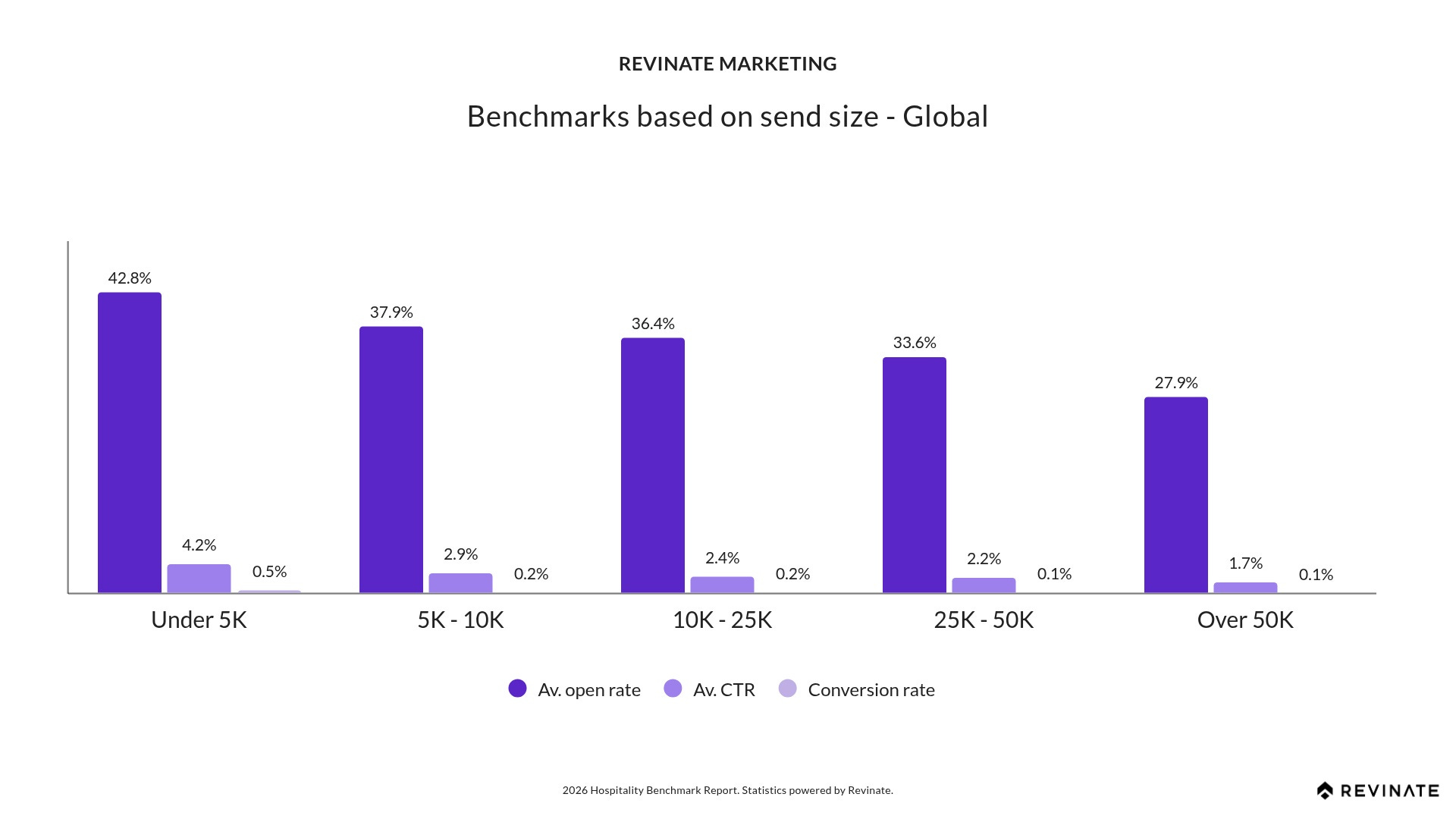
The industry is moving away from unsegmented promotional blasts to massive contact lists. Mass blasts to lists of over 50,000 contacts suffer from abysmal engagement. They average just a 0.06% conversion rate while driving up spam complaints.
Relying on these reactive, discount-heavy blasts triggers a self-defeating operational loop. It erodes cash margins. It trains guests to wait for price drops rather than booking at full value.
Operators should instead cap list segments at under 5,000 contacts. Segmenting your database achieves 8x to 10x higher conversion rates.
Your strategic focus must move to automated behavioural workflows: booking abandonment, post-dining welcome sequences, and pre-arrival operational briefs. These sequences account for only 5.3% of send volume, yet they generate nearly 41% of total email revenue.
Major mailbox providers like Google and Yahoo have implemented non-negotiable technical requirements and compliance thresholds for all bulk senders. To protect inboxes from spam and synthetic manipulation, AI filters actively detect automated warm-up services that exchange bot emails.
Providers like Google and Microsoft now issue full tenant-level domain suspensions for using these synthetic rings. Cut them off immediately.
Additionally, providers enforce a strict maximum spam complaint threshold of 0.30% to protect user experience, though you must actively target below 0.10%. All senders must ensure full alignment of SPF, DKIM (using a minimum 1024-bit key, ideally 2048-bit), and DMARC authentication protocols. Furthermore, marketing platforms must implement RFC 8058 one-click unsubscribe headers, and operators are required to process all opt-out requests within two business days.
Ignore these baseline protocols, and you actively guarantee your marketing never reaches a hungry guest.
When up to 60% of your recorded email clicks originate from automated corporate firewalls rather than hungry humans, your dashboard is lying to you. Upgrade to VIP to isolate genuine diner engagement from server-side security bots and reclaim your true conversion baseline.

🗑️ AI Slop & The Inbox Sieves
The fundamental relationship between email senders and inbox providers has fractured. Major tech platforms are deploying aggressive artificial intelligence filters. These act as an inbox sieve designed to brutally cull promotional noise and protect user attention.
The platforms’ ultimate financial incentive is to keep users engaged on their own systems. They want to serve ads or retain device loyalty. Any external marketing that causes user fatigue is actively suppressed.
Traditional hospitality marketing habits now directly clash with these algorithmic gatekeepers. Relying on heavy HTML templates and verbose, polished sales copy results in immediate technical and commercial penalties.
Inbox sieves fundamentally alter how messages are processed and displayed. Apple Intelligence operates locally on-device. It actively overwrites a marketer’s carefully crafted custom preview text with an automated, one-to-two sentence summary of the message’s core intent.
Apple also features a Priority Stack. This system prioritises urgent items, such as direct requests or same-day cancellations, while burying standard promotional noise.
Conversely, Google’s Gemini in Gmail evaluates the actual semantic intent of a message on its cloud servers. It hunts for explicit action items, deadlines, and deliverables rather than just scanning keywords and sender metadata.
If critical offers or calls-to-action are buried deep within a newsletter, these AI summaries miss the core hook entirely. The email remains stranded in the Promotions tab or gets summarised into a dismissive blurb.
This algorithmic gatekeeping is severely compounded by the AI Slop problem. In response to the demand for consistent content, marketers are increasingly generating lazy, automated copy. They churn out generic phrasing like “nestled in” or “indulge in our exquisite offerings”.
This creates an absurd “AI-to-AI” friction loop. Senders use an AI model to inflate a short thought into a massive, multi-paragraph memo. The recipient then uses Apple Intelligence or Gemini to compress it back down to a single sentence.
Furthermore, AI spam filters easily detect the mathematical symmetry and uniform sentence lengths of this generated text. This has caused open rates for some senders to collapse from 35% down to 8%.
Look, the consumer backlash to this synthetic digital filler is measurable and severe. Audiences now suffer from intellectual banner blindness. They instinctively tune out generic AI tones before they even process the message.
Consequently, 43% of consumers state they are less likely to purchase from brands they perceive as over-relying on AI-generated content. A further 33% report it actively damages their perception of the brand.
This deep fatigue from being sold to by a machine is driving audiences away from open email channels entirely. They are moving into private group chats and gated communities to seek out authentic, human recommendations.

Are inbox sieves summarising your brand into white noise?
Apple Intelligence and Google Gemini now rewrite your subject lines and discard promotional prose before a human ever reads them. In this week’s VIP intelligence briefing, we break down the semantic structures required to bypass automated inbox filters and land squarely in front of high-spending guests.
Unlock the VIP Briefing: Master Deliverability & Inbox Algorithms
🚨 Breaking the Destructive Panic-Sending Cycle
When management panics and deploys unsegmented, discount-heavy email blasts to force instant cash flow, it sparks a four-stage death spiral:
The Panic Blast: A sudden, desperate drop offering deep cuts with zero narrative context.
Subscriber Burn: Unsubscribes and spam flags spike. Diners only hear from you when you are begging for trade.
Radio Silence.
Audience Atrophy & Deliverability Decay: Rattled by the unsubscribes, management cuts communications entirely for weeks. The list goes cold. Inbox algorithms (Google, Yahoo, Apple) immediately downgrade your domain reputation for erratic volume spikes.
When covers slump again, the cycle restarts with a damaged, half-dead list, resetting the customer’s psychological price anchor, training guests to hold out for last-minute deals while attracting transactional bargain hunters who rarely spend on high-margin ancillaries.
Behind the scenes, these erratic blasts trigger spam complaints that easily exceed the strict 0.30% maximum ceiling, causing inbox providers to throttle sending speeds or route future operational emails straight to spam folders.
Ultimately, the panic cycle delivers almost no return. Unsegmented mass promotional blasts achieve a dismal conversion rate of just 0.06% and a verified return-visit rate of only 0.27%, generating a meagre $80 in attributed revenue per 1,000 emails sent. By contrast, trusting the psychology of targeted, automated behavioural workflows generates 41% of total email revenue from just 5.3% of send volume. This strategic approach delivers 18 to 109 times higher revenue per recipient than panic blasts.

🗓️ Inside This Week’s VIP Edition
🔪 Free subscribers get the ingredients.
👨🍳 VIP members get the recipe and method.
In this week’s VIP edition, I break down the strict sending volume thresholds, the financial calculation for Revenue Per Recipient (RPR), and the exact implementation checklist you need to safeguard your deliverability and automate your highest-converting workflows.
Stop treating your email database like an emergency cash dispenser when covers drop off. Mailbox algorithms reward human discipline, clean formatting, and consistent value. Protect your kitchen margins, speak directly to your guests, and let your desperate competitors race each other to the bottom.
Here’s to your success! 🥂

Dawn Gribble MIH MCIM
Hospitality Marketing Insight
P.S. When you eliminate synthetic copy and configure your sender reputation properly, your emails stop fighting algorithms and start filling tables.
Need our team to inspect your digital foundations directly? Schedule a consultation with DG Consulting or explore our full suite of strategic playbooks at the Hospitality Marketing Hub.
📚 Sources & Resources
2026 Hospitality Benchmark Report - Leadership Series, Apple Podcasts (2026)
Apple’s Mail Privacy Protection Is Here: What It Actually Means for Email Marketers and What to Do Now, Litmus (2021)
Bot or Not: Understanding Email Bot Clicks, Braze (2026)
Doubling Down on Restaurant Marketing Spend, Modern Restaurant Management (2026)
Email marketing benchmarks by Industry 2026, Klaviyo UK (2026)
Email sender guidelines, Gmail Help (2026)
Hospitality and Hotels—Email Marketing Benchmarks, Email Calculator (2026)
Shore, M., Are These Clicks for Real? The Rise of Bot Clicks and What Marketers Can Do About It, Validity (2026)
Team, M., 2025 Hotel email marketing strategy: Monthly tips for success, Revinate (2025)
Team, M., Email Channel—Global, Revinate (2026)
Wilson, W., Restaurant Email Marketing Benchmarks 2026 | Bloom, Bloom Intelligence (2026)
Yahoo Sender Hub, Yahoo (2026)