



Part of our VIP Monthly Strategic Update series
🌞 Hello and welcome to Hospitality Marketing Insight. I’m your host, Dawn Gribble, and this month we’re focusing on what actually affects visibility, conversion, and trust. Inbox filtering, agent-led bookings, zero-click summaries, and rising consumer verification behaviour are tightening the margin for error. Precision now matters more than volume.
Executive Summary
Gmail’s Personal Intelligence filtering is compressing campaigns before they are opened, complicating attribution and weakening generic segmentation. Agentic commerce now allows AI to complete bookings, including voice calls to venues, turning response time into a conversion variable. At the same time, zero-click AI Overviews are forming guest expectations before a website visit occurs.
Consumer behaviour reflects similar caution. Travellers are booking with clearer intent, diners are moderating spend, and verification-led creative is outperforming aspirational messaging.
📄 On the Menu
From Search to Action
Buyer Behaviour Update
Verification Marketing Guide
Creative Kitchen - expertly sourced ingredients for your marketing campaigns.
Platform Updates to Pay Attention To
Action Plan - what to do, what to stop and what to avoid.
PLUS April 2026 Social Media Planner
Let’s Check In ☕

➡️ From Search to Action
The marketing landscape has moved from “Search” to “Action.” It is no longer enough to drive traffic to your website. Your venue must be the most digestible option for an AI agent.
📩 Gmail’s AI Layer
Google’s integration of Gemini with personal data across Gmail and Photos creates a proactive marketing environment. With Personal Intelligence launched in January 2026, Gemini now summarises and prioritises inbox content.
If a user has Personal Intelligence enabled, Gemini generates a daily briefing or AI Inbox tab. Generic campaigns are compressed into a single line or moved into clutter summaries. The user reads the AI’s interpretation instead of your email. Gemini responds to behavioural patterns, not demographic assumptions.
If your buyer personas are more than 18 months old, you are marketing to ghosts.
📞 Voice, Schema, and the Booking Layer
With the launch of the Universal Commerce Protocol, AI agents can move from discovery to checkout without visiting a website. You must provide answer-ready data, including real-time inventory schema, so Gemini can confirm availability without scraping your site.
When structured data is missing, AI agents call the venue.
If the phone goes unanswered, you are effectively offline to the AI economy. AI agents timeout after approximately 30 seconds and move to the next option. Five rings to voicemail is not a missed call. It is a lost booking.
🛡️ Zero-Click Defensive Strategy
In 2025, over 13% of queries ended in an AI Overview. February 2026 data suggests that for high-intent travel searches, the zero-click rate is now closer to 80%.
That means many guests are forming a decision inside Google’s summary layer. They are not comparing five websites. They are reading one compressed answer and acting on it.
Your website may be cited. It may also be reduced.
To be discovered in this placement, you must practise Entity Linking through schema to demonstrate expertise. Connect Person and LocalBusiness schema to strengthen E-E-A-T signals and make authority explicit.
Google’s AI Mode prioritises structured, authoritative results.
Your content needs to be short, punchy, and highly scannable. An algorithm may summarise you in two sentences, so every line must carry weight. Think of it like a haiku, or cast your mind back to the original Twitter days when space forced clarity. You have limited room to make an impression. Write accordingly.
👥 Buyer Behaviour Update
Consumer behaviour in April is characterised by shoulder-season travel and value-driven dining, as economic pressures continue to shape discretionary spending.
The market is split between Everyday Value, price-sensitive routine visits, and Premium Experiences, infrequent but high-theatre, memorable occasions, with the middle ground becoming harder to sustain.
Within this polarisation, a cautious class is emerging: high-income earners who are becoming more deal-sensitive and planning fewer, more conservative trips. At the same time, mass-market luxury is showing signs of decline, as travellers who previously splurged are retreating to more value-oriented choices.
Consumer behaviour is increasingly driven by emotional gratification rather than rational functionality. Luxury brands have historically succeeded by providing emotional value through status, exclusivity, and storytelling, while budget brands have focused on functional value, price, location, and basic needs. The middle market has traditionally occupied a grey zone where neither value is fully realised.
Perception of value is moving from traditional ROI to Return on Experience, where higher prices are justified by perceived improvements in comfort, convenience, or emotional depth.
🌿 Shorter Trips, Deeper Meaning
Travellers are actively seeking out popular destinations during shoulder seasons to avoid overtourism and high peak-season prices, making April a key month for what is now termed “Off-Peak Tripping.”
Approximately 31% of travellers intend to visit popular locations only during shoulder periods like April, when crowds are lighter.
There is a continued rise in trips lasting four days or less, often extending public holidays with minimal annual leave to maximise travel time, with a 34% global increase in meaningful short trips, particularly among the 25–49 age demographic.
In 2026, the “Whycation Movement“ sees travel planning begin with a motivation to reconnect, recharge, or discover, rather than just a destination.
Within this sits the emerging trend of Hushpitality. Guests are actively seeking quiet, restorative environments as a new status symbol.
🍽️ Selective Spending at the Table
Diners in early 2026 are highly selective, with “meaningful value” becoming the primary driver for venue choice as structural costs for restaurants remain high.
Due to rising household bills, approximately 46% of consumers intend to reduce the frequency of eating out. To save money, 29% seek out special discounts or offers, while others reduce spending on alcohol, 17%, during their visits.
A growing segment of Gen Z and Millennial diners, 13%, now treat post-9 PM meals as a social ritual rather than a snack, frequently pairing them with non-alcoholic beverage options. This behaviour is likely to strengthen as we move into warmer months, when extended daylight, terrace culture, and lighter drinking patterns encourage later, socially driven dining occasions.
🗓️ April Marketing Dates That Drive Demand
April 1: April Fools’ Day / National Sourdough Bread Day
April 2: National Burrito Day / National Peanut Butter and Jelly Day
April 3: Good Friday / National Chocolate Mousse Day
April 4: National Vitamin C Day / International Carrot Day
April 5: Easter Sunday / National Deep Dish Pizza Day
April 6: Easter Monday / National Carbonara Day
April 7: World Health Day / National Beer Day
April 8: Zoo Lovers Day
April 9: National Gin and Tonic Day
April 10: National Siblings Day / Cinnamon Crescent Day
April 11: National Pet Day / National Cheese Fondue Day
April 12: National Grilled Cheese Sandwich Day
April 13: Peach Cobbler Day
April 14: Pecan Day
April 15: National Glazed Ham Day
April 16: National Eggs Benedict Day
April 17: National Cheeseball Day
April 19: National Garlic Day
April 20: National Cold Brew Day
April 21: National Tea Day
April 22: Earth Day / National Jelly Bean Day
April 23: World Book Day / National Picnic Day
April 24: National Pigs-in-Blanket Day
April 25: National Zucchini Bread Day
April 26: National Pretzel Day
April 27: National Prime Rib Day
April 28: National Blueberry Pie Day
April 29: Stop Food Waste Day
April 30: National Bubble Tea Day
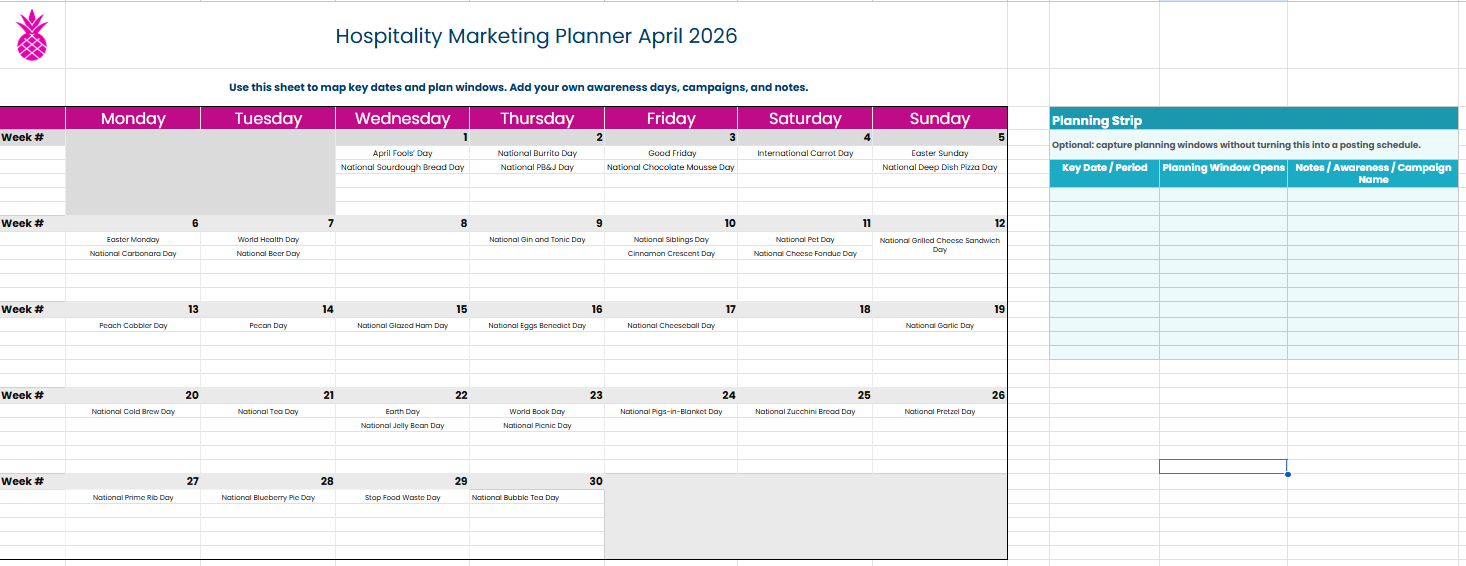
Upgrade to VIP today for the April 2026 VIP Planner and get immediate access to a structured monthly action plan, pre-analysed trend research, and campaign guidance you can implement straight away.
PLUS as a VIP, you gain access to 100+ hospitality marketing resources, exclusive reports, playbooks and priority Q&A support.
