


While not as heavily advertised as Mother’s Day, Father’s Day remains a significant demand-capture opportunity for hotels, restaurants, and foodservice.
Interest is there, but it turns into last-minute bookings, smaller groups, and lower revenue per table.
Father’s Day bookings are concentrated, not evenly distributed. Some venues secure high-value tables early. Others rely on late, lower-spend bookings or miss out entirely. The difference comes down to how well operators understand buyer behaviour, timing, and decision pressure.
This matters commercially because Father’s Day is moving toward fewer bookings at higher spend. If you are not set up to guide decisions quickly and clearly, you lose both the booking and the margin.
By the end of this article, you will understand where Father’s Day bookings start, what drives spend, and where demand is being lost before it converts.
📄 On the Menu
🏨 Why Father’s Day Bookings Are Shifting Toward Higher-Value Dining Experiences
👨👧👦 What People Actually Want on Father’s Day — and How That Drives Spend
📍 Where Father’s Day Bookings Actually Start (and Why They Stall Before Conversion)
📉 How Poor Targeting Lowers Father’s Day Restaurant Bookings
💔 How Insensitive Father’s Day Campaigns Affect Customer Response and Retention
⏰ How Last-Minute Decision-Making Drives Father’s Day Demand
Let’s Check In ☕

🗞️ Hospitality Marketing - Grab & Go Brief
What changes for operators, marketers, and managers
For Operators
Father’s Day demand is concentrating on fewer bookings at higher spend. Revenue varies based on how effectively demand converts into group occasions and premium tables. The gap between venues comes from how demand is captured, not how much exists.
For Marketers
Discovery begins early, but booking decisions happen close to the date. Visibility does not translate evenly into bookings. Buyers are often planning on behalf of others, which affects how decisions are made and what information is required before committing.
For Managers
Bookings are made under time pressure, often with incomplete information. Guests look for clarity before confirming. Variations in communication, booking flow, and expectation-setting affect whether demand converts into confirmed covers.
🏨 Why Father’s Day Bookings Are Shifting Toward Higher-Value Dining Experiences
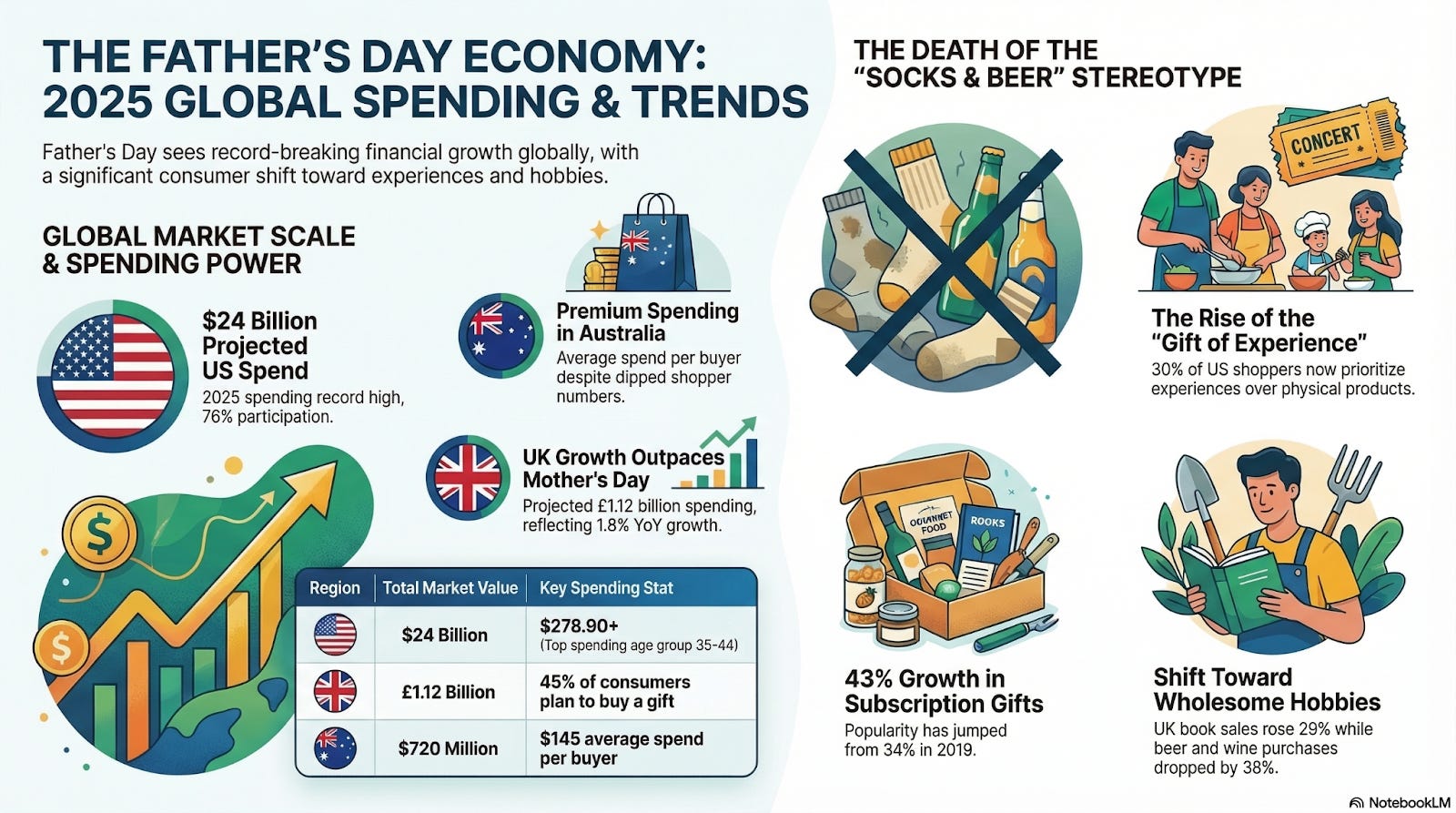
In the United States, Father’s Day is a major and growing commercial moment, with 2025 spending reaching a record-breaking $24 billion. Approximately 76% of consumers plan to celebrate the holiday in 2026.
The average expected spend per person in 2025 was $199.38, up nearly $10 on the previous year. The highest-spending demographic is consumers aged 35 to 44, who plan to spend between $278.90 and $289.90 on average.
Within the U.S. market, “special outings” such as dining, experiences, or activities represent the largest single spending category, accounting for $4.8 billion alone.
In the United Kingdom, Father’s Day spending reached £1.12 billion in 2025. This reflects 1.8% year-on-year growth, outpacing Mother’s Day for the first time. Despite this increase in total spend, only 45% of UK consumers intend to purchase a physical gift.
In Australia, the Father’s Day market is valued at $720 million, driven by an estimated 4.7 million shoppers. While overall participation has declined slightly, the average spend per buyer has increased by 44% to $145, indicating a shift towards fewer, higher-value purchases.
Across all three markets, the pattern is consistent: fewer people are buying, but those who do are spending more, increasingly prioritising higher-value and experience-led purchases.
👨👧👦 What People Actually Want on Father’s Day — and How That Drives Spend
People are not buying gifts. They are trying to get the day right.
Shared experiences are outperforming individual physical gifts because consumers are increasingly driven by the desire to foster emotional connections and create lasting memories, rather than simply exchanging goods.
Emotional drivers play a major role in purchasing decisions, with 37% of consumers explicitly stating they want a gift that creates a special memory.
Gift preferences have shifted away from traditional, stereotypical items such as gift-wrapped socks, cufflinks, and beer.
There is growing momentum towards experiential gifts and subscriptions. In the U.S., 30% of shoppers plan to give a “gift of experience”, up from 23% in 2019. Similarly, 43% plan to gift a subscription box, a significant increase from 34% in 2019.
In the UK, sales data reveal a 38% drop in beer and wine purchases leading up to Father’s Day, while hobby-related gifts have surged, with book purchases increasing by 29% and golfing goods by 14%.
Around 65% of people say spending time together matters more than gifts.
“Special outings”, such as a restaurant meal or an activity, now capture the largest single market share, totalling $4.8 billion in the U.S. alone.
Pure “gifts of experience”, such as concert tickets or event passes, continue to gain traction. In 2025, 30% of shoppers gifted an experience, up from 23% in 2019.
In Australia, experiences are directly competing with physical products for wallet share, with 28% of consumers choosing to celebrate by sharing a meal at a café, restaurant, or at home.
However, there is a notable mismatch between what fathers want and what they actually receive. Despite a stated preference for experiences or new tech, the most common gift purchased remains alcohol. While traditional “boozy” presents are declining in favour of hobbies and experiences, alcohol still dominates as the default choice.
But what really drives revenue is shared experiences:
Set-menu lunches or BBQ specials
Whisky, steak, or craft beer pairings
Father-child experiences, e.g. cooking classes, grill sessions
Brewery or distillery collaborations
“Dad eats complimentary” mechanics when a table books for X people
These create group bookings and higher average spend, which standard gift marketing misses.

📍 Where Father’s Day Bookings Actually Start (and Why They Stall Before Conversion)
Father’s Day follows a compressed and reactive buyer journey, where discovery, decision-making, and purchase happen in a tightly condensed window.
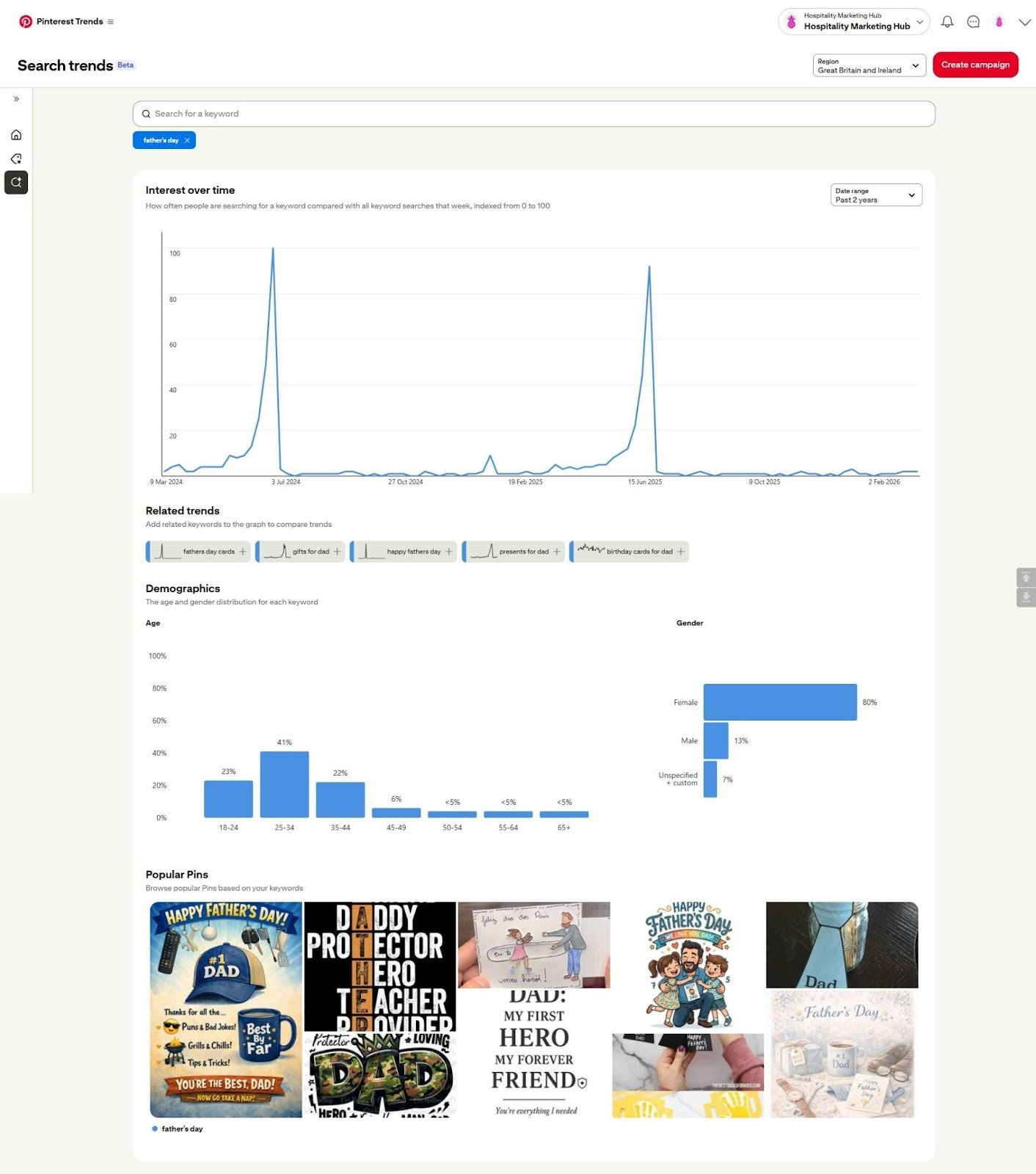
The optimal time for brands to launch a Father’s Day campaign is three to four weeks before the holiday. This early window provides the necessary time to raise awareness, guide early shoppers, and build in adequate shipping times.
Because Father’s Day dates vary globally — falling on the third Sunday of June in the US and UK, but in September in Australia and November in Nordic countries — brands must adjust their timelines by country to activate on the correct local dates.
During the discovery phase, brands should encourage early purchases through pre-sales or payment plans, which helps budget-conscious consumers spread out their spending.
Finding the right gift requires heavy guidance, as 20% of consumers still do not know what they will buy just two weeks ahead of the holiday. To intercept these searches and overcome buyer indecision, brands are deploying gamified logic quizzes and interactive gift paths on their website landing pages, while using email, paid social media, in-app messages, and pop-ups to drive traffic there.
📉 How Poor Targeting Lowers Father’s Day Restaurant Bookings
Marketers often target the wrong person during Father’s Day. The buyer is rarely the father himself; it is the partner, child, or family member organising the experience.
In Australia alone, an estimated 1.9 million people are shopping for someone other than their biological father.
Consumers are purchasing Father’s Day experiences for:
Husbands 25%
Sons 12%
Brothers 9%
Friends 8%
Grandfathers 6%
Instead of marketing to “Dad”, brands should focus on the person planning the day, helping them choose, justify, and deliver the right experience.
One of the most common mistakes is treating “Dad” as a single stereotype. Family structures are highly diverse, and brands that rely on a narrow, outdated version of fatherhood miss a significant share of demand.
This requires a broader and more inclusive approach to targeting and messaging. Stepdads, grandfathers, partners, and “chosen” father figures should all be reflected in how the occasion is positioned.
Many campaigns still rely on outdated stereotypes rather than actual consumer behaviour, using generic, gendered shorthand that fails to reflect how people celebrate today.
To maximise effectiveness, brands should segment their audience based on relationship dynamics and intent, and test messaging that speaks to different types of father figures and buying scenarios.
Brands that continue to rely on a single version of “Dad” are not just simplifying the audience; they are missing demand.
💔 How Insensitive Father’s Day Campaigns Affect Customer Response and Retention
Some marketers blast their entire subscriber list with Father’s Day promotions, failing to recognise that the holiday can be deeply triggering due to childhood bereavement or estranged relationships.
When brands are insensitive to these realities, the backlash can be severe.
Jawbone’s panic-inducing “Re: Your Dad” email is a clear example. In an attempt to drive Father’s Day sales, the wearable technology company sent a promotional email to thousands of subscribers using the highly casual and attention-grabbing subject line: “Re: Your Dad”.
While intended to be a clever marketing hook, the campaign immediately backfired. For recipients whose fathers had passed away, were estranged, or were in poor health, the email triggered severe distress.
One recipient whose father had died five years prior reported that the subject line caused a panic attack, while thousands of others took to social media to express anger at the insensitive message.
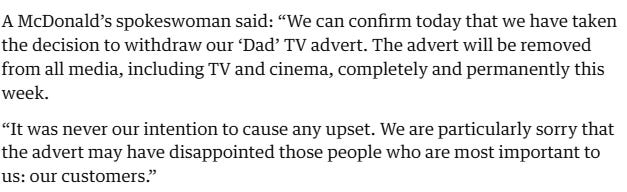
Another example comes from McDonald’s, which was forced to pull a television advert after viewers and bereavement charities accused the brand of exploiting childhood grief to sell sandwiches.
In 2017, McDonald’s released a television advert featuring a young boy asking his mother about his deceased father. The boy appears sad because he seemingly has little in common with his dad, but his face lights up when he eats a Filet-O-Fish, and his mother reveals it was his father’s favourite meal.
The campaign sparked immediate outrage, with bereavement charities accusing the brand of exploiting grief to sell sandwiches..
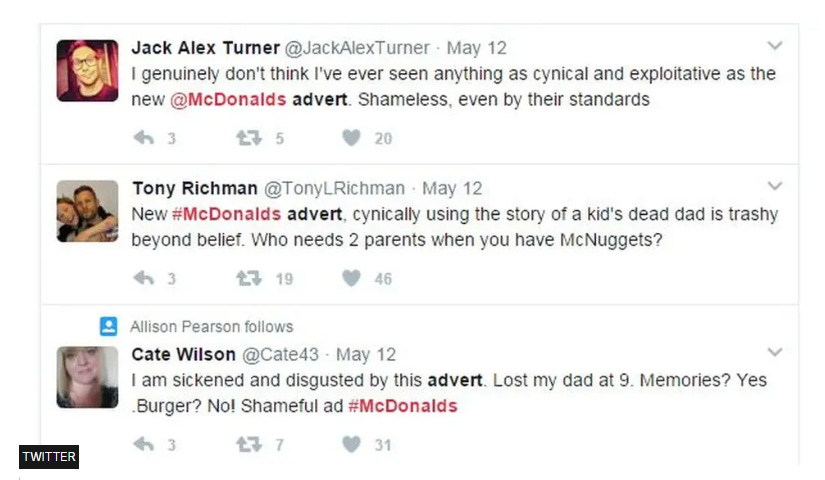
The UK’s Advertising Standards Authority received over 100 complaints from viewers who found it highly insensitive to use bereavement as a sales tactic, particularly given the advert’s proximity to Father’s Day.
Due to the backlash, McDonald’s withdrew the advert and issued a public apology.
Without empathy, even well-intentioned campaigns can cause harm and damage brand trust at scale.
⏰ How Last-Minute Decision-Making Drives Father’s Day Demand
Father’s Day is not a gifting moment. It is a last-minute decision on where to go, what to book, and how to get it right.
Decisions are made late, often within days, under emotional pressure, with a strong fear of getting it wrong. In that moment, buyers default to what feels easiest, safest, and most certain. Many are still undecided weeks out, actively searching for guidance and reassurance before committing.
They are not buying for themselves. They are trying to get the day right for someone else, often across a wide range of father figures, from partners and husbands to grandfathers and chosen family.
This is where bookings are lost. Offers, menus, and products are promoted, while the buyer is trying to secure a plan that feels thoughtful, appropriate, and worth the spend.
What drives spending is not the product itself, but the experience around it. Shared occasions, set menus, and group-led experiences outperform standard offers because they remove uncertainty and make the decision feel complete.
If the experience does not support a quick, confident decision, the booking moves elsewhere.
This is where demand is captured, and where margin is won or lost.
📅 Coming Up in this week’s VIP Edition
How to turn Father’s Day demand into higher-margin bookings through better experience design, pricing, and messaging.
Memory-Driven Marketing — design moments that increase perceived value and spend
Revenue Design for Father’s Day — structure menus, upgrades, and group offers to lift spend per table.
Father’s Day Messaging Strategy — guide faster decisions and reduce hesitation at the point of booking
Paid readers see where late-stage demand is being lost before booking and how to capture it at higher spend.
Plus access to 100+ tools, reports, and playbooks used by senior operators worldwide to improve bookings, spend, and campaign performance.

That’s it for this edition. I hope you’ve enjoyed the newsletter. I look forward to serving you again soon.
All the best
Dawn Gribble MIH MCIM
Hospitality Marketing Insight
Here’s to Your Success 🥂

📚 Sources
cncrndmm, Random Thought regarding Father’s Day and those opt-out emails, Reddit (2023)
Consumers More Inspired to Buy if Brands Let People Opt Out of Holiday Emails, Business Wire (2022)
Father’s Day gift guide: What dads really want to receive, The Independent (2025)
Father’s Day hits record sales high, Salon (2025)
Fewer Shoppers, Bigger Splurges: What Father’s Day 2025 Means for Brands, Truly Deeply (2025)
Hajjar, G., Father’s Day Spending to Reach Record-breaking $24 Billion, The Food Institute (2025)
Hobby-focused gifts dominate UK spending for Father’s Day 2025, Retail Rewired (2025)
McDonald’s pulls ad that ‘exploited child bereavement’, The Guardian (2017)
NRF, Father’s Day Spending to Reach Record $24 Billion, NRF (2025)
Pinterest, Pinterest, Pinterest (2026)
Study: 64% celebrate Father’s Day, but few influenced by social media, Marketing-Interactive (2025)
The Pinterest Men Trend Report: How Gen Z and Millennial men are redefining masculinity through style, substance, and self-care, Pinterest (2026)
The state of inclusive marketing in 2025, HubSpot (2025)
Trisha, Tech company sends harmless Father’s Day message, turns out to be its biggest mistake ever, India TV News (2016)
Ward, G., Father’s Day spending to rise in 2025—But retailers must step up, Boutique Magazine (2025)
World, S. S., Zeppole: An Italian Father’s Day Tradition, Sweet Savory World (2026)
When we shifted our restaurant concept from a breakfast/brunch concept to a craft bbq concept, our peak demand day shifted from Mother’s Day to Father’s Day. Father’s Day is a huge opportunity for hospitality brands and most marketers get it wrong sure. Great insights.
People aren’t really buying a meal, they’re trying to get the day right. That’s where places lose it. They focus on menus and offers while the person booking is under pressure to get it right for someone else. People don’t want more options. They want something that feels like a safe, complete plan. If that’s not clear right away, they move on.