



If your property does not appear in AI-generated answers, you are excluded before a guest reaches the booking stage. AI now handles discovery, comparison, and recommendation in a single step. This reduces the number of opportunities to influence choice later in the journey.
The commercial impact is immediate. When AI cannot interpret your data, your business is not considered. This reduces direct bookings, increases reliance on paid channels, and weakens margin control during key demand periods.
When tested in AI tools, properties with incomplete or inconsistent data are often excluded from answers. That reduces the number of times a guest considers your property and increases reliance on paid channels to recover demand.
This article explains how AI search affects buyer decisions, where visibility is being lost, and how to assess your current position. By the end, you will understand what information must be structured, how AI evaluates your property, and what to prioritise to protect bookings before the next planning window begins.
Plus exclusive prompts from our guest contributor Excellent AI Prompts
Each prompt is designed for immediate execution. Replace bracketed placeholders with your specific information, then copy-paste into your preferred AI tool (ChatGPT, Claude, Gemini).
📄 On the Menu
AI in 2025, What Really Changed
How AI Is Transforming the Guest Experience
2026 AI Outlook, What’s Next for Hospitality Marketing
Balancing Innovation and Integrity, Setting the New Guardrails
Let’s Check In ☕
👉 The full breakdown is best read online. Continue Reading Here
Before we get started, there are a few more acronyms that you’ll need to get familiar with. Here’s our helpful glossary
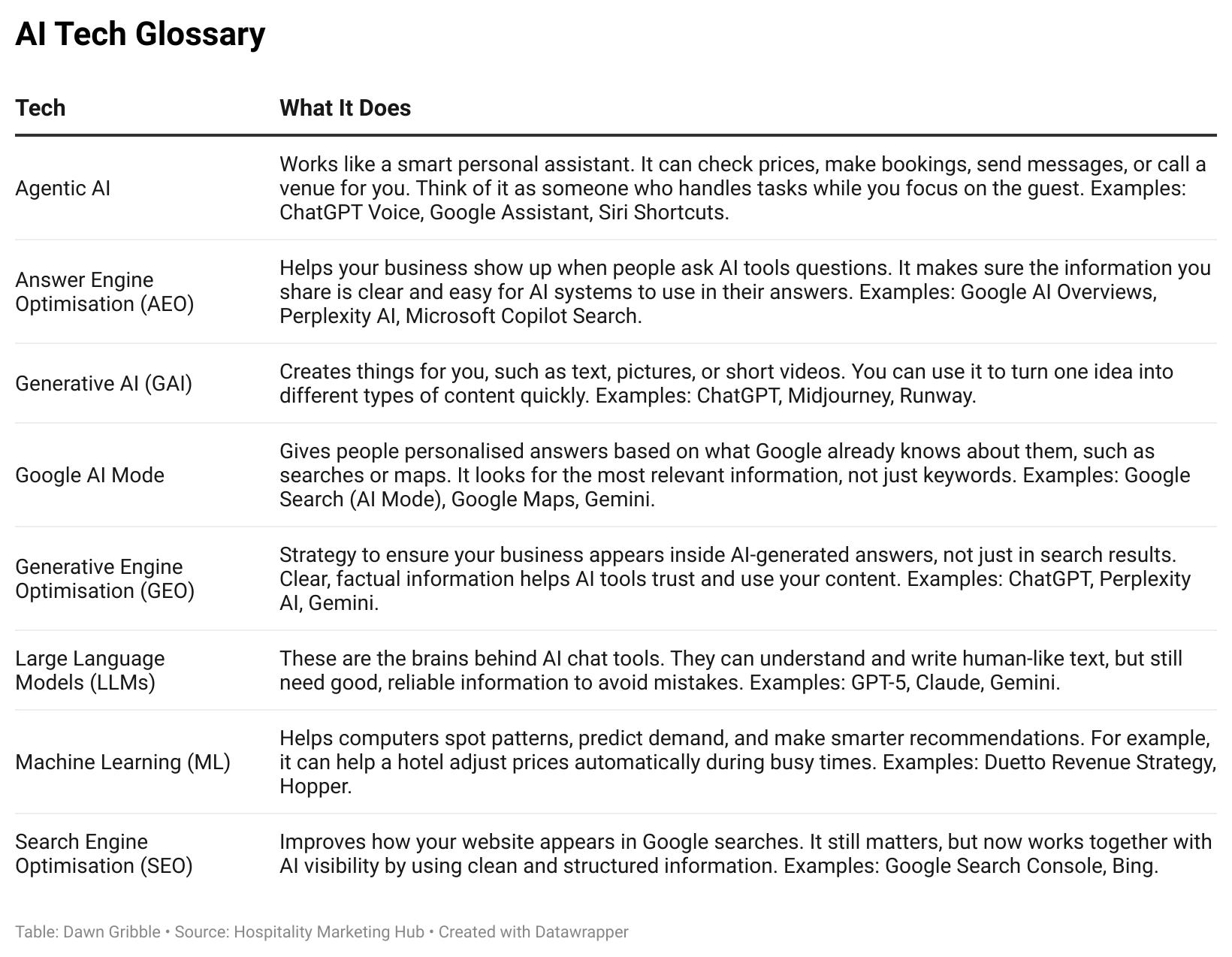
🤖 AI Search and the New Rules of Visibility
Visibility in 2026 will no longer be earned through keywords, but through clarity. The brands that structure their data best will own the answers AI delivers.
Visibility is moving from SEO to GEO and AEO. The key now is making sure your information is clear, up to date, and easy for AI to use.
AI systems now draw more authority from lived experience than from official sources. In 2025, Google AI cited Wikipedia in less than 1% of answers, instead favouring real guest opinions, reviews, and forum discussions. Authentic, up-to-date feedback has become the most influential factor in whether your business appears in AI-driven recommendations.
In 2025, social and hospitality platforms adopted Generative AI, reshaping content creation. Meta and WhatsApp launched AI-powered summaries, giving users more control. TikTok’s ‘AI Alive’ tool turns images into videos, making automated storytelling the standard for engagement.
YouTube expanded its Veo text-to-video system, with Veo 3 already in testing, and introduced SynthID watermarks to identify AI-created visuals.
Reddit has become a visibility engine in its own right, ranking as the second most cited domain in Google’s AI Mode. It appeared in 77% of product review searches, proving that authentic community discussion now shapes algorithmic authority. For marketers, this shift means visibility is earned through genuine conversation, not corporate content. However, it should be noted that Reddit is taking action against AI companies in a bid to stop them from scraping its data.
TripAdvisor joined Google AI’s top ten citation sources, while OpenTable launched its AI Concierge — a conversational assistant that uses menu and review data to answer diner questions instantly.
These changes mean your visibility now depends on whether AI can find, understand, and trust your data.
In practice, this appears when a guest asks for a recommendation and your property is not returned, while a competitor with clearer data is included. That is not a ranking issue. It is an inclusion issue, and it affects whether you enter the decision at all.
AI Readiness Assessment Prompt
Conduct a complete AI search visibility audit for my hospitality property.
PROPERTY DETAILS:
- Name: [property name]
- Type: [hotel/restaurant/venue/resort]
- Location: [city, region, country]
- Website: [URL]
- Target guest: [demographic/psychographic]
AUDIT AREAS:
1. Answer Engine Optimization (AEO) readiness
   - Schema markup completeness
   - Structured data quality and coverage
   - Factual vs. marketing language ratio
   - Machine-readable amenity details
2. Current AI visibility
   - Test in ChatGPT, Gemini, Perplexity for: “[location] [property type]”
   - Document where we appear, what’s cited, what’s missing
3. Competitive positioning
   - How competitors appear in AI answers
   - Data structure gaps vs. competitors
4. Visual search readiness
   - Image metadata quality
   - Alt text optimization
   - Visual indexing capability
5. Conversational commerce readiness
   - Booking flow machine-readability
   - Direct messaging capabilities
   - Agentic AI compatibility
OUTPUT REQUIREMENTS:
- Executive summary with visibility score (0-100)
- Prioritized action list (high/medium/low impact)
- Quick wins (under 2 hours implementation)
- 30/60/90 day roadmap
- Specific technical fixes with examples
- Competitive advantages to leverage
👉 Paid readers see where AI visibility is being lost, how data gaps affect inclusion, and what to prioritise before demand periods begin.
🏨 How AI Reshaped Hospitality Performance in 2025
The same changes affecting platforms are also changing business results in hospitality. AI is now a key driver of performance, not just a support tool.
Hotels are leading the structural change. Marriott has advanced its predictive pricing models to deliver hyper-personalised offers, while Hilton’s AI-enabled accessibility tools are setting a benchmark for inclusive guest experience. Boutique innovators such as citizenM are exploring real-time sentiment analysis to respond instantly to guest feedback, creating a feedback loop between emotion and service delivery.
Restaurants are bringing AI into the kitchen. Chipotle’s demand forecasting system now predicts prep volumes with high accuracy, reducing waste and boosting speed. Premium venues are experimenting with menu-level AI to align dishes with guest preferences and social trends, while independents are using AI-driven review analysis to monitor sentiment shifts daily.
Foodservice is where AI’s operational power is most visible. Compass Group and Sodexo are scaling pilots that use AI to analyse consumption patterns, guide menu planning, and improve sustainability metrics. Across contract catering, predictive systems are helping teams cut overproduction, refine sourcing, and manage costs with precision.
As we move into 2026, AI visibility and smart operations are coming together.
Brands that treat their data as a valuable resource, keeping it clean, organised, and ready for AI, will be the ones guests find first and remember.
🤝 How AI Is Transforming the Buyer Experience
The guest journey has collapsed from a chain of touchpoints into a single intelligent interaction. Where discovery once began on TikTok, moved through Instagram for vibe checks, then on to Google for reviews and a website for booking, AI now manages that entire process in one step. The search, the comparison, and the decision are increasingly handled by systems that predict what a guest wants before they even begin to look.
🔍 From SEO to AEO
The hospitality search environment has shifted from keyword ranking to structured response. AI search and AEO enable systems like Google AI Mode and Gemini to extract facts and context directly from multiple data sources. This process enables personalised, answer-level interactions that align with each guest’s intent, allowing for decision-making at scale through the precision of AEO and AI search.
Here’s how SEO and AEO compare:
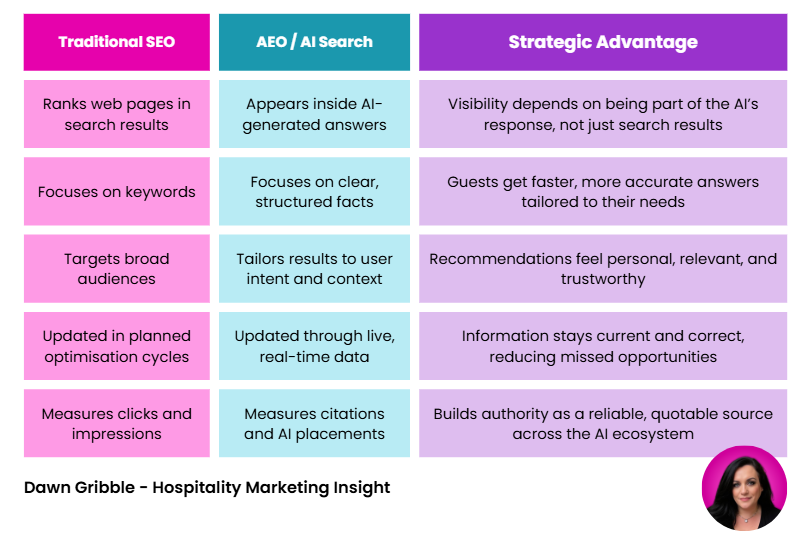
When your data is clean, structured, and machine-readable, AI systems can deliver results that reflect the exact needs of the buyer, from dietary preferences to accessibility and amenity availability.
The reward is both commercial and experiential: brands that provide structured, verifiable data experience stronger inclusion in AI-driven recommendations, leading to higher conversion rates, increased guest satisfaction, and direct bookings through AI channels.
Operators must have an AEO strategy in 2026
🖼️ Visual Search Adoption
In addition to answer engines, buyers are increasingly searching with images. Instead of typing “romantic restaurant in Kissimmee” or “accessible boutique hotel near the harbour,” users now scan a photo of a dish, cocktail, or room to identify where it is from, how much it costs, and whether it can be booked directly. AI then interprets visual data points, such as lighting, layout, décor, and even plating, to locate comparable experiences that align with user intent.
In 2025, the use of visual recognition tools like Google Lens increased sharply for travel and dining searches, processing 12 billion image searches per month and transforming how guests find venues.
If your venue isn’t visually legible, you’re already harder to find. This change highlights a transition from relying on keyword searches to using image-based intent mapping. In this approach, the accuracy, up-to-date visuals, and clarity of images play a crucial role in making content easier to find. High-quality, correctly tagged images now serve as both persuasion tools and machine evidence.
Today’s buyers are using Google Lens, Pinterest Lens, TikTok Vision Search, and in-platform tools like Instagram’s image match to find venues, menus, and experiences visually, not through text.
Visual search now serves as a proof layer for buyers, confirming whether what they see online matches reality. When photos are current, clearly labelled, and context-tagged, AI systems can confidently connect your property with the experiences guests are searching for (romantic, family-friendly, step-free, sustainable). This makes visual accuracy a direct driver of AI visibility.
Visual Search Optimisation Framework Prompt
Create a visual search optimization checklist for our property’s [100] images currently on our website and Google Business Profile.
For each image category (rooms, dining, exterior, amenities, accessibility features), specify:
- Required filename structure
- Alt text formula with examples
- EXIF data requirements
- Schema image object markup
- Seasonal update schedule
- AI-testable verification method
Output as a implementable spreadsheet template.
🙏This is the complimentary edition of Hospitality Marketing Insight, brought to you by Dawn Gribble, and made possible through the kind support of our VIP subscribers.
This week, we’re exploring how AI and digital strategy are reshaping guest discovery, marketing performance, and brand visibility across the hospitality industry - with special thanks to our guest contributor Excellent AI Prompts
Be sure to check out their newsletter!
Subscribe if you want to see how AI evaluates your property and why it may not be included in guest decisions.
Paid readers get a structured approach to improving visibility, reducing reliance on paid channels, and protecting margin.
Generative AI: What Hospitality Leaders Need to Know

“Generative AI has the potential to change the world in ways that we can’t even imagine. It has the power to create new ideas, products, and services that will make our lives easier, more productive, and more creative.”
🔮 2026 AI Outlook, What’s Next for Hospitality Marketing
Agentic AI marks the next stage in the development of generative systems. It goes beyond summarising information to completing multi-step tasks such as checking prices, confirming availability, and placing calls to businesses on behalf of users.
These systems now decide which brands to present, recommend, and transact with. Marketing content must provide the operational data that allows AI to act. If pricing, availability, or service details are incomplete or unstructured, the property will simply disappear from the buying journey.
This evolution is similar to the move from static brochure websites to interactive commerce platforms. Sites that are not machine-readable, or that hide key details behind design elements, will be excluded from AI-driven visibility.
In 2010, a website that could not process payments lost bookings; in 2026, a site an AI cannot interpret will lose placement in search and booking flows.
For marketing teams, optimisation now means making data usable by machines. Every piece of marketing information—menus, rates, amenities, images, and policies—must be structured for AI comprehension. Businesses that meet this standard will not only appear in AI answers but also become preferred choices within AI action plans, driving direct conversions without a click.
Agentic AI Compatibility Audit Prompt
Assess our booking system’s compatibility with agentic AI systems that will complete bookings on behalf of users.
CURRENT BOOKING SYSTEMS:
- Website booking: [platform/system]
- Phone reservations: [system/process]
- Email bookings: [system/process]
- Third-party platforms: [which ones]
AGENTIC AI REQUIREMENTS CHECKLIST:
**1. Machine-Readable Availability**
- Real-time availability API
- Structured pricing data
- Calendar integration quality
- Booking window clarity
**2. Transparent Pricing**
- Base rates clearly stated
- Additional fees itemized
- Total cost calculable
- Currency clearly specified
**3. Policy Clarity**
- Cancellation policy (machine-readable)
- Modification rules
- Deposit requirements
- Special request handling
**4. Verification Capability**
- Confirmation format (email/SMS)
- Booking reference system
- Modification authentication
- Receipt generation
**5. Functional Details for AI Execution**
- Can AI navigate booking form?
- Are required fields clearly marked?
- Is phone verification required? (AI blocker)
- Are CAPTCHA tests present? (AI blocker)
CURRENT COMPATIBILITY ASSESSMENT:
For each system, evaluate:
- Agentic AI can discover availability: YES/NO
- Agentic AI can interpret pricing: YES/NO
- Agentic AI can complete booking: YES/NO
- Agentic AI can modify booking: YES/NO
DELIVER:
- Compatibility score for each booking channel
- Identified blockers (technical obstacles for AI)
- Priority fixes to enable agentic bookings
- 30-day implementation roadmap
- Testing protocol for AI booking simulation
- Competitive advantage opportunities
⚖️ Balancing Innovation and Integrity
While AI has become indispensable to hospitality marketing, its rapid adoption brings new threats, including misinformation, loss of human touch, functional limitations, data security concerns, and ethical considerations.
Factual Control. All AI output must be verified, edited, and approved before release.
Emotional Balance. AI should remove friction, not warmth. Hospitality relies on human connection, so your tech must handle routine or repetitive tasks while staff focus on more complex queries and personalised care.
Recognising AI’s Limitations. Currently, AI cannot interpret nuance, emotion, or trust. Ensure that you humanise your copy if you’re using AI to generate it.
Data Privacy forms the structural backbone of every AI initiative. Sensitive guest information should never pass through public or free AI tools, nor should your marketing strategies.
Ethics underpin every deployment. Fairness requires removing bias, protecting identity, and ensuring compliance with the EU AI Act and GDPR.
Data Privacy & AI Processing Compliance Prompt
Create a data privacy compliance framework for AI use in hospitality marketing and operations.
CURRENT AI TOOLS IN USE:
[list all AI tools: ChatGPT, Claude, Gemini, Midjourney, etc.]
DATA TYPES WE PROCESS:
- Guest names
- Email addresses
- Phone numbers
- Booking history
- Preference data
- Payment information
- Accessibility needs
- Dietary requirements
- Review content (guest-written)
- Location data
- Device information
COMPLIANCE FRAMEWORK NEEDED:
**1. Data Classification:**
For each data type, specify:
- Sensitivity level (public, internal, confidential, restricted)
- Can this be processed in public AI tools? (YES/NO)
- What approved systems can process this? (list)
- Retention requirements
- Deletion triggers
**2. AI Tool Safety Matrix:**
For each AI tool we use:
- What data types are ALLOWED in this tool?
- What data types are PROHIBITED in this tool?
- Is data logged/retained by the tool provider?
- What privacy controls are available?
- Is this GDPR/CCPA compliant for our use case?
**3. Use Case Approval:**
Common scenarios - allowed or prohibited?
SCENARIO: Guest sends booking inquiry via email. Can we paste into ChatGPT to draft response?
ANSWER: [NO - contains PII. Use approved CRM system with AI integration instead]
SCENARIO: Guest review mentions their name. Can we use AI to draft response?
ANSWER: [YES if name removed first, or use privacy-compliant tool]
SCENARIO: Creating persona-based marketing. Can we use aggregated booking data?
ANSWER: [YES if properly anonymized and aggregated]
SCENARIO: Training staff with sample guest scenarios?
ANSWER: [Only with fully fictionalized data, never real guest information]
**4. Vendor Requirements:**
For any AI tool we consider:
- Data Processing Agreement required
- Privacy policy review
- Data residency requirements (EU, US, etc.)
- Breach notification obligations
- Right to deletion capability
- Audit rights
**5. Staff Training Requirements:**
All staff must know:
- What data never enters public AI tools
- When to seek approval
- How to anonymize/aggregate properly
- Incident reporting process
- Personal device policies
**6. Breach Response:**
If guest data is accidentally processed in unauthorized AI tool:
- Immediate action steps
- Who to notify (internal)
- When to notify guest
- When to notify authorities
- Documentation requirements
DELIVER:
- Data classification table
- AI tool safety matrix
- Use case decision tree
- Staff training module
- Policy document (1-2 pages, plain language)
- Quick reference wallet card for staff
- Quarterly compliance audit process
- Vendor assessment checklist
If AI cannot interpret your data, your property is excluded from guest decisions.
The VIP analysis shows how to measure answerability, identify gaps in visibility, and prioritise fixes that improve inclusion, conversion quality, and direct booking performance.
Paid subscribers get earlier insight into demand movement, buyer behaviour, and booking friction so decisions can be made with more confidence.
⭐️⭐️⭐️⭐️⭐️
That’s all for this week’s complimentary edition of Hospitality Marketing Insight.
Thank you for reading, sharing, and supporting an independent publication designed for hospitality professionals who seek practical, data-driven insights that drive growth and delight guests. See you next week in the VIP-Exclusive January 2026 Strategic Update.
All the best
Dawn Gribble MIH MCIM
Hospitality Marketing Insight
Here’s to Your Success 🥂
📅 Coming Up Next Time…
January Strategic Update
We’ll be exploring tactics and strategies to start the new year successfully, including key marketing dates for your diary and the latest expert insights.
Subscribe today so you never miss an issue 👇
📚 Sources
78% of travelers want to use AI in accommodation journey, PhocusWire (2025)
2026 Travel Trends: AI and Luxury Experiences Take Center Stage in EMEA, Hotel News Resource (2025)
AI in Search is driving more queries and higher quality clicks, Google (2025)
Blair, A., AI and the Art of Non-Linear Customer Experience, Retail TouchPoints (2024)
Francia, J., SEO Is Getting Torched, Marketing Insider (2025)
Goodwin, D., 1.5 million chats reveal who uses ChatGPT and why, Search Engine Land (2025)
Google Lens & Visual Search: The Next Big SEO Trend, LinkedIn (2025)
Guan, L.L., 76% of AI Overview Citations Pull From Top 10 Pages, SEO Blog by Ahrefs (2025)
How Marketers Are Planning to Use AI, Influencers and More in 2026, Social Media Today (2025)
Kitishian, D., Marriott’s AI Strategy: Analysis of Dominance in Lodging, Klover.ai (2025)
You're right. The guest doesn’t move through five tabs anymore. They ask one question and get one answer. If our information isn’t structured in a way a machine can interpret, we’re simply not included. That’s a very different visibility challenge than most operators are used to thinking about. Many need cleaner info. Defined amenities. Straightforward policies. Transparent pricing. AI rewards those who can be understood.
Excellent resource.