
Last night, your property missed an opportunity.
Whether you’re steering a 200-room hotel or a 50-cover high-street restaurant, we’ve all been conditioned to look backwards to judge our success.
We check yesterday’s EPOS reports, look at PMS data, tally up the covers, and if we’re holding steady against the local comp set, we breathe a sigh of relief and assume the marketing funnel is doing its job.
But let’s be honest: it’s a comforting lie. And in the current macro climate, it’s a lie that is becoming incredibly expensive to maintain.
That’s why for today’s briefing, I’ve teamed up with hotel portfolio and revenue strategist Mark Shemel. Together, we’re exposing where invisible revenue leaks are draining your bottom line and explaining exactly why your go-to data systems are lying to you.
📄 On the Menu
The Revenue Your Venue Is Leaving on the Table Every Night
Why Smart Operators Still Miss It
What Closing the Gap Actually Looks Like
Let’s Check In ☕

We are operating in a highly volatile landscape. Independent research shows that human-centric, high-intent consumer discovery happens weeks before a transaction engine ever registers a click. Yet, operators continue to pour inflated budgets into over-saturated ad networks.
Following the latest Google Marketing Live updates, digital advertising has moved toward automated, conversational AI ads—meaning broad targeting logic simply buys you more expensive inefficiency at a higher cost per click.
Compounding this is our dangerous reliance on third-party aggregators. While regulatory bodies like the Competition and Markets Authority (CMA) actively investigate dominant food service and booking marketplaces over review transparency, operators remain trapped in their ecosystems, systematically forfeiting 15% to 30% of their margins just to rent their own local customers.
When a room sits empty or a table remains unbooked, it isn’t a footfall or an occupancy problem. It is a visibility and discovery blind spot—a revenue leak that your standard reporting tools are fundamentally blind to tracking.
💰 The Revenue Your Venue Is Leaving on the Table Every Night
If 35% of your rooms sat empty last night, you didn’t just lose room revenue. You lost F&B, spa, parking, resort fees, and most importantly, a repeat customer. That’s not an occupancy problem. That’s a revenue leak, and most hotels have two of them. Across properties of every size, I’ve watched the same pattern repeat: the issue is not about not having enough visitors. The hotel just wasn’t found when the visitor was looking to make a reservation.
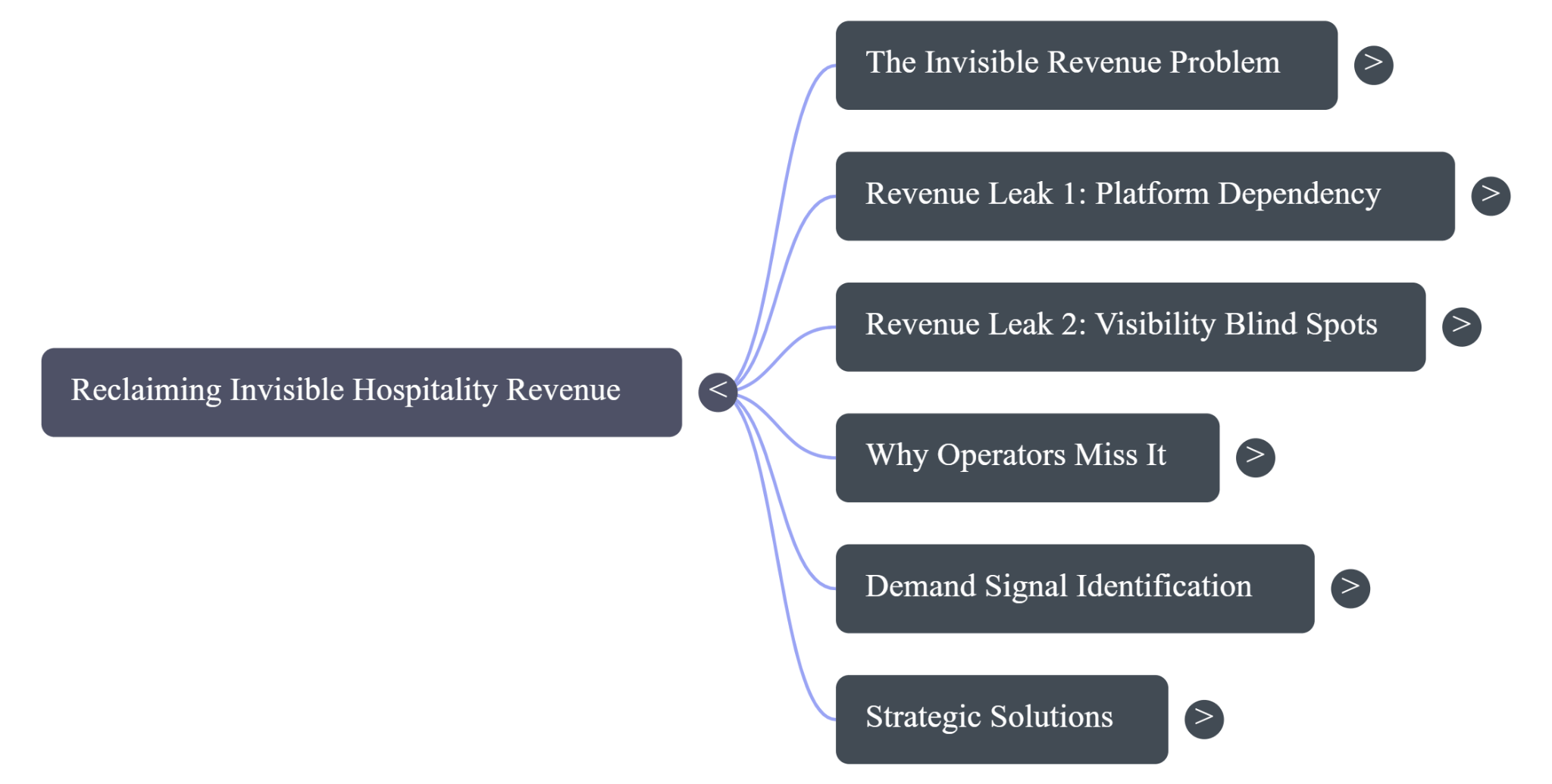
📱 Revenue Leak 1
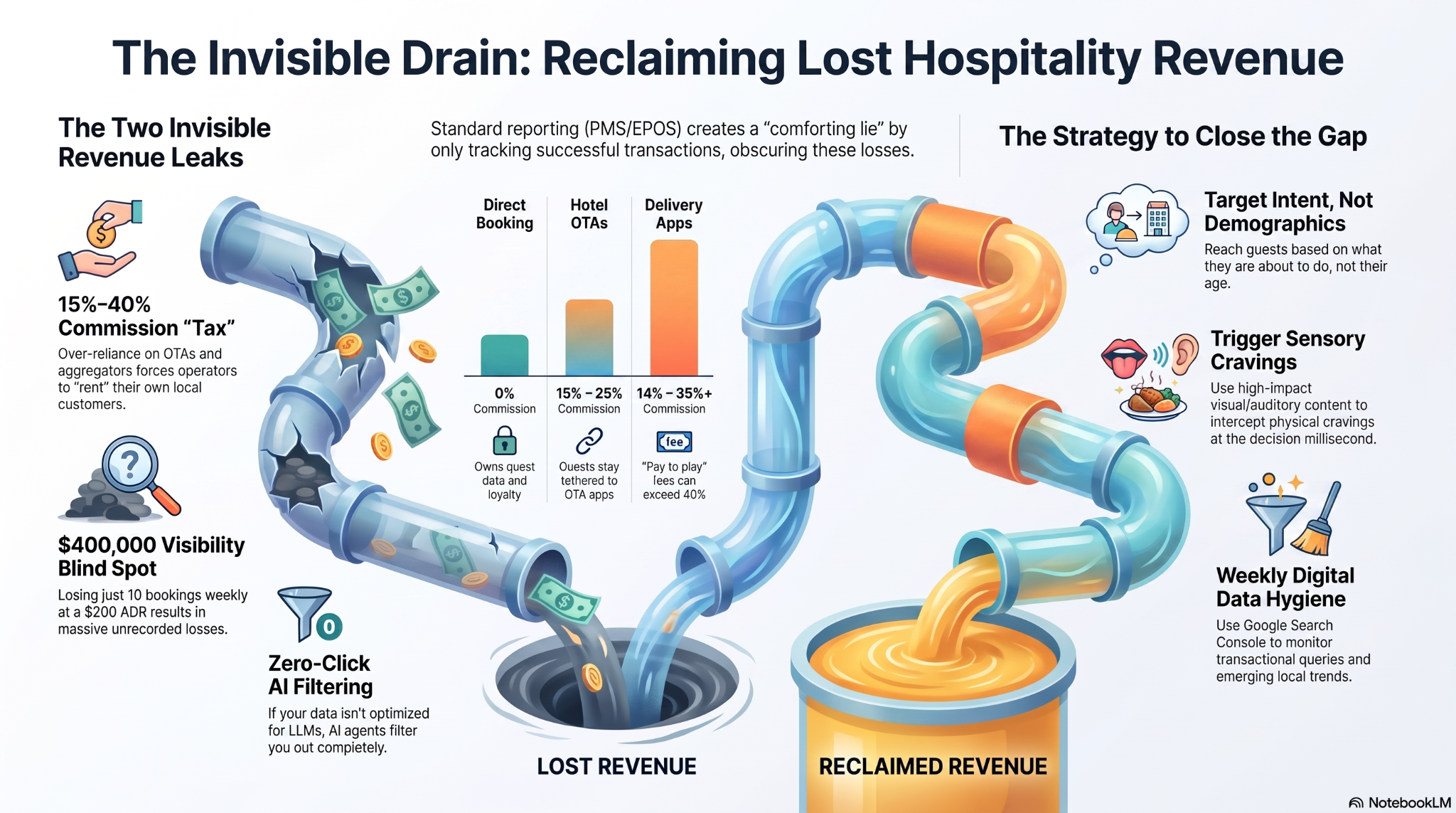
When a guest searches for a hotel in your market, discovers your property, and secures a booking, that sounds successful. However, if that reservation originated through Expedia or Booking.com, you have essentially forfeited 15% to 25% of that room rate in commissions. Beyond the immediate financial hit, that guest is now tethered to the OTA’s loyalty ecosystem rather than your own. When they return to your area, they will likely return to that same app instead of visiting your website. Most hoteliers recognise this dilemma, yet OTAs continue to dominate by simply outspending properties on search visibility and rewards programs. This structural disadvantage is a reality that compounds over time, leaving even more money on the table.
High street operators face a parallel crisis, replace Expedia, Deliveroo, Uber Eats, or Just Eat, and independent kitchens face a standard 14% to 35% commission tax on every order. To survive this pressure, operators are forced into a price hike trap, inflating their digital delivery menus by 20% to 30% higher than in-venue prices just to subsidise the app.
The frustration has intensified as these aggregators pivot from order fulfillers into aggressive media advertising platforms. It is no longer enough to pay the base commission; operators must now “pay to play” via sponsored listings and in-app bid auctions just to maintain their visibility within a saturated feed. When stacked with mandatory platform promotions and processing fees, the true platform take-rate can escalate past 40%, completely severing the restaurant’s direct relationship with its data.
"Your PMS cannot track the guest who never arrived, and your STR data won’t provide insight on the opportunities you missed."
👻 Revenue Leak 2
This secondary leak is hard to spot, and makes it significantly more harmful to your bottom line. It occurs when a high-intent traveller, that is actively researching your specific market and property type within your booking window, never encounters your hotel at all. They don’t see it on an OTA, and not through direct search. They ultimately secure a reservation with a competitor simply because that property commanded the visibility you lacked.
If your property runs 200 rooms and loses even 10 bookings a week to this blind spot, at a $200 ADR, that’s $400,000 in annual revenue your PMS never recorded as lost. In my experience, this is frequently more costly than the OTA commission dilemma, and it remains unaddressed because it defies easy measurement. This does not even factor in lost out-of-room spend.
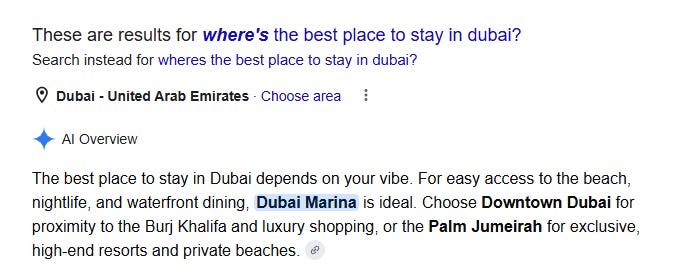
On the high street, this invisible drain is driven by the surge in the use of generative AI search engines. Think of a diner asking an AI agent to “find and book a table at the best steakhouse near me that has outdoor seating open at 8 PM.” Under 2026 conditions, the buyer journey has condensed into a rapid, one-step, zero-click transaction.
If your venue’s core database, menus, and inventory signals aren’t structurally optimised to feed these LLMs, your restaurant is completely filtered out of the response before the consumer ever sees you.
"Most booking engines can tell you who abandoned a booking. They cannot tell you who spent two weeks researching your market and never considered your property at all."
🧠 Why Smart Operators Still Miss It
Standard hotel reporting tells you what happened with the occupancy, ADR, and RevPAR. It doesn’t tell you about the traveller who was ready to book but chose a competitor. This visibility gap isn’t a result of poor management but is a limitation of the tools we use to judge our success.
That limitation is baked into how we benchmark. Hotels typically measure themselves against a local comp set, which seems logical until you realise that if every hotel in that set suffers from the same visibility blind spot, you’re all measuring against a floor, not a ceiling. Everyone looks fine on paper while the real opportunity goes untracked.
When I looked at the hotels in my own portfolio, it was clear how much demand existed in my markets that my properties simply weren’t intercepting. The discrepancy in data wasn’t due to poor reporting, but rather because we were focused on the wrong signals altogether. I often find that you cannot optimise for a potential guest you never even realised you missed.
This blind spot compounds on the high street because operators habitually fall into a reactive “copycat” loop. Restaurateurs look at their immediate local competitors, see them posting aimlessly on social media or running generic price promotions, and assume that is the benchmark for success.
As with hotels, if your entire local market is ignoring digital optimisation, copying each other simply means you are duplicating their inefficiencies. You look stable on paper compared to the venue down the road, while a massive pool of active local dining intent is systematically bypassed. You are optimising your business for a baseline of survival rather than capturing the actual demand available in your area.
📡 The Demand Signal Hotels Are Missing
Traveller intent is readable before the booking happens. Search behaviour, destination research, and content consumption are all signals that indicate that someone is in a planning or decision window. The traditional hotel marketing approach responds to demand after it’s already been expressed. The smarter approach identifies demand before it’s expressed and gets in front of it first.
Technology has advanced enough that we can stop marketing to who your guest is, and start reaching them based on what they’re about to do. While age and income brackets offer a baseline, they possess limited predictive power for actual booking intent. Behavioural signals tell you who is actually about to book. This methodology is already the gold standard in other industries, yet hospitality continues to lag behind in adopting it.
When I restructured the targeting logic across my properties, the question changed from “Who are our guests?” to “What demand are we not seeing?” That shift alone changed the quality of travellers we were reaching, and the conversion rates reflected it.
This is exactly where restaurant marketing often falls flat. Operators can waste thousands chasing demographic personas, targeting broad age groups, income brackets, or postcodes on Meta ads, hoping someone gets hungry. But demographic profiles don’t predict a dining decision; active behavioural intent signals do.
A consumer researching local weekend event schedules, checking train times into the city, or browsing specific culinary trends on TikTok is throwing off high-intent signals long before they type a restaurant name into a search bar. The traditional high-street model waits for the guest to express demand by searching for a specific venue or opening a delivery app.
⚙️ What Closing the Gap Actually Looks Like
The answer is not more ad spend. Hotels that increase their digital advertising budget without changing their targeting logic just get more of the same inefficiency at a higher cost. And it’s definitely not deeper discounting; that strategy attracts price-sensitive travellers, not high-value ones, and slowly trains your market to expect lower rates.
What actually moves the needle is identifying travellers who are already in a decision window for your market and your property type and reaching them through a direct channel before an OTA does. The conversion rate of that audience is fundamentally different from a broad-reach campaign because you’re not convincing someone to travel if they’ve already decided. You’re just making sure they find you before someone else does.
This is where the investment logic changes. It’s not about spending more; it’s about spending on the right traveller at the right moment. Over time, that precision compounds with more direct bookings, lower commission drag, and guests who actually belong to your ecosystem rather than OTAs.
Closing the gap for a restaurant requires a completely different execution model: you must pivot from broad visibility to micro-moments of intense emotional and sensory impact. You aren’t trying to convince someone to become a diner; you are intercepting a physical craving that is already forming. This is where savouring content becomes your primary conversion tool. It’s the visual and auditory trigger that breaks through the noise—the exact moment a knife pierces a perfectly baked pie crust, producing a distinct, audible crunch that triggers a feeling of physical relief.
To achieve this, you have to understand the specific emotional drivers of the individual tribes within your customer base and speak their language. A time-poor corporate worker looking for a frictionless lunch needs a different sensory trigger than a group of experiential foodies seeking a theatrical weekend dinner. When you align your content with these distinct psychological moods, your direct conversion metrics shift fundamentally. You stop wasting margin on broad discount campaigns and start capturing high-value guests at the exact millisecond their purchasing decision transitions from a thought to a physical craving.
🏆 The Hotel That Finds Its Guest First
Every night, a hotel closes its books; it records what happened. Far fewer operators are measuring what could have happened, and that gap is where the real revenue story lives.
Hotels have been optimised to track guests who arrived, not those who chose someone else. Until that changes, the revenue walks out the door every night without ever appearing in a report.
The operations and marketing teams that are thriving right now aren’t outspending their competitors. They stopped targeting broadly and started reaching travellers at the moment a decision was already forming. That precision changes the quality of guests in your building, reduces commission drag over time, and builds a direct relationship your comp set can’t see or replicate.
The hotel that wins isn’t always the one with the best product. It’s the one that found its guest first.
🍽️ Restaurant Visibility
Whether you are selling rooms or covers, broad demographic targeting is dead. Under 2026 conditions, your marketing must adapt to highly specific customer segments—and crucially, to their current psychological mood.
Closing this visibility gap does not require an inflated advertising budget. It requires using the data touchpoints you already control
Invest in Digital Data Hygiene: Maintain control over your direct booking pipelines, platform data structures, and local search metadata while staying compliant with GDPR standards.
Mine Real-Time Local Context: Spend targeted time monitoring local digital footprints. Track who tags your street location, check-ins, and neighbourhood landmarks to map your active local customer base.
Check Google Search Console Weekly: Open your Google Search Console one to two times a week to identify the exact transactional queries driving traffic to your site. Cross-reference these terms with Google Trends to spot emerging culinary or accommodation searches spiking in your specific area.
Demographic data only tells you who a guest is. For example, a student cramming for exams exhibits entirely different purchasing behaviour and basket spend than that same student celebrating a deadline with a group of friends. Mood dictates how they spend.

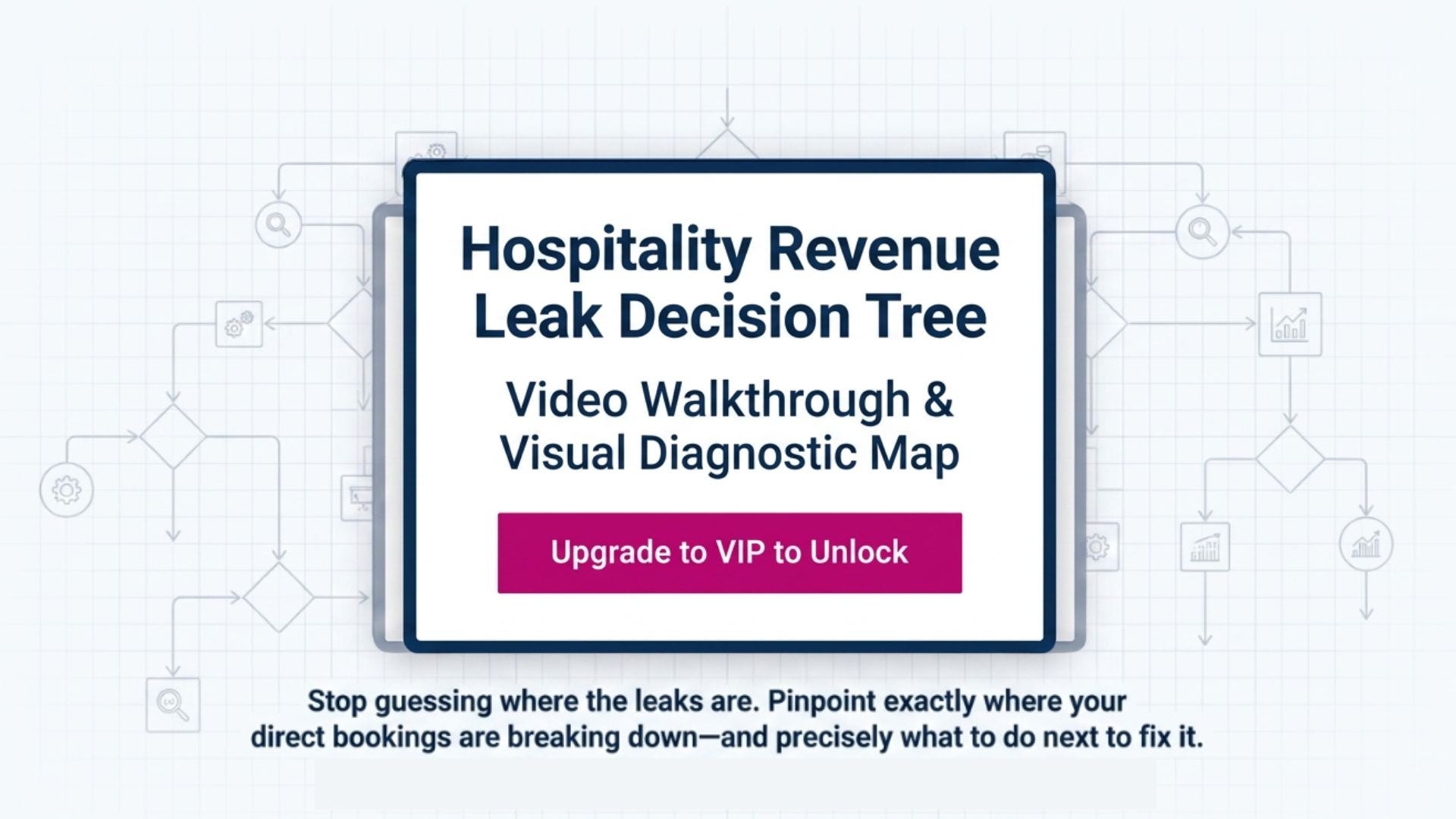
This Thursday, VIP members are getting the Hospitality Revenue Leak Decision Tree alongside an exclusive video walkthrough from me.
I’m breaking down this visual diagnostic map step-by-step so you can audit your business in real-time. Just follow the arrows based on your property’s current data signals, watch the video to see exactly where to find the numbers, and instantly pinpoint where your direct bookings are breaking down—and precisely what to do next to fix it.

My special thanks to Mark Shemel for guest writing today’s newsletter.

Mark Shemel is Co-Founder of Sail Tech and Chief Revenue Officer and Managing Partner of Think Hospitality. With a background in hotel operations, real estate portfolio management, and revenue optimisation, he helps hotels increase direct bookings, reduce OTA dependency, and implement data-driven strategies that maximise revenue.
That’s it for this edition. I hope you’ve enjoyed the newsletter. I look forward to serving you again soon.
All the best
Dawn Gribble MIH MCIM
Hospitality Marketing Insight
Here’s to Your Success 🥂