



What expectations are we setting? Do we deliver on our promises? And what happens if we break those promises?
🌞 Hello and welcome to Hospitality Marketing Insight. I’m your host, Dawn Gribble, and this week we’re looking at managing expectations. Have you seen this at your venue?
Guests are asking more questions, not fewer.
They double-check details.
They hedge.
They ask “what if” questions.
They probe for risk.
With more content, clearer messaging, and greater transparency than ever, guests should feel more certain. Instead, many teams are experiencing the opposite.
The issue isn’t that guests don’t understand. It’s that expectations have inflated faster than most businesses can comfortably deliver.
📄 On the Menu
The Commercial Power of Promises Kept
Pre-Arrival Expectations
The Cost of Broken Promises
Let’s Check In ☕

🤝 The Commercial Power of Promises Kept
Why is it so important to deliver on promises made?
Promises are not marketing language. They are operational commitments that guests test, consciously and unconsciously, at every stage of the experience.
McKinsey has repeatedly shown that organisations which optimise customer journeys deliver 5–10% revenue growth and 15–25% cost reductions within two to three years.
Businesses that consistently meet customer expectations outperform competitors on margin by more than 26%.
In the hospitality sector a 1% increase in customer satisfaction can drive a 5–10% increase in revenue, while a 1% uplift in perceived brand promise increases a guest’s intent to rebook by over 4.5%.
Those gains are the result of reliability, from promises made clearly and kept consistently.
Keeping promises also changes how guests evaluate price. When customers trust that a brand will reliably deliver on what it signals, perceived risk drops. As a result, price becomes less of a barrier. Guests are more willing to pay what is asked because they are not pricing in the possibility of disappointment. This reduces reliance on discounts, incentives, or reassurance-heavy selling to secure the booking.
Reliability also creates tolerance. Brands known for keeping their promises are given more latitude when something goes wrong. A service failure is more likely to be interpreted as an exception rather than evidence that the brand cannot be trusted. Guests are therefore significantly more willing to return after a disruption, because the underlying promise still feels intact.
Over time, this consistency compounds. When expectations are repeatedly confirmed, guests adjust their internal reference point to align with the brand’s promise. Satisfaction is no longer tied to novelty or surprise, but to dependability. This reinforces loyalty, increases lifetime value, and makes guests more accepting of gradual price increases without triggering resistance or churn.
Of course, there is a downside. When expectations are misaligned, the cost rarely appears as formal complaints. 91% of dissatisfied customers simply do not return.
The real cost is largely invisible. For every guest who complains, approximately 26 say nothing at all. There is no feedback loop, no opportunity to recover the relationship, and no signal that demand has quietly dropped away. From the operator’s perspective, bookings simply stop coming back.
This matters because replacement is expensive. Acquiring a new customer costs between 5 and 25 times more than retaining an existing one. When misaligned expectations drive silent churn, growth has to be bought back through marketing spend rather than sustained through repeat behaviour, undermining profitability over time.
There is also an operational cost. Misaligned expectations create expectation debt that is paid by frontline teams. Staff spend disproportionate time on reassurance, explanations, and service recovery, work that exists purely to close the gap between what was promised and what is being delivered. That time is diverted away from revenue-generating activity, directly increasing operating costs.
The risk does not end there. Dissatisfied guests are significantly more vocal than satisfied ones. While happy guests tell an average of five people, dissatisfied customers share their experience with ten to twenty others. One broken expectation therefore carries a multiplier effect, influencing far more future decisions than a positive experience ever does.
To see why this damage is so widespread and so quiet, we need to understand how expectations are formed before a guest ever arrives.
🧠 How Do Expectations Form?
Guest expectations are largely formed before arrival or before ordering, often well before a booking decision is made. They are not created in a single moment or channel. They are built cumulatively, through repeated exposure to marketing language, imagery, and platform summaries that shape what a customer believes is normal, reasonable, and likely to occur.
In hospitality, expectations are formed pre-arrival through three primary inputs: language (website copy, room descriptions, menu wording, review snippets), visuals (hero photography, room images, interiors shared on social media), and platforms (Google Business Profile, booking sites, and review platforms). These platforms create mental reference points that the guest later uses to judge whether the experience has met or fallen short of what was promised.
🗣️ Language
Language plays a central role in expectation formation because it defines how an experience is imagined, not just what is offered.
Research shows that wording which activates the senses creates stronger and more specific expectations than neutral description. Phrases such as “the room feels calm,” “the restaurant is lively,” or “the dish tastes rich” encourage the reader to mentally simulate the experience. This process happens automatically. The guest begins to imagine pace, atmosphere, quality, and effort level before they ever arrive.
The more precise the language, the narrower the expectation becomes.
For example, describing a room as “quiet and well-appointed” leaves room for interpretation. Calling it “soundproofed, west-facing, with blackout blinds and a rainfall shower” creates a much narrower expectation that must be delivered consistently.
Saying a restaurant offers “seasonal, relaxed dining” allows flexibility. Describing it as “a candlelit, intimate space with low lighting, small plates, and a calm atmosphere” fixes expectations around noise levels, pace, and social suitability.
Once language has shaped this mental picture, it becomes the benchmark. The guest does not assess the experience on its own terms, but against what they have already been led to expect.
🖼️ Visuals
Visual content reinforces and amplifies what language establishes.
Photography, video, and interior imagery do not function as decoration. Customers and AI Search Models treat them as evidence. Lighting, composition, crowd density, décor, and finishes all signal what sort of experience to expect and who the venue is “for.”
Highly stylised or saturated images raise expectations around atmosphere, energy, modernity, and consistency. When the real experience is quieter, more worn, or more variable than the imagery suggests, the guest does not register this as a difference in taste, mood, or timing. It is processed as an absence.
Something they were led to expect is missing. That absence is what the guest remembers, because the brain prioritises broken predictions over neutral reality. The experience is not recalled as “fine but different,” but as incomplete.
In restaurants, this often relates to interiors, noise levels, and overall vibe. In hotels, it frequently appears around room finish, quietness, and perceived quality across the stay. In both cases, visuals narrow the guest’s tolerance for variation.
📱 Platforms
Visuals shape expectation, but platforms lock it in by repeating, summarising, and standardising what guests are told to expect.
Repeated exposure comes from the sheer volume of content guests see before they ever book. Instagram posts showing the same dishes, rooms, or corners of the space. TikTok videos, behind-the-scenes clips, and “ask me anything” replies repeat the same assurances. Website banners, limited-time offers, seasonal menu launches, pinned posts, email subject lines, and booking page highlights all reinforce similar messages. Quiet rooms. Relaxed atmosphere. Seasonal food. Special events. Limited availability. None of these appears once. They appear everywhere, over time.
Psychologically, repetition changes how information is processed. When the brain encounters the same message repeatedly, it becomes easier to recognise and easier to recall. That ease is misread as accuracy. The message feels familiar, and familiarity is subconsciously interpreted as truth. The brain does not keep checking whether the claim has been proven. It assumes that if something keeps showing up, it must be reliable.
This is why expectations often feel settled by the time a guest reaches a booking page.
🗝 Upgrade to a VIP subscription to unlock 90+ exclusive playbooks and frameworks, in-depth marketing reports, and expert trend analysis created for hotels, restaurants, and hospitality brands.
📅 VIP strategy editions are published every Thursday.
📈 How Guest Expectations Have Changed
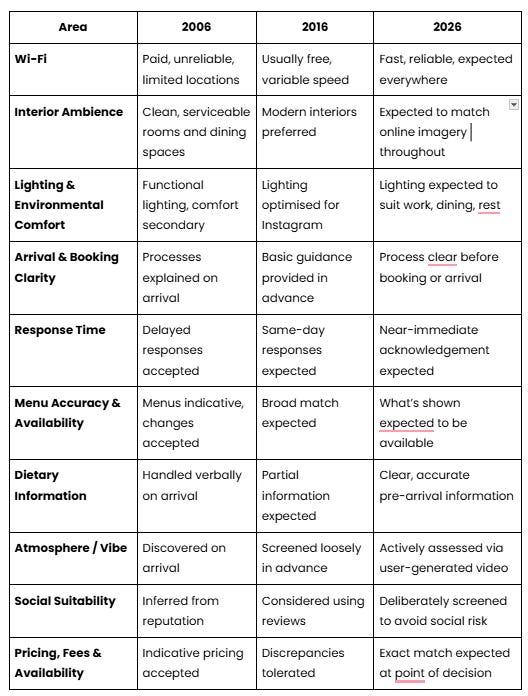
Expectation inflation is most easily observed in what is now considered standard. In hotels and restaurants, elements that once signalled quality or advantage are now assumed. Guests do not register their presence as a value-added service. They register their absence as something going wrong.
The table below sets out how these expectations have evolved over time, and why many teams feel they are working harder just to meet today’s baseline.


💔 Broken Promises
Broken promises feel bigger than the issue that caused them. A small gap between expectation and reality can trigger a strong emotional reaction, not because of what went wrong, but because of what the choice was meant to say about the guest. To understand that reaction, we need to look at how hospitality choices connect to identity.
🎭 Social Identity
When customers choose a hotel or restaurant, they are not just making a practical decision. Increasingly, they are making an identity choice.
Where customers stay and where they eat signal taste, judgement, social awareness, and competence. This is especially true when the choice is visible to others, a partner, friends, colleagues, or family. The venue becomes part of how the customer presents themselves. Marketing plays a central role in this by framing the experience as something that reflects who the customer is, or wants to be.
People begin to associate the brand with their own sense of self: “I’m the kind of person who stays here” or “This is the sort of place I would choose.”
When a brand underdelivers against that promise, the failure is internalised. The guest does not simply feel let down by the business. They feel let down by their own judgment. What should have reinforced their self-image instead threatens it.
This effect is magnified when the guest is hosting others. Booking a hotel for a partner, choosing a restaurant for a date, or organising a group meal moves the emotional risk onto the decision-maker. If the experience falls short, the failure is experienced as a loss of status, not just dissatisfaction.
This is why some reactions feel disproportionate to the operational issue. The guest is not responding to a delay, a worn fixture, or an unclear policy in isolation. They are responding to what that failure says about them.
💥 The Broken Narrative
By the time a guest arrives, they have already lived the imagined experience. Marketing language and imagery trigger narrative processing, allowing the guest to mentally pre-consume what is about to happen. They have already pictured the room, the atmosphere, the flow of the evening, and how it will feel to be there.
When reality contrasts with that imagined experience, the disappointment is not simply informational. It is narrative. The guest experiences the moment as the collapse of a story they were already part of.
A business traveller who expected quiet or functionality may simply decide the hotel is unreliable and not return. A leisure guest may feel disappointed if the stay fails to deliver the sense of occasion they anticipated.
In restaurants, the reaction is usually more immediate and social. Guests who chose a venue for a date, celebration, or group meal may feel exposed or embarrassed if the atmosphere or experience does not align with what they expected.
A broken narrative feels like the loss of something that already existed, rather than the absence of something new.
📉 Cognitive Dissonance and Withdrawal
At this point, the guest experiences cognitive dissonance. Cognitive dissonance is the discomfort guests feel when reality contradicts their decision to choose a brand, and it is commercially dangerous because it pushes people toward withdrawal, not recovery.
To resolve that discomfort, guests often move from disappointment to self-protection. They question the value of the purchase. They reassess whether it was worth the price. They begin to frame the experience through regret or buyer’s remorse. If unresolved, this reaction can harden into a long-term negative association with the brand.
Importantly, this dissonance is amplified in social situations. When others are involved, a disappointing experience becomes public. The guest is no longer managing private frustration, but visible embarrassment. The emotional cost rises sharply because the failure reflects not just on the venue, but on the guest’s judgement.
At this point, behaviour changes. Guests are far more likely to externalise the discomfort by talking about it afterwards. Dissatisfied customers share their experience with significantly more people than satisfied ones, often warning 10 to 20 others, compared to the small number reached by positive word of mouth. What begins as a single broken expectation can therefore influence many future decisions, well beyond the original visit.
This is why broken promises are so commercially damaging. The reaction is not an overreaction. It is a defence mechanism. Guests are trying to restore their sense of competence and status by reframing the experience negatively or disengaging entirely. In many cases, the simplest response is withdrawal.
No complaint. No conversation. No second chance.
By the time the impact becomes visible through churn or weakened loyalty, the opportunity to recover the relationship has already passed.
🥡 Key Take-Aways
Expectations are not a marketing output; they are the standard guests use to judge everything that follows.
Increasingly, expectations are not set by brands, but by AI summaries that decide what matters before a guest ever clicks.
When guests are disappointed, it’s rarely because of what happened; it’s because the story they believed fell short.
Most disappointed guests never complain; they simply don’t return, and by then the damage is already done.
Fewer promises, clearly framed and consistently delivered, outperform louder claims every time.
🔑 Coming Up in this week’s VIP Edition
In the VIP Edition, we go deeper into the mechanics of managing expectations before a guest arrives.
This week, you’ll get:
Pricing, sequencing, and control
How pricing presentation and timing shape expectations, and what to stop doing now.Shaping pre-arrival expectations
How to manage content, platforms, and listings once “new normals” are assumed.What to stop promising
The hospitality promises that now create more risk than value.

That’s it for this edition. I hope you’ve enjoyed the newsletter. I look forward to serving you again soon.
All the best
Dawn Gribble MIH MCIM
Hospitality Marketing Insight
Here’s to Your Success 🥂
📚 Sources
Albrecht, M.G., Green, M. and Hoffman, L. (2023). Principles of Marketing. [online] Houston, Texas: OpenStax. Available at: https://openstax.org/books/principles-marketing/pages/11-2-the-service-profit-chain-model-and-the-service-marketing-triangle,.
Duncan, E., Fanderl, H., Maechler, N. and Neher, K. (2025). Customer experience: Creating value through transforming customer journeys. [e-book] McKinsey & Company. Available at: McKinsey.com,.
Ketron, S. et al. (2025). Color Saturation and Perceived Sensory Intensity: An Account of Psychological Proximity. Psychology & Marketing..
Kron, N., Björkman, J., Ek, P., Pihlgren, M., Mazraeh, H., Berggren, B. and Sörqvist, P. (2023). The demand-what-you-want strategy to service recovery: achieving high customer satisfaction with low service failure compensation using anchoring and precision effects. Journal of Service Theory and Practice, [online] 33(7), pp.73–93. Available at: https://doi.org/10.1108/JSTP-02-2023-0029,.
Schiebler, T., Lee, N. and Brodbeck, F.C. (2025). Expectancy-disconfirmation and consumer satisfaction: A meta-analysis. Journal of the Academy of Marketing Science, [online]. Available at: https://doi.org/10.1007/s11747-024-01078-x,.
Shukla, A., Mishra, A. and Dwivedi, Y.K. (2025). Expectation Confirmation Theory: A review. In: S. Papagiannidis, ed., TheoryHub Book. [online] Available at: https://open.ncl.ac.uk,.
Yao, Q. and Chen, H.A. (2025). The Impact of Sensory Verbs in Online Reviews on Helpfulness Perception and Purchase Intention: The Mediating Role of Narrative Processing. Psychology & Marketing.
I have a better appreciation for the disaparity between what a customer thinks they are getting and what they actually get after reading this. I wonder if it is possible to understand what the expectation is and try to match it or at least match it to what can be delivered?
I don’t think guests are getting pickier. I think they’re just trying not to get burned.
I just got burned in fact 😡 and I am in the industry!
With promises flying at potential guests from every direction (websites, OTAs, socials, AI summaries), they’re scanning for risk, not romance. The line about promises being operational commitments, not marketing language, is spot on. Feels like the quiet winners right now are the places that promise less… and then just do exactly that, really well.