


Part of our Hospitality Marketing Monthly Strategic Update series
🌞 Hello and Welcome To Hospitality Marketing Insight, I’m your host, Dawn Gribble
As we move towards May 2026, hospitality demand is increasingly being shaped by a “Worth It” economy, where prestige is defined less by price and more by cultural relevance, ethical transparency and scarcity.
Restaurants are becoming primary travel anchors, while behaviours such as solo dining and earlier “daycaps” reflect a growing preference for self-care and more intentional socialising.
At the same time, buyer behaviour is becoming more complex. Cognitive overload, planning anxiety and pricing scrutiny are slowing decisions and concentrating spending on fewer, higher-value experiences. Understanding how guests research, evaluate and commit is becoming commercially critical for hospitality organisations today.
📄 On the Menu
Restaurants as Cultural Destinations
Changing Social Dining Patterns
The Reputation Economy
Cognitive Overload and Decision Fatigue
Planning Anxiety
Selective Premium Spending and Experiential Scarcity
May 2026 Marketing Dates
Let’s Check In ☕

📈 Demand Trends
The hospitality landscape is being reshaped by a series of powerful consumer demand trends. Changes in travel behaviour, social habits and cultural expectations are influencing where people go, how they gather and what they expect from hospitality experiences.
🌍 Restaurants as Cultural Destinations
One of the most significant trends emerging across hospitality is the way restaurants are increasingly functioning as cultural destinations in their own right. For a growing number of consumers, restaurants are becoming the reason they travel.
Food now plays a central role in travel behaviour and expenditure. Tourists spend roughly 40% of their overall holiday budget on meals, illustrating how dining has evolved into a primary driver of global tourism. Travellers are increasingly designing itineraries around restaurants, food markets and distinctive culinary experiences.
This trend is particularly visible among younger travellers. Generation Z consumers are deliberately saving money on flights and accommodation so they can spend more on food and experiences once they arrive. Travel planning increasingly resembles location scouting, with travellers using tools such as Google Maps to ensure their accommodation is positioned as close as possible to the restaurants they intend to visit.
In parallel, restaurants are evolving into environments designed to transport guests into an immersive experience. Consumers are actively seeking highly specific atmospheres that provide a sense of escapism. Parisian-style cafés, garden restaurants, rooftop bars and beachside eateries are benefiting from growing demand for immersive indoor-outdoor dining experiences, where the setting becomes part of the attraction.
Within this broader trend, a particularly dedicated segment of diners has emerged. Often referred to informally as “star chasers”, these consumers devote significant time, identity and income to travelling the world in pursuit of exceptional dining experiences.
One Redditor described travelling frequently for food and spending an extraordinary amount of time chasing exclusive reservations, while another reflected on spending a significant portion of their adult life pursuing fine dining across the globe.
Reservation scarcity has therefore become a powerful cultural signal. Limited availability creates prestige and social currency, reinforcing the perception that a restaurant experience is something worth travelling for. In this environment, restaurants are becoming cultural venues that shape travel decisions and anchor entire journeys.
👥 Changing Social Dining Patterns
Another clear trend emerging across hospitality is the way social dining patterns are evolving. Changes in working habits, lifestyle priorities and social expectations are reshaping when, where and how people gather around food and drink.
One of the most visible developments is the move toward more local and earlier dining occasions. The rise of remote and hybrid working has altered the geography of hospitality consumption. With fewer people commuting into city centres daily, many consumers are choosing to dine closer to home in suburban neighbourhoods or at convenient transport hubs rather than travelling into central districts.
Dining times are also shifting. In the UK, full-service restaurant occasions occurring before 5:00 PM have recovered strongly, while late-evening dining remains below previous levels as fewer workers spend extended days in city-centre offices. However a sense of nostalgia is beginning to surround traditional late-night dining culture, particularly as summer approaches and longer evenings encourage groups to linger.
Alongside these timing changes, restaurants are also becoming venues for more intentional and structured social interaction. Research shows that 59% of UK adults who visit pubs and bars are interested in attending organised social events there, including activities such as book clubs and curated gatherings. Rather than purely spontaneous nights out, consumers are increasingly seeking low-pressure social environments that combine hospitality with shared experiences.
Solo dining has surged by 52%, and quick-service restaurant visits are now 47% solo, rising from 31% just four years ago. Eating alone is no longer widely viewed as a sign of loneliness. Instead, many consumers are embracing what some observers describe as the “Me-Me-Me Economy,” choosing solo dining as a form of personal self-care and quiet time.
A further behavioural change can be seen in the shift in social drinking patterns. The traditional late-night drink is increasingly being replaced by the “daycap,” an earlier social drink that allows people to spend time with friends while still maintaining their evening routines. As one observer noted, “Forget nightcaps – an afternoon tipple is the new way to squeeze socialising into your evening, while still getting to bed on time.”
There is also a growing pushback against restaurants that prioritise high-energy atmospheres over comfortable conversation. Loud music and nightclub-style environments are generating visible fatigue among diners who simply want to talk to the people they are with. As one frustrated guest remarked, “This has got to stop. So many restaurants play music all…” Conversations about the role of music and ambience are now occurring even within fine-dining circles, reflecting a broader desire for spaces that support connection rather than distraction.
These patterns suggest that social dining is not disappearing. Instead, it is becoming earlier, more flexible and more intentional, reflecting the changing rhythms of modern life.
🧑🍳 The Reputation Economy
Modern buyers are increasingly aligning themselves with brands that reflect their personal values. Research shows that 83% of consumers are willing to pay more for products they know are ethically sourced, while 30% of global consumers are willing to pay up to 10% more for brands that actively support social justice or sustainability causes. For hospitality businesses, reputation is becoming a measurable commercial asset.
Industry observers increasingly describe this dynamic in simple terms:
“We’re living in a reputation economy. Value still comes from product, pricing and distribution, but more and more it moves through trust.”
For hospitality brands, that trust now extends beyond the guest experience to include workplace culture, leadership behaviour and ethical standards.
Leadership behaviour is becoming an increasingly visible influence on how hospitality brands are discovered and discussed. Online communities and industry forums are actively debating workplace culture, management practices and the reputations of chefs and operators themselves.
Within this reputation economy, a notable pattern is the growing interest in what some observers describe as “kind chefs.” Leadership style and kitchen culture are becoming part of a venue’s reputation, as guests pay closer attention to the values and behaviours behind the brands they support.
The reputational consequences of toxic culture can be significant.
A recent example that brought this issue into focus involved the world-renowned restaurant Noma. Reports surfaced describing allegations of abusive kitchen behaviour, with former staff detailing an environment characterised by “punching, slamming and screaming.”
The fallout extended beyond media coverage. Major corporate partners, including American Express, withdrew financial support connected to the Noma LA project, illustrating how reputational damage can translate directly into commercial consequences.
Hospitality brands are now evaluated not only on their guest experience but also on their culture, leadership and ethics. In today’s hospitality environment, culture is no longer hidden behind the kitchen door. People are paying attention.
While these demand trends reveal how consumer expectations are evolving, the way buyers make decisions is also changing. Understanding the psychology behind these purchasing behaviours is critical for hospitality brands navigating an increasingly complex marketplace.
🧠 Buyer Behaviour Trends
While demand trends reveal how consumer expectations around hospitality are evolving, the way buyers make decisions is also undergoing significant change. Increasing cognitive overload, heightened planning anxiety and more selective spending behaviours are reshaping the path to purchase across travel, dining and hospitality experiences.
😵💫 Cognitive Overload and Decision Fatigue
One of the most powerful forces influencing buyer behaviour today is cognitive overload. Consumers are navigating an unprecedented volume of choices, information and digital inputs, turning what were once straightforward hospitality decisions into mentally demanding tasks.
Modern lifestyles are already placing consumers under considerable pressure. 64% of consumers report feeling under constant pressure to get things done, while 76% say they are actively looking for ways to simplify their lives. Digital connectivity, while convenient, is also contributing to this strain. 45% of consumers say that using the internet adds significantly to their daily stress levels, highlighting the growing cognitive burden associated with constant information exposure.
As a result, many consumers are actively seeking ways to reduce the time and mental effort involved in planning. 50% of consumers say they are willing to spend money simply to save time, reinforcing the value placed on convenience and simplified decision-making.
Across travel forums and online communities, this cognitive strain is becoming increasingly visible. Travellers frequently describe feeling overwhelmed by the number of options available when planning trips:
“Maldives – choice paralysis, overwhelmed with all the options.”
“Feeling a bit overwhelmed planning my two-week Europe trip.”
“Planning a trip shouldn’t take longer than the trip itself.”
These sentiments echo a growing gap between inspiration and decision-making. While social media and travel platforms generate endless destination ideas, turning that inspiration into a concrete itinerary is becoming significantly harder.
Over time, this overload leads directly to decision fatigue. Faced with constant choices and information, consumers begin to conserve mental energy by seeking shortcuts, relying on trusted recommendations, or favouring options that simplify the booking process. Many are also placing stronger boundaries around their time. 75% of consumers report actively separating work and personal life in an effort to reduce stress and regain balance.
For hospitality businesses, this environment changes how decisions are made. In a marketplace defined by abundant choice, the brands that succeed will often be those that reduce complexity, provide clear guidance and simplify the path to purchase.
😰 Planning Anxiety
As cognitive overload increases, many buyers are experiencing a second behavioural effect: planning anxiety. Hospitality decisions often involve significant financial commitment, limited vacation time, and high personal expectations. As a result, travellers are increasingly concerned about making the wrong choice when booking hotels, destinations, or dining experiences.
One of the clearest behavioural signals of this anxiety is the growing number of travellers asking online communities to review their plans before they finalise bookings. Across travel forums, posts asking for a “sanity check” on itineraries or accommodation choices have become increasingly common.
“Solo trip sanity check: 8 weeks through Europe…”
“Sanity check on my Paris / Brussels itinerary?”
These requests highlight an important behavioural pattern. Consumers are no longer relying solely on official sources or brand messaging. Instead, they are seeking confirmation from peers that their decisions are sensible before committing time and money.
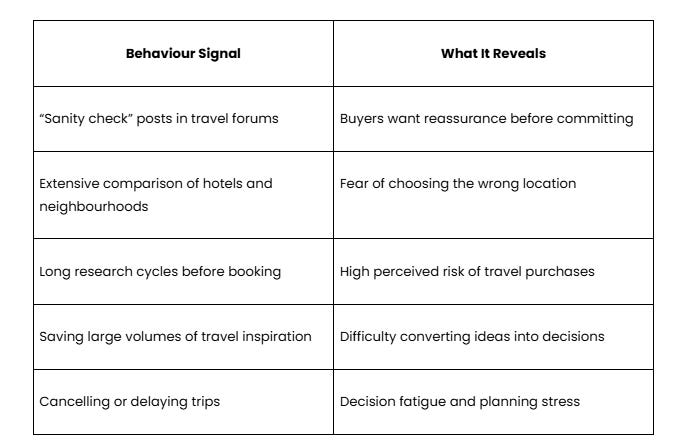
For many travellers, this planning process can become overwhelming. Some admit to overthinking their plans or repeatedly revising itineraries. Others delay booking altogether while they continue researching alternatives.
💎 Selective Premium Spending and Experiential Scarcity
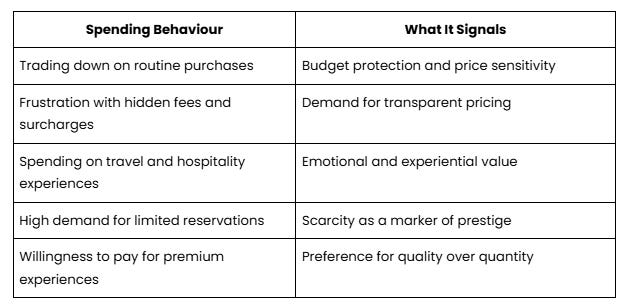
Despite ongoing economic pressure, buyer spending has not disappeared. Instead, it is becoming increasingly selective. Across hospitality sectors, many consumers are reducing routine purchases while protecting budgets for experiences they perceive as meaningful or memorable.
This behaviour reflects what analysts often describe as a “worth it” economy, where buyers carefully evaluate whether a purchase justifies its cost. Everyday spending is facing greater scrutiny, particularly in areas such as casual dining and routine purchases, where consumers are increasingly comparing prices with supermarket alternatives or lower-cost options.
A growing factor influencing this behaviour is fee fatigue. Across travel and hospitality, consumers are increasingly frustrated by hidden charges, resort fees, service surcharges, and other unexpected add-ons that inflate the final price of an experience. As a result, buyers are scrutinising pricing structures more closely and reacting negatively to costs that appear unclear or excessive. In contrast, premium experiences that present transparent and straightforward pricing are often perceived as better value, even when the overall price is higher.
At the same time, demand for premium hospitality experiences remains strong. The global luxury hotel sector, for example, is projected to reach $143 billion by 2030, driven by high-net-worth travellers and growing interest in wellness and personalised travel experiences.
This pattern reflects a broader change in consumer priorities. Research suggests that 39% of consumers prefer to buy fewer, higher-quality products, while 83% say they are willing to pay more for products that are ethically sourced. Rather than maximising quantity, many buyers are concentrating their spending on experiences that feel distinctive, memorable or aligned with their personal values.
Another important influence is the growing role of experiential scarcity. In hospitality, demand increasingly concentrates around experiences that appear rare, exclusive or difficult to access. Limited reservations, short-term pop-ups and one-off events can generate intense consumer interest precisely because availability is restricted.
Across travel and dining forums, consumers frequently discuss the difficulty of securing reservations or accessing highly sought-after experiences:
“Reservations just opened and immediately sold out.”
“It’s been near impossible to book anything.”
These discussions highlight how scarcity itself has become a signal of desirability. In many cases, the challenge of securing access forms part of the perceived value of the experience.
This environment is also contributing to the emergence of what some observers describe as “collector behaviour.” Rather than consuming hospitality casually, some consumers now approach experiences almost as collectable moments. Travellers may build entire itineraries around securing a specific reservation or attending a particular event, treating these experiences as milestones worth documenting and sharing.
Taken together, these patterns illustrate how buyer spending is evolving. Consumers are not simply reducing their budgets. Instead, they are becoming more deliberate and selective, concentrating their spending on experiences that feel distinctive, memorable and genuinely worth the investment.


🗓️ May 2026 Marketing Dates
May 1: May Day
May 2: National Fitness Day / National Truffle Day
May 4: Early May Bank Holiday (UK) / Star Wars Day (May the 4th)
May 5: Cinco de Mayo
May 6: National Beverage Day
May 7: National Roast Leg of Lamb Day
May 8: National Coconut Cream Pie Day
May 9: National Moscato Day
May 10: Mother’s Day (US, CAN, AUS)
May 11: National Eat What You Want Day
May 12: International Nurses Day
May 13: National Apple Pie Day
May 15: International Day of Families / National Chocolate Chip Day
May 16: National BBQ Day
May 17: World Baking Day
May 19: National Devil’s Food Cake Day
May 21: International Tea Day
May 23: World Turtle Day / National Taffy Day
May 25: Memorial Day (US) / Spring Bank Holiday (UK) / National Wine Day
May 26: National Blueberry Cheesecake Day
May 27: National Sunscreen Day
May 28: National Hamburger Day
May 30: National Mint Julep Day
May 31: National Smile Day
Upgrade to VIP
Today’s Strategic Update highlights the behavioural forces shaping hospitality demand.
The VIP edition on Tuesday goes a step further, translating these signals into a practical strategy you can apply inside your organisation.
VIP subscribers unlock the full strategy library behind Hospitality Marketing Insight — insights drawn from 25+ years of international hospitality marketing work, previously delivered through consulting projects typically valued between £1,000 and £5,000 per engagement.
VIPS get access to:
Campaign playbooks
Marketing diagnostics
Behavioural insight frameworks
Platform and channel intelligence
Strategic planning tools
The value compounds as the archive grows, and the price you subscribe at today remains your price for as long as you stay subscribed.
If there’s one takeaway from this month’s update, it’s that hospitality buyers are not disappearing, they’re becoming more deliberate.
Understanding how guests think, how they plan, and what ultimately motivates them to commit can make a meaningful difference to how your organisation attracts and converts demand.
Thank you for taking the time to read this edition. I hope it’s given you a few useful perspectives to take back to your team.
All the best
Dawn Gribble MIH MCIM
Hospitality Marketing Insight
Here’s to Your Success 🥂

❓ Got a question about this issue?
If something in this issue raised a question or touched on a challenge you’re facing, ask in the comments below or DM me

📚 Sources
Cafeteria, 2026 Travel Reset: Gen Z maps the future of travel, hotel, airlines & rideshare, 4Hoteliers (2026)
Kong, H., 2026 Travel Reset: Gen Z maps the future of travel, hotel, airlines & rideshare, 4Hoteliers (2026)
Kong, H., Luxury hotel analysis report 2026, 4Hoteliers (2026)
Oladipo, T., The State of Social Media Engagement in 2026: 52M+ Posts Analyzed, Buffer (2026)
Pauser, S. and Wagner, U., Selling With Negative Emotions—Better Than None? Nonverbal Expressiveness During Sales Presentations: An Experimental Approach, Psychology & Marketing (2026)
PR Analysis, March HARO bundle strategic review, PR Analysis (2026)
ResearchAndMarkets, Luxury hotel analysis report 2026, 4Hoteliers (2026)
May 2026 Strategic Update Reddit Research, SS44 (2026)
Kaiseki experiences, Google Search (2026)
Omakase, Google Search (2026)
The State of Social Media Engagement in 2026: 52M+ Posts Analyzed, Buffer (2026)
Top Instagram Reels Trends to Try in 2026 (Updated Weekly), Later (2026)
Guests aren’t just looking for options anymore. They’re looking for confidence they picked the right one.