



As we saw in Social Media Sales Funnels, every major social network operates within a closed digital environment.
If your marketing strategy relies on sending users off the platform to an external website, organic reach drops. Platforms penalise content containing external links because off-site clicks reduce their advertising revenue.
To convert attention into venue bookings, your entire sales funnel must operate natively within each platform ecosystem. In this VIP edition, we look at how to protect your organic reach and track your conversions properly.
📄 On the Menu
Conversion Tracking Quick-Start Guide
Hospitality Social Media Funnel Mapping
Tracking Conversions with UTMs
Let’s Check In ☕

📈 Conversion Tracking Quick-Start Guide
Conversion tracking is a digital analytics process that monitors and records when a digital visitor takes a specific, high-value action on your site after interacting with your brand.
What Is a Conversion?
A conversion is any completed activity that moves a user closer to a core business goal. Conversions are split into two primary categories:
Macro-Conversions (Primary Financial Actions):
Completing a checkout purchase
Booking a hotel room night or restaurant table cover
Signing a contractual service agreement
Micro-Conversions (Early Intent Indicators):
Submitting a “Contact Us” or lead generation form
Creating a user account or profile
Downloading an informational brochure or menu PDF
Adding an item to a digital shopping basket
How Does Conversion Tracking Work?
Conversion tracking functions as an invisible digital receipt system built across three primary technical steps:
The Interaction: A user clicks on a tracking link inside an Instagram ad, a TikTok video, an email newsletter, or a Google Search result.
The Tracking Script: When the user arrives on your site, a small piece of code—such as a Google Analytics 4 tag, a Meta Pixel, or a Server-Side API—drops an anonymous identifier onto their browser session.
The Success Page: When the user completes the action (e.g. clicking “Place Order”), they are redirected to a unique “Thank You” or confirmation page. The tracking script links the sale back to the original source and records the exact financial value—even if that journey spans multiple sessions.
Why Is Conversion Tracking Important?
Without conversion tracking, running a digital business is like throwing money into an empty dining room and hoping you have a profitable evening. It is the single most important component of your digital infrastructure for four core reasons:
1. It Proves Your Return on Investment (ROI)
Conversion tracking cuts through misleading metrics like likes, shares, or view counts. It explicitly shows you how much revenue a specific marketing channel generated. If you spend £1,000 on Instagram Ads, conversion tracking tells you cleanly whether that spend generated £5,000 in direct bookings or £0.
2. It Powers Platform AI and Machine Learning
Modern ad networks like Meta Ads Manager, TikTok Ads, and Google Ads rely heavily on artificial intelligence. When you track conversions, you feed that data back to the platform. The AI analyses the profiles of the people who actually converted and automatically optimises your targeting to find similar high-intent buyers.
3. It Prevents Wasted Marketing Budget
If you run three distinct marketing campaigns, conversion tracking allows you to execute precise budget triage:
Campaign A: Generates 10,000 clicks, but 0 conversions.
Campaign B: Generates 500 clicks, but 50 conversions.
Without tracking, you might assume Campaign A is winning because it drove the most traffic. But conversion tracking proves Campaign A is burning cash on low-quality traffic, allowing you to shut it down immediately and reallocate budget to Campaign B.
4. It Pinpoints Friction Points in Your Buyer’s Journey
If your analytics show that thousands of users are clicking your ads, but zero people land on the final Thank You confirmation page, you know exactly where your system is leaking revenue - your booking engine, landing page or checkout flow is too slow, confusing, or driving customers away at the final step.
Tracking visitor actions gives you baseline data. However, converting users requires aligning your content with how platform algorithms process user intent.

🗺️ Hospitality Social Media Funnel Mapping
When you look at how social media algorithms are programmed, every major channel enforces a very specific algorithmic funnel structure. If you try to run a traditional funnel, the platforms will actively choke your reach because off-platform clicks hurt their ad revenue.
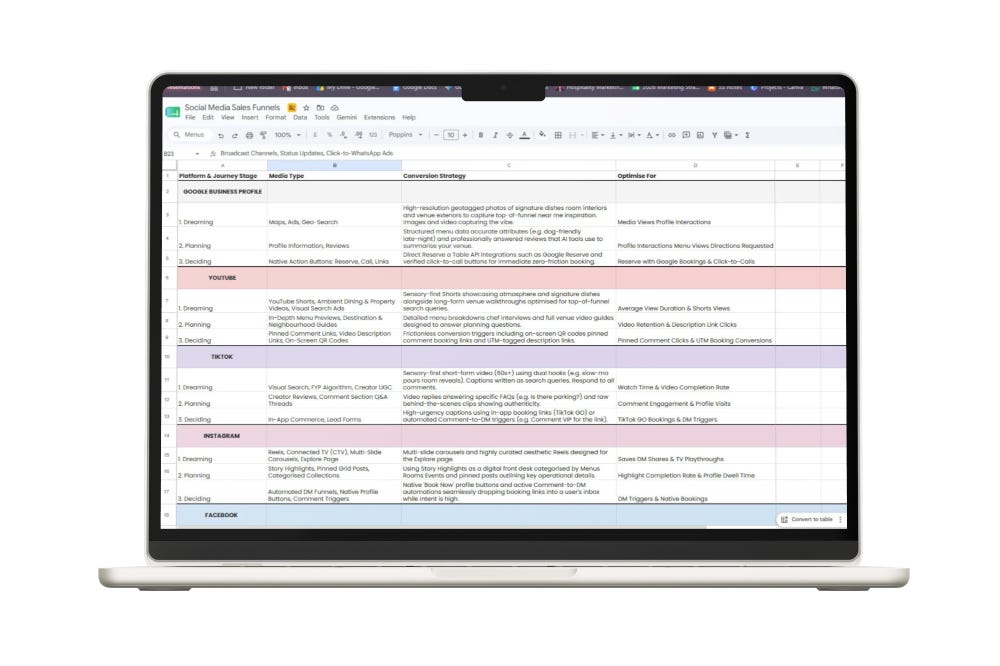
To protect organic reach and capture guest demand, your campaign activity must align with native platform features. You need a dedicated strategy for the Dreaming, Planning, and Deciding phases on each app.
Upgrade your subscription today to access the rest of this briefing. You will receive:
The complete Hospitality Social Media Funnel Map covering Google, TikTok, Instagram, and WhatsApp.
Our step-by-step UTM Tracking Guide to stop weekend revenue leakage.
