



If you have noticed that your front-of-house teams are more exhausted or that your cost of guest acquisition is rising, you are in the right place. We are operating in a market where guests are finding it harder to judge what is real, what is reliable, and what is worth trusting.
📄 On the Menu
🛑 Stop Paying the “Distrust Tax” on Your Guest Acquisition
🚩 Why Trust is Weakening
🔺The Hospitality Trust Pyramid
Join thousands of hospitality leaders getting the exact strategies to drive bookings, demand, and revenue every week.
Here’s a template to expense a subscription

Hospitality Marketing - Grab & Go Brief
Operators - Foundational trust leaks in safety or fairness are not something brand storytelling can overcome. Weak trust often drives a forced reliance on OTAs, as guests pay a commission premium simply for third-party protection. This suspicion at the checkout is a primary driver of lost re-booking intent and diminished margins.
Marketers - Social proof is losing its edge as “too perfect” reviews now appear manufactured to sceptical audiences. Marketing spend is frequently wasted when guests abandon a journey due to foundational friction rather than a lack of interest. In this environment, transparent pricing and verified identity are what actually secure the sale over glossy aesthetics.
Managers - Distrustful guests are more expensive because they escalate minor errors and require significantly more emotional labour from the team. Confusion over service charges or inconsistent policies is often interpreted as operational neglect, which damages the perception of reliability. This friction directly impacts both the operating margin and staff mental health.
Let’s Check In ☕
🛑 Stop Paying the “Distrust Tax” on Your Guest Acquisition
A distrustful guest is an expensive guest. When a customer lacks confidence in your brand, they do not simply book elsewhere. They consume your team’s time with basic questions. They scrutinise service charges and are quicker to escalate small errors. They arrive at your door expecting a problem. Front-of-house teams are noticing this change in attitude first. Guests appear more entitled and are increasingly confused by payment systems or booking policies.
Over the last 20 years, we have moved from trusting professional authority to trusting peer signals. Now, in 2026, even those peer signals feel manufactured. Research by Lambert reveals that 20% of luxury hotel reviews are now AI-generated. Furthermore, the UK Competition and Markets Authority is currently investigating platforms like Just Eat and Pasta Evangelists for inflating star ratings and concealing incentives.
BrightLocal’s Consumer Review Survey shows that 81% of consumers believe they have seen fake reviews. This triggers what psychologists call a “negativity bias.” Humans have an evolutionary propensity to remember and use negative information far more than positive information.
In hospitality, guest trust is paramount. It is the belief that the room matches the photo. It is the certainty that the “service charge” is fair and that a booking won’t vanish into a digital void. According to analysis in the European Management Journal, when this trust is violated, the consequences include a direct loss of competitive advantage and a decrease in turnover.


🚩 Why Trust Is Weakening
I have spent time recently conducting an analysis of hospitality-focused forums and Reddit communities. Across thousands of posts from travellers, diners, and front-line teams, a clear pattern appears.
People are openly admitting that reviews now sound like “just more marketing.” Guests are moving toward independent forums because these channels appear more objective. The commercial result is Trust Friction. This is the invisible tax on your conversion rate. When a guest encounters a confusing booking interface or a non-transparent service charge, they do not simply get annoyed. They become suspicious of the entire brand.
This friction dictates how people spend. Guests are cross-checking more sources than ever before. To move a guest from “sceptical researcher” to “confident booking,” we must address their underlying need for safety. They require more than physical safety. They must feel financially, digitally, and procedurally safe. Trust does not fail in one place. It fails across the system.
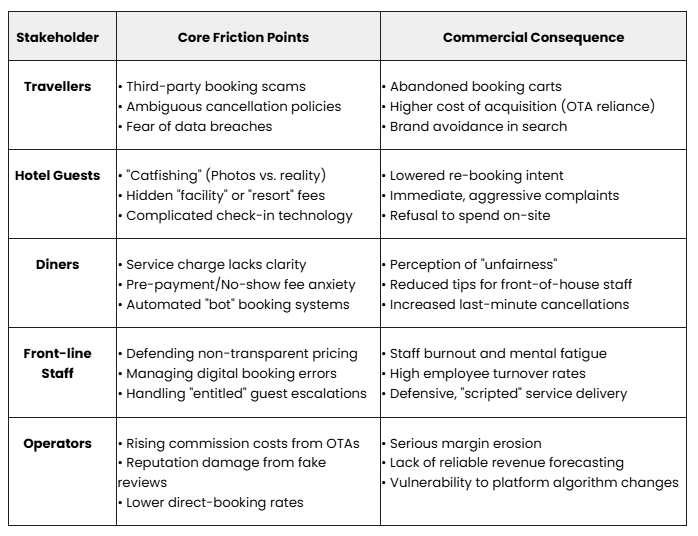
Once a guest perceives a “negative” signal in your booking process, it carries more weight than all your positive reviews combined - this is known as the negativity bias. To solve this, we must look at how trust is encountered in your business.

The free newsletter provides research on current hospitality market conditions. The VIP tier delivers the operational frameworks to execute, implement, and optimise those strategies.
VIP members receive:
Operational frameworks to translate market research into commercial application.
Commercial Problem Diagnosis to identify where bookings break down before payment or visit.
Monthly Strategic Updates for earlier decision support on demand and buyer behaviour.
Clear instructions to repeat and optimise your marketing processes.
Upgrade for commercially useful analysis before the next trading month starts.
🔺The Hospitality Trust Pyramid
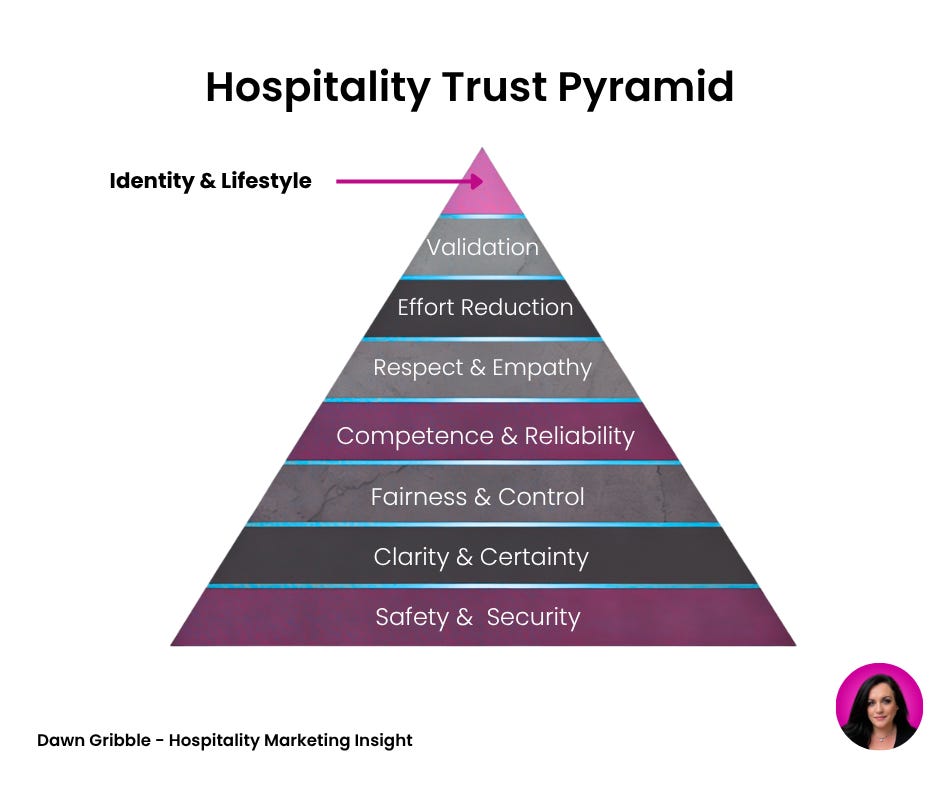
If trust is unclear in your operation, conversion becomes unpredictable. You must start treating it as a tiered foundation. In my consultancy work, I use the Hospitality Trust Pyramid to help operators identify exactly where they are losing revenue. Poor systems make your marketing spend significantly less efficient. If your ‘Safety’ or ‘Clarity’ layers are weak, you end up paying to attract guests who ultimately abandon the journey due to foundational friction. Your brand storytelling cannot compensate for a lack of trust.
Trust is not binary. A guest can trust that your food is safe, but still fear that your booking system will leak their data. Each level of the pyramid must be secure before the guest moves to the next. If a lower tier is weak, the tiers above it will fail to convert.
Level 1: Safety and Security
This is the absolute foundation. It addresses the guest’s primary fear of financial or physical harm. With the rise of “cloned” websites and sophisticated third-party scams, guests are actively assessing risk. If your direct booking site does not look significantly more secure and professional than an OTA, the guest will pay the commission to the OTA just for the perceived protection. One single doubt about your digital security ends the booking journey immediately.
Level 2: Clarity and Certainty
Distrust often stems from ambiguity. This layer is about removing guesswork. Confidence is weakened before the purchase even happens if your data is inconsistent. If your Google listing says you are open until 11 PM, but your website says 10 PM, you are sending a signal of incompetence. Guests assume that if you cannot manage your data, you cannot manage their stay.
Level 3: Fairness and Control
Guests become distrustful when they feel a power imbalance. People are reacting to fairness, not just price. A guest may be happy to pay £200 for a room but will feel cheated by an unexpected £15 “facility fee” at checkout. This sense of being misled damages this layer and kills re-booking intent. If a guest feels “trapped” by a policy, they perceive it as an integrity failure.
Level 4: Competence and Reliability
This layer is the proof of your operational excellence. In an era of AI-generated content, real-world reliability is a premium asset. We have reached a point where “too perfect” looks “too fake.” When guests see a sea of five-star reviews that read like marketing copy, they feel suspicious rather than validated. Real competence is shown through consistent, authentic delivery that matches the guest’s expectations.
Level 5: Respect and Empathy
Here, trust moves from the functional to the human. It is the guest’s belief that you value them as an individual. This is built through proactive communication and acknowledging operational constraints honestly. Guests who feel respected are far more forgiving of minor errors. This layer acts as a buffer that protects your reputation when things go wrong.
Level 6: Effort Reduction
Modern guests are time-poor and overwhelmed. This layer is about making the “right choice” easy. By simplifying the path to purchase and providing clear social proof, you validate their decision. When you reduce the mental effort required to book, you increase your conversion rate. This is where you turn a “sceptical researcher” into a “confident booker.”
Level 7: Lifestyle and Identity
This is the peak of the pyramid. At this level, the guest trusts that your brand reflects who they are. The venue becomes a part of their lifestyle. At this level, price stops being the deciding factor. Trusting guests become advocates who defend your brand against external criticism, providing you with the ultimate organic marketing advantage.
If you cannot identify where trust is breaking in your journey, you are already paying for it in lost bookings.

🎟️ How to Fix Your Biggest Revenue Leak
Trust is the commercial precondition for every conversion. This edition shows you where trust breaks. The VIP edition shows you exactly how to fix it.
You’ll get:
The trust signals guests look for before they book
The friction points most likely to weaken direct conversion
How to audit your website, Google presence, pricing, and booking journey
A Trust Marketing Audit Checklist you can use with your team this week
The takeaway for today is simple but high-stakes. In an environment saturated with AI-generated “perfection” and hidden fees, your most valuable asset isn’t your creative copy—it is your operational integrity.
When you simplify a booking journey or fix a data discrepancy on Google, you aren’t just performing admin. You are removing the “Trust Friction” that currently acts as an invisible tax on your revenue.
The brands that convert best may not be the loudest. They will be the clearest, fairest, and easiest to trust.
All the best
Dawn Gribble MIH MCIM
Hospitality Marketing Insight
Here’s to Your Success 🥂

The pace of modern marketing makes it difficult to see what is actually working. Campaigns run, but the link between activity and revenue is often unclear. My bespoke marketing audits provide a data-led approach to fix this. I identify exactly where performance breaks down and what needs to change.
These bespoke audits deliver clear commercial direction:
Pinpoint weaknesses in your digital strategy to upgrade marketing performance.
Identify reputation risks to strengthen trust and increase conversion.
Map your customer journey to improve retention, spend, and loyalty.
Secure your audit before you allocate your next quarter's marketing budget.
📚 Sources & Resources
1 in 5 Luxury Hotel Reviews Are AI-Generated in 2025, Originality.AI (2026)
Balaban, D. C., Szambolics, J., & Chirică, M., Parasocial Relations and Social Media Influencers’ Persuasive Power: Exploring the Moderating Role of Product Involvement, Acta Psychologica (2022)
Bozic, B., Consumer Trust Repair: A Critical Literature Review, European Management Journal (2017)
Fake Online Reviews Research: Executive Summary, GOV.UK (2026)
Just Eat Under Investigation for Fake Reviews, The Caterer (2026)
Logg, J. M., Minson, J. A., & Moore, D. A., Algorithm Appreciation: People Prefer Algorithmic to Human Judgment, Organizational Behavior and Human Decision Processes (2019)
Paget, S., Local Consumer Review Survey: Trends, Behaviors, and Platforms Explored, BrightLocal (2026)
Tripadvisor Continues Fight Against Fraudulent Reviews as Incidences Increase, Phocuswire (2026)
Vaish, A., Grossmann, T., & Woodward, A., Not All Emotions Are Created Equal: The Negativity Bias in Social-Emotional Development, Psychological Bulletin (2008)
Guests don’t drop off because they’re unsure, they drop off because something doesn’t add up.
Different prices across channels. Extra fees at checkout. Hours that don’t match. Reviews that read like ads. That’s enough to stop finishing the booking.
This isn’t a marketing problem. It’s bad information and unclear policies showing up in front of the guest.