



When a guest does not trust your brand, the cost is not limited to a lost booking. It shows up in longer decision cycles, increased pre-arrival queries, and heightened scrutiny at every touchpoint. This erosion of confidence creates ‘Trust Friction’, a commercial drag that raises acquisition costs and places sustained pressure on front-of-house teams.
Executive Summary
In 2026, we are operating in a market where guests find it harder to judge what is real. With research showing that 20% of luxury hotel reviews are now AI-generated and 81% of consumers believe they have seen fake reviews, “too perfect” social proof is starting to lose its edge.
In Why Guest Distrust Is Costing You Bookings, we examined the commercial impact of declining trust. This is how to address it.
📄 On the Menu
The Psychology Behind the Hospitality Trust Pyramid
How to Market to Each Level
Trust Marketing Checklist
Quick Wins Audit
Let’s Check In ☕
Join thousands of hospitality leaders getting the exact strategies to drive bookings, demand, and revenue every week.
Here’s a template to expense a subscription

🧠 The Psychology Behind the Hospitality Trust Pyramid
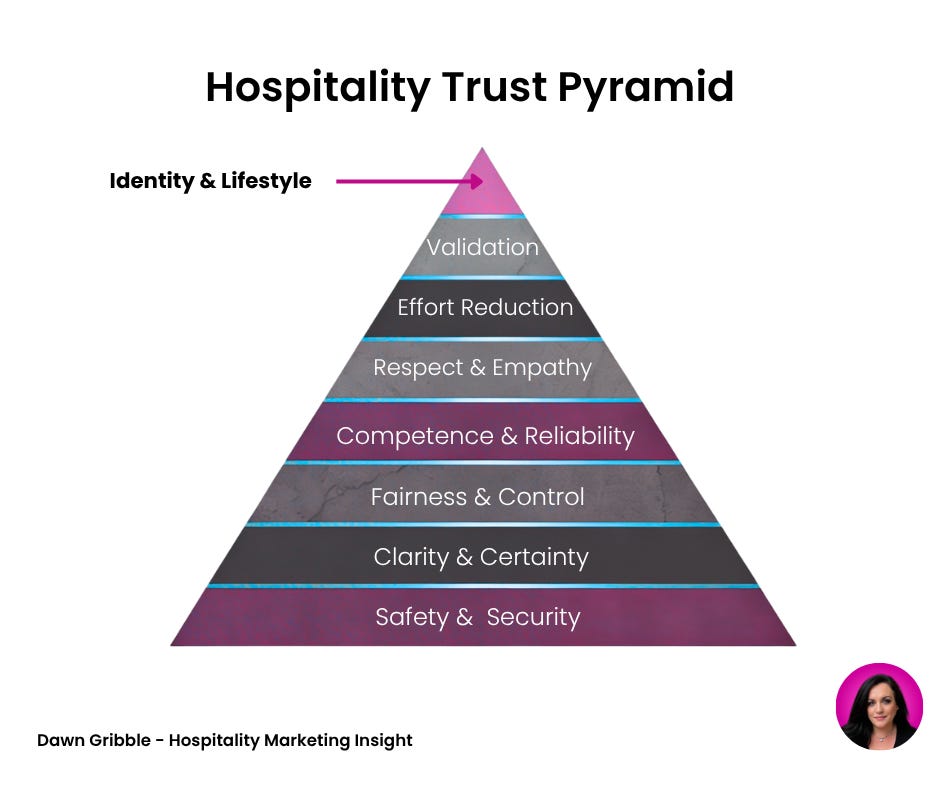
Before committing to a booking, modern guests are actively trying to reduce perceived risk across financial, emotional, and practical dimensions. Guests cross-check multiple sources to resolve uncertainty before they make contact.
They are asking
Is this safe?
Is this clear?
Is this fair?
Can I rely on this?
Do they value me?
Is this easy?
Does this reflect me?”
Trust is what your brain relies on when it does not have all the information required to take an action or make a decision.
The higher the risk of getting it wrong, the more your brain slows down to make a decision. It compares what it sees now with learned experience, and if something feels off, even slightly, that doubt builds quickly. This is not just a rational reaction; it’s physical, too. When something feels uncertain, your body shifts into a more cautious state. You become more alert, more sceptical, and more likely to double-check.
This response is hardwired. According to Hancock et al., humans evolved to prioritise avoiding danger over pursuing opportunity, because missing a threat could be fatal, whereas missing a gain rarely was. That is why your brain looks for problems first. It is actively scanning for anything that feels inconsistent, unclear, or unfair. It’s the reason why one negative signal carries more weight than multiple positive ones.
When the experience feels clear and consistent, decisions feel easier, faster, and safer. That is why trust is not built through messaging alone. It is built by removing doubt before the guest has to question it.
Identify where doubt is costing you bookings.
Access the full Trust Marketing Audit Checklist
